Scaling Distributed PyTorch Training on Amazon EKS with Pre-Built Ray Train Deep Learning Containers

The primary bottleneck for scaling PyTorch model training across large computing clusters is rarely the underlying model architecture itself; instead, it is the logistical complexity of maintaining a consistent containerized environment. Engineering teams frequently struggle with the fragile synchronization of CUDA runtimes, PyTorch builds, the NVIDIA Collective Communications Library (NCCL), and the specialized networking drivers required for high-performance computing, such as the Elastic Fabric Adapter (EFA). AWS has addressed this systemic friction by formalizing the Ray Train Deep Learning Container (DLC), a pre-validated, AWS-managed stack that eliminates the need for manual image construction. By offloading the integration of these complex libraries to a centrally managed image hosted on Amazon ECR Public, organizations can focus their engineering resources on model fine-tuning rather than infrastructure maintenance.
The evolution of distributed machine learning has reached a point where the software stack—comprising PyTorch, Ray, and low-level networking protocols—must be treated as a single, immutable unit. Previously, when a single component within the training stack was updated, the entire container image required a rebuild, testing, and redeployment cycle. This process, often referred to as "dependency hell," frequently resulted in silent failures where NCCL would revert from high-speed EFA networking to standard TCP sockets, causing significant performance degradation without triggering explicit error messages.
The Anatomy of a Managed Training Stack
The Ray Train DLC represents a shift in how infrastructure is consumed in the age of generative AI. By assembling a pre-tested environment that includes Ray 2.58.0, PyTorch 2.13.0, CUDA 13.0.2, and the critical AWS OFI NCCL plugin, AWS provides a "golden image" that is gated by rigorous multi-node training tests. This approach ensures that the networking layer, which is notoriously difficult to optimize, remains performant by default.
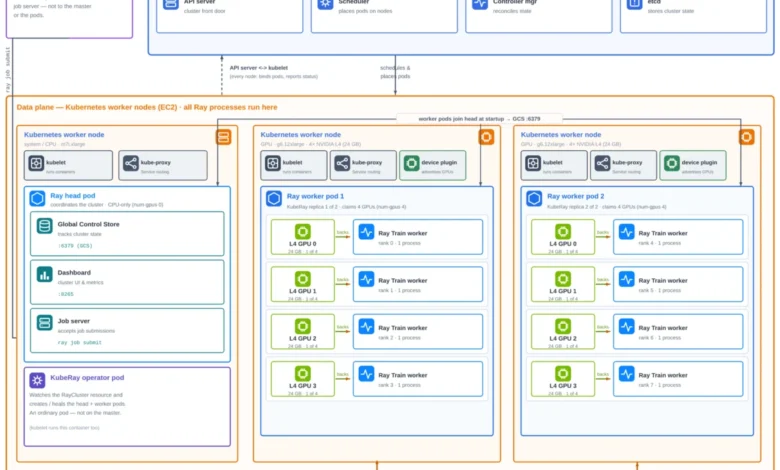
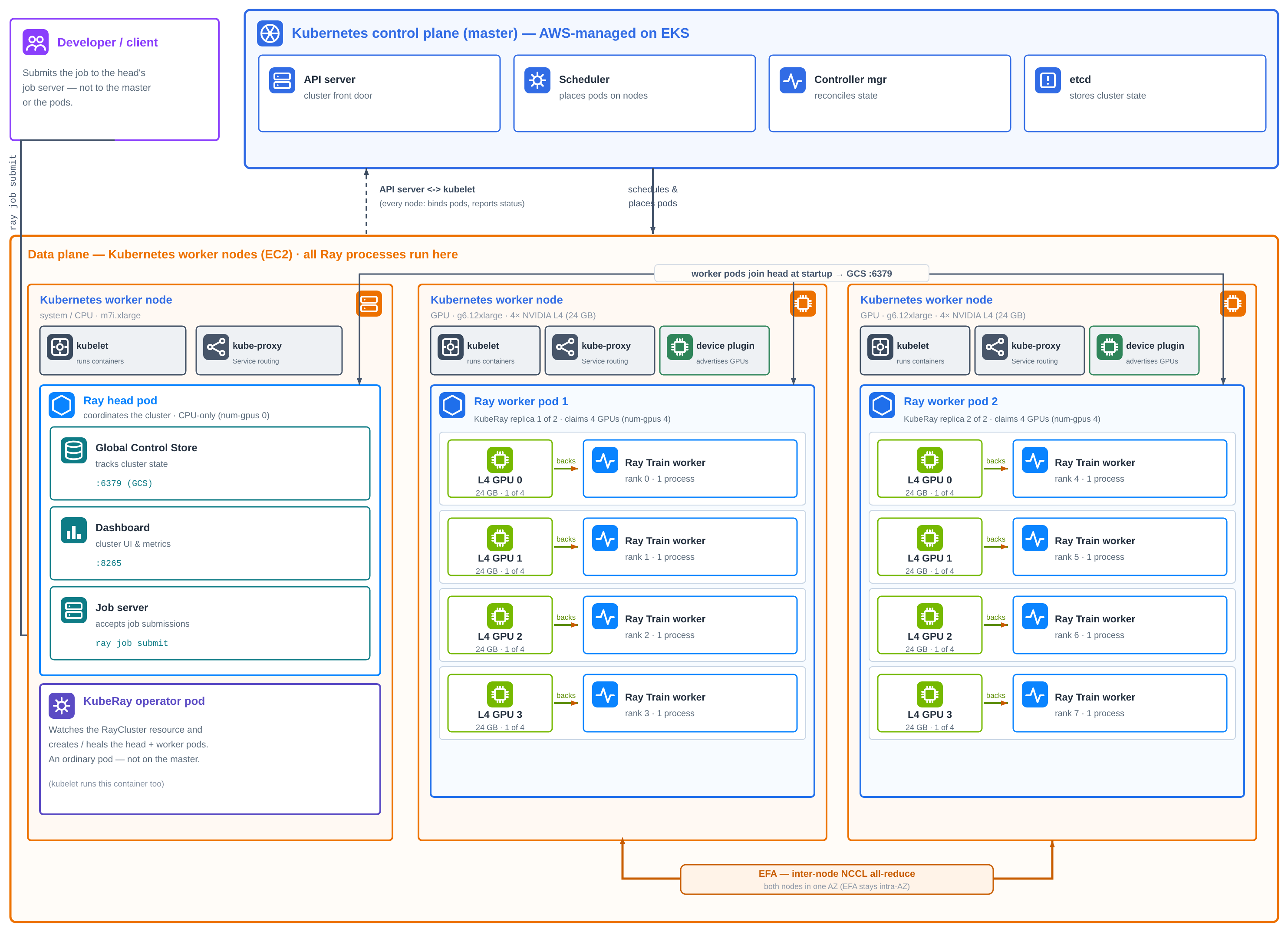
When deploying these containers within an Amazon Elastic Kubernetes Service (EKS) environment, the KubeRay operator acts as the orchestrator. KubeRay interprets a RayCluster manifest, allowing administrators to define the structure of the head node and worker nodes within a single YAML file. This architectural decision decouples the infrastructure definition from the training logic. In practice, the head node serves as the control plane—managing the job dashboard and global state—while the GPU-enabled worker nodes handle the intensive computational tasks. By using the same container image for both roles, operators maintain environment parity throughout the cluster, significantly reducing the surface area for configuration drift.
Technical Implementation and Resource Allocation
For organizations looking to implement this architecture, the process centers on configuring the environment from the outside in, rather than modifying the container image itself. In a typical deployment scenario, such as fine-tuning a model like Qwen2.5-1.5B, the training code remains model-agnostic. The training loop is written as a functional block that Ray Train dispatches across available GPUs. By utilizing Fully Sharded Data Parallel (FSDP) strategies, the model weights, gradients, and optimizer states are partitioned across all available GPUs, which is essential for handling large-scale parameters on limited hardware.
The resource layout involves a dedicated system node—typically an m7i.xlarge instance—running the KubeRay operator and the Ray head. This node does not perform training, thereby ensuring the stability of the cluster control plane. Training workloads are assigned to specialized worker instances, such as the g6.12xlarge family, which are equipped with NVIDIA L4 GPUs and EFA interfaces. Because EFA traffic is bound to specific availability zones, the infrastructure deployment scripts are designed to verify regional availability of these instances before the cluster is initialized. This pre-flight checking is a critical component of modern machine learning operations (MLOps), as it prevents the deployment of clusters that lack the necessary hardware capacity to sustain high-throughput training.
Comparative Analysis of Traditional vs. Managed Builds
The efficiency gains of moving to a pre-built DLC are best illustrated by comparing the responsibilities of a DevOps engineer in a traditional environment versus a managed one. In a self-built environment, the engineer is responsible for the manual alignment of:
- Distributed Runtime: Ensuring Ray and KubeRay versions are compatible.
- Frameworks: Recompiling PyTorch to match the specific CUDA toolkit.
- GPU Runtimes: Validating the interoperability of cuDNN and NCCL releases.
- Networking: Building and patching the libfabric and EFA drivers.
- Diagnostics: Integrating performance testing tools like all_reduce_perf into the image.
In contrast, the Ray Train DLC provides these components pre-integrated. The networking layer, in particular, is a source of substantial overhead in self-managed environments. By shipping the AWS OFI NCCL plugin within the container, the DLC guarantees that the training job utilizes the EFA fabric, which is essential for multi-node communication. If this integration fails, the system defaults to lower-speed protocols; however, because the DLC is tested as a unit, the probability of such a failure is drastically reduced.
Operational Implications for Enterprise Workloads
The transition toward configuration-driven infrastructure allows for greater agility. When a data scientist needs to introduce a new Python library, they do not need to build a new image. Instead, they leverage the Ray runtime_env feature, which installs the necessary dependencies at submission time. This mechanism preserves the integrity of the base image while providing the flexibility required for rapid experimentation.
Furthermore, the reproducibility of experiments is enhanced through versioned tagging. By pinning to a specific minor release tag—such as train-ml-cuda-v1.1—teams can ensure that their cluster environment remains consistent across multiple runs. For high-stakes compliance environments, developers can pin to a specific digest, ensuring that the environment is byte-identical even months after the initial training session.
Broader Impact on the AI Research Lifecycle
The implications of this managed infrastructure extend beyond simple convenience. By lowering the barrier to entry for distributed training, AWS is effectively democratizing access to large-scale computing. Smaller organizations that lack the dedicated platform engineering teams required to manage complex EFA-enabled Kubernetes clusters can now deploy sophisticated models using the same architecture as large-scale enterprise entities.
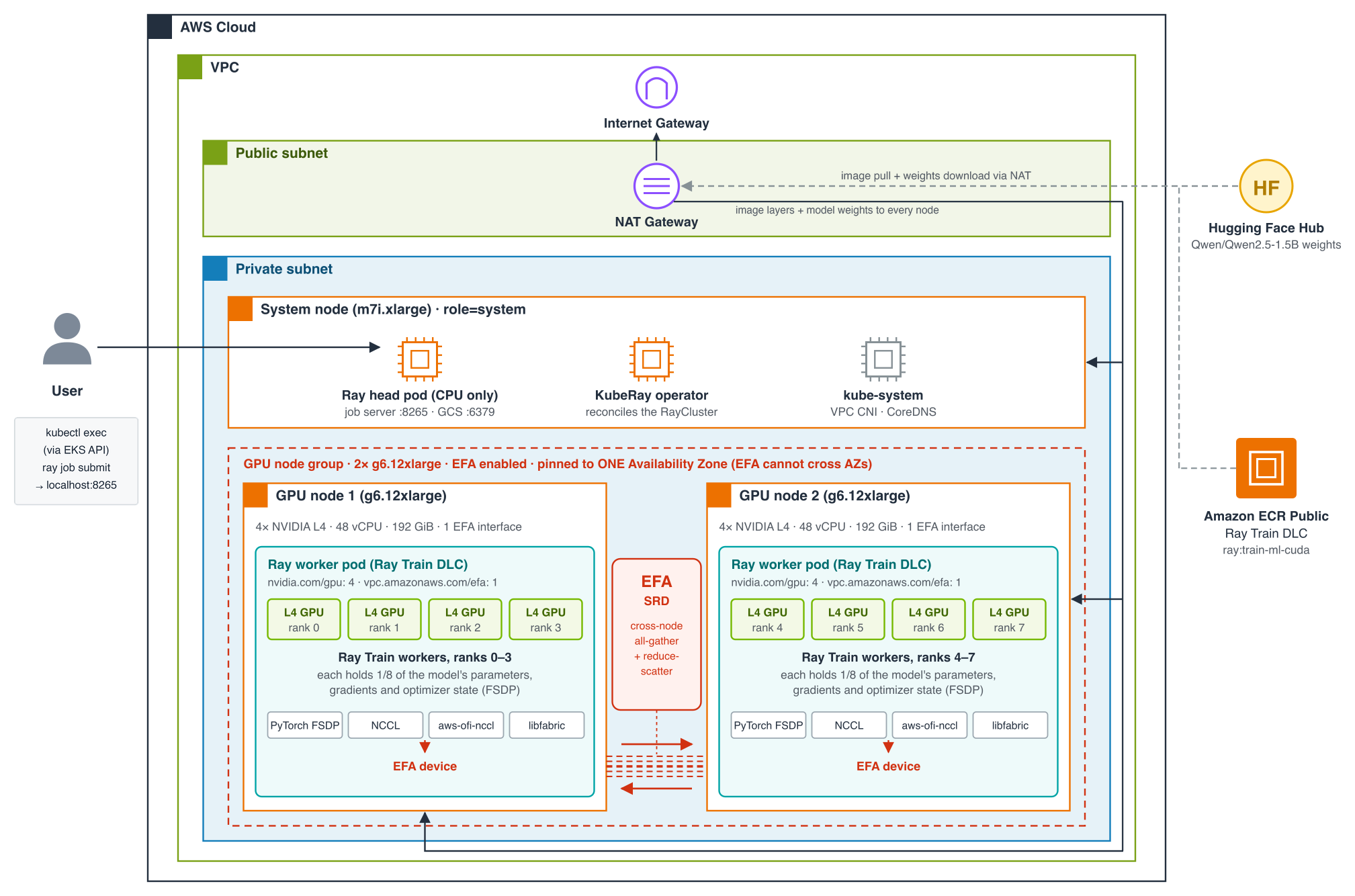
Industry analysts observe that this trend is part of a broader "commoditization of infrastructure" in the AI space. As the underlying hardware and networking stacks become more standardized, the competitive advantage shifts toward the efficiency of the training loop and the quality of the data pipeline. By removing the "plumbing" of distributed training, researchers are empowered to spend more time iterating on model architectures and hyperparameter optimization.
Future Directions and Scalability
Looking ahead, the integration of these DLCs with EKS provides a clear roadmap for scaling. As training demands grow, organizations can transition from two-node clusters to multi-rack deployments by simply adjusting the replicas parameter in the RayCluster manifest. Because the networking configuration is handled via environment variables—such as FI_PROVIDER and NCCL_NET_PLUGIN—the shift to larger clusters does not require a change in the container layer.
This architecture also facilitates a more robust approach to failure recovery. Since the KubeRay operator monitors the health of the RayCluster, it can automatically replace failed pods without requiring manual intervention. When combined with the pre-validated nature of the DLC, this creates a self-healing environment that can sustain long-running training jobs that might otherwise be interrupted by infrastructure volatility.
Ultimately, the shift toward standardized, AWS-managed containers for Ray Train signifies a maturation in the machine learning ecosystem. By standardizing the environment in which models are trained, industry players are establishing a new baseline for reliability and performance. This move toward modularity—where the cluster, the image, and the training code are treated as separate, interoperable components—is likely to become the standard practice for enterprise AI development in the coming years. Through this approach, the technical debt associated with managing custom-built AI infrastructure is significantly mitigated, allowing for a more streamlined path from research to production.