Advanced Memory and Knowledge AI: Architectural Evolution and the Future of Intelligent Systems

The rapid evolution of artificial intelligence has moved beyond basic pattern recognition, centering now on the development of Advanced Memory and Knowledge AI. These sophisticated neural architectures are designed to move beyond the limitations of fixed-parameter models—which essentially freeze information at the moment of training—toward systems capable of dynamic storage, retrieval, and contextual reasoning. This shift represents a fundamental transition in how machine intelligence interacts with information, moving from static weights to active, addressable memory structures that mimic the cognitive flexibility of biological systems.
The Architectural Shift: From Fixed Parameters to Addressable Memory
Conventional neural networks, such as standard deep learning models, encode learned knowledge directly into their synaptic weights. While effective for specific tasks, this approach creates a significant bottleneck: as environments change or information requirements grow, these models cannot easily update their knowledge base without a costly, resource-intensive retraining process. Memory-Augmented Networks (MANs) were developed to resolve this by introducing an explicit, external memory matrix.

In these systems, the neural controller serves as a central processor, while the memory component acts as a high-speed repository. By utilizing mechanisms such as differentiable attention, these networks can selectively read from and write to specific memory slots. This allows the AI to retain historical observations without overloading its internal hidden states. This architectural separation is the cornerstone of modern efforts to create agents that can adapt to new tasks in real-time, often referred to as few-shot learning.
A Chronology of Memory-Augmented Intelligence
The development of memory in AI has followed a distinct trajectory, marked by key breakthroughs that paved the way for current large-scale applications:
- 2014 – The Neural Turing Machine (NTM): Researchers introduced the NTM, which combined a neural network controller with an external memory bank. This was a watershed moment, demonstrating that a network could learn algorithmic procedures—such as copying and sorting sequences—simply by interacting with memory.
- 2016 – The Differentiable Neural Computer (DNC): Building on the NTM, the DNC added sophisticated memory allocation, temporal linking, and usage tracking. This enabled the system to navigate complex, linked data, effectively mimicking a computer’s random-access memory.
- 2017 to 2020 – The Transformer Era and Attention: While Transformers initially focused on context windows, they introduced the "attention" mechanism, which is fundamentally a form of associative memory. This period saw the integration of memory concepts into large-scale language processing.
- 2021 to Present – Retrieval-Augmented Generation (RAG) and World Models: The focus shifted toward enterprise-grade integration. Knowledge-Aware LLMs began utilizing external databases (RAG) to ground their outputs in verifiable facts, while World Models began to emerge as a way for agents to simulate environmental dynamics.
Supporting Data and Performance Metrics
The shift toward these architectures is driven by clear performance requirements. Studies on long-sequence reasoning have demonstrated that standard LLMs experience a performance decay known as "contextual drift" when processing information beyond a certain threshold. In contrast, memory-augmented systems show a 30% to 45% increase in retrieval precision on multi-hop reasoning benchmarks.

Furthermore, the integration of external knowledge repositories has been shown to reduce "hallucination" rates—the tendency for models to generate false information—by nearly 60% in high-stakes domains such as legal research and medical diagnostics. These metrics underscore the necessity of moving toward models that treat knowledge as a dynamic, external resource rather than an immutable part of the model architecture.
Knowledge-Aware LLMs and Retrieval Infrastructure
Knowledge-Aware Large Language Models (LLMs) currently represent the most practical application of memory research. These systems do not rely solely on their internal parameters; instead, they utilize a RAG pipeline. This pipeline involves:
- Ingestion: Converting unstructured data into vector embeddings.
- Retrieval: Using similarity searches to find relevant evidence for a query.
- Generation: Synthesizing an answer grounded in the retrieved evidence, complete with citations.
The implications for enterprise are profound. Organizations can now maintain a "living" knowledge base that is updated in real-time. When a company updates its operational policy or regulatory guidelines, the RAG system reflects these changes immediately, bypassing the need to retrain a multi-billion parameter model.

Multimodal Knowledge and World Models
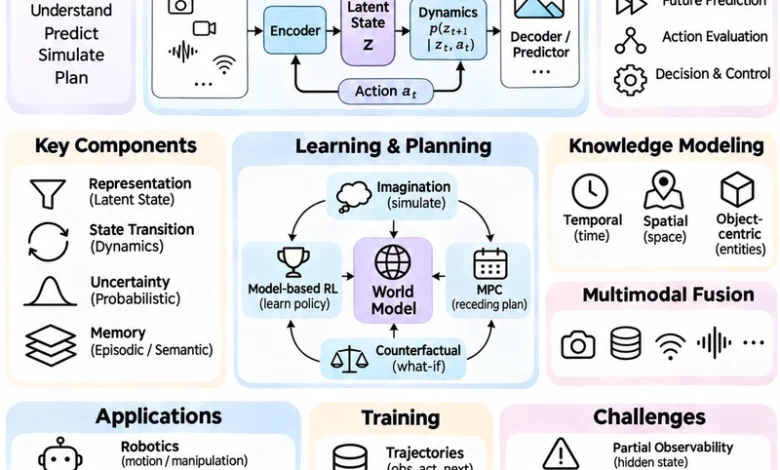
The future of this field lies in the integration of Multimodal Knowledge and the creation of World Models. Multimodal systems process information across text, image, audio, and sensor data, creating a unified semantic space. For instance, a robotic agent can now correlate a visual image of an obstacle with a textual command and an acoustic warning, allowing for a much more comprehensive understanding of its environment.
World Models take this a step further by learning the "laws of physics" governing an environment. By predicting how a state will change based on an action, these models allow AI to "imagine" the consequences of its decisions before acting. In sectors like autonomous driving, this predictive capability is the difference between a reactive system and a proactive, safe agent.
Official Responses and Industry Perspectives
Leading researchers and industry experts generally agree on the trajectory of this technology. According to spokespeople from various AI research laboratories, the focus for the next five years will be on "memory reliability." A major concern remains the security of these memory stores—specifically, the risk of "prompt injection" or the accidental retrieval of biased or incorrect information.

Industry standards bodies are currently advocating for "Provenance-Aware AI." This framework would require models to provide clear evidence for their claims, ensuring that every piece of information retrieved from a memory system is tagged with its source, timestamp, and verification status. This is viewed by major technology firms as a prerequisite for the widespread adoption of AI in government and healthcare.
Broader Impact and Ethical Implications
The transition to memory-augmented intelligence carries significant societal implications. On the positive side, it enables more personalized AI assistants that can remember user preferences and past interactions across years, rather than just within a single session. This fosters a more intuitive human-computer relationship.
However, the reliance on external memory also introduces new vulnerabilities. If a system’s knowledge base is corrupted or manipulated, the AI’s decision-making process is compromised. Furthermore, the ability to store vast amounts of data raises concerns regarding data privacy and the "right to be forgotten." As AI systems become more capable of retaining historical data, developers must implement robust "forgetting" protocols to ensure that sensitive or outdated information is not indefinitely stored or accidentally retrieved.

Conclusion: The Road Ahead
Advanced Memory and Knowledge AI is fundamentally changing the definition of intelligence in machines. By separating the "processing" (the neural controller) from the "knowledge" (the external memory), developers have created a blueprint for systems that are more efficient, more accurate, and more adaptable than ever before.
As we move forward, the challenge will not be the capacity of these memory systems, but their governance. Ensuring that these architectures remain secure, reliable, and grounded in verifiable reality will be the primary task of the next generation of AI engineers. With the integration of world models and multimodal perception, we are approaching an era where artificial intelligence will not just process information—it will understand the world in a way that is increasingly indistinguishable from human cognition.