InfoQ Announces Two Specialized Five-Week Online Certification Cohorts for October 2026 Focusing on AI Security and Assisted Engineering

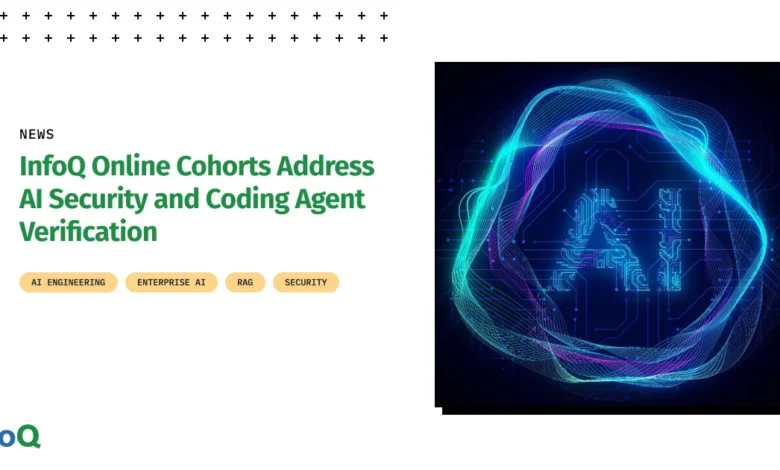
As artificial intelligence rapidly transitions from experimental sandbox environments into mission-critical enterprise production systems, organizations face unprecedented architectural, security, and operational challenges. To address the critical skills gap in securing machine learning pipelines and safely managing autonomous coding agents, InfoQ has announced two intensive, five-week online certification cohorts scheduled for October 2026. Designed specifically for experienced software engineers, technical architects, and engineering leaders, these programs aim to move beyond theoretical discussions, offering hands-on methodologies, peer collaboration, and actionable frameworks that participants can immediately apply within their own organizations.
The first program, the AI Security & Privacy Engineering cohort, is slated to commence on October 26, 2026. This curriculum directly addresses the growing apprehension surrounding data leakage, model poisoning, and systemic vulnerabilities within modern AI product architectures. Running concurrently, the AI-Assisted Engineering cohort will begin a week earlier on October 19, 2026. This second track focuses heavily on the practical governance, boundary setting, and automated validation required when deploying autonomous coding agents into complex, pre-existing brownfield codebases.
Background Context and Industry Evolution
The launch of these targeted educational cohorts arrives at a pivotal moment in the software development lifecycle. Over the past several years, the widespread adoption of generative AI and large language models has fundamentally altered how applications are built, maintained, and secured. However, this technological leap has introduced a vast new surface area for security exploits, data privacy infringements, and architectural instability.
Traditional application security models, which were largely designed around deterministic code execution and perimeter defense, often prove inadequate when dealing with probabilistic AI outputs and dynamic agentic workflows. Similarly, while AI coding assistants have dramatically accelerated feature delivery, engineering teams increasingly struggle with technical debt, undocumented architectural drift, and the challenge of verifying machine-generated code at scale. Recognizing that manual code reviews and generic security checklists are no longer sufficient, InfoQ has structured these October 2026 programs to provide rigorous, peer-reviewed engineering solutions to these modern systemic risks.
Deep Dive into the AI Security & Privacy Engineering Cohort
The AI Security & Privacy Engineering program is built around the practical realities of protecting sensitive data and rigorously testing security controls within real-world AI products. Rather than relying on abstract threat vectors, participants in this cohort bring an active work-related problem from their own professional environments. Throughout the five-week duration, engineers trace the precise lifecycle of sensitive information—identifying vulnerable entry points into the AI workflow, tracking data movement across internal and external boundaries, and analyzing potential downstream destinations.
Participants utilize advanced threat modeling and red teaming techniques to rigorously examine complex AI architectures. The curriculum emphasizes the testing of security controls and prompts engineers to determine what types of system failures must be deliberately made visible for effective monitoring and incident response.
To complete the program, cohort members collaborate on a comprehensive group capstone project. For this final assessment, teams evaluate an intricate AI product architecture, explicitly detailing the specific security risks identified, the defense controls chosen, the testing methodologies applied to validate those controls, and the organizational ownership of residual risk decisions.
Katharine Jarmul, author of Practical Data Privacy and a globally recognized expert in machine learning privacy and security, serves as the lead facilitator for the security cohort. Jarmul, who delivered the opening keynote address at the InfoQ Dev Summit Munich and has frequently presented at QCon events, emphasizes the holistic nature required for modern AI defense:
"An AI security review has to follow the data and the decisions across the whole system. In the cohort, we’ll map where sensitive information can go, test the controls we choose, and make clear who owns the risks that remain."
Structuring Autonomous Workflows: The AI-Assisted Engineering Cohort
In parallel with the security curriculum, the AI-Assisted Engineering cohort tackles the operational complexities of integrating generative coding tools into production environments. As software organizations increasingly rely on autonomous or semi-autonomous coding agents to modify existing codebases, engineering leaders face the daunting challenge of maintaining system integrity and quality control.
The five-week program places participants inside a shared, complex brownfield repository. Within this environment, engineers learn how to construct proper context for the coding agent, establish strict permission boundaries, implement targeted tests and runtime sensors, and cleanly separate code generation from human review before automating checks within continuous integration (CI) pipelines.
The capstone requirements for this track require participants to present a fully realized validation harness. Furthermore, engineers must submit an original rule or specialized agent skill derived from recurring code review findings. Throughout the program, participants log their iterative results over five weeks and compare those empirical outcomes against their initial predictions, fostering a data-driven approach to AI adoption.
Thoughtworks Leaders Lead the Engineering Track
The engineering cohort is co-facilitated by two prominent industry veterans from Thoughtworks: Zichuan Xiong, Head of AIOps, and Premanand Chandrasekaran, Head of Technology.
Zichuan Xiong has driven enterprise architecture and software delivery initiatives since 2008, currently focusing on the development of agentic systems for software operations. In addition to his role within the InfoQ cohort, Xiong leads harness engineering training sessions at QCon San Francisco. Highlighting the core engineering dilemma of agentic workflows, Xiong notes:
"A coding agent can make a change quickly, but the harder question is what it was allowed to do and how we know the change is sound. We’ll build context and limit permissions before putting checks around an agent working in an existing codebase."
Co-facilitator Premanand Chandrasekaran brings two decades of leadership experience dedicated to continuous delivery, engineering excellence, and internal software quality. Chandrasekaran emphasizes the necessity of embedding these validation mechanisms directly into standard enterprise workflows:
"Reviewing every agent change by hand does not tell us which checks should become part of the engineering workflow. We’ll put independent review and CI checks to work, then compare five weeks of results with what we expected at the start."
Peer Collaboration and Confidential Knowledge Sharing
A defining characteristic of InfoQ certification cohorts is the emphasis on confidential, cross-organizational peer groups. Participants are intentionally grouped with senior engineers and architects operating under diverse technical constraints and business pressures. This structural design encourages candid discussions regarding architectural trade-offs, the efficacy of specific security controls, and the real-world performance of automated validation harnesses.
By comparing logged empirical results against original hypotheses within a trusted peer network, participants gain broader visibility into industry best practices that extend well beyond their own corporate silos.
Broader Impact and Enterprise Implications
The introduction of these specialized October 2026 cohorts reflects a broader, necessary maturation phase across the technology sector. As regulatory scrutiny regarding data privacy intensifies globally—exemplified by frameworks such as the European Union Artificial Intelligence Act and evolving domestic cybersecurity directives—enterprises can no longer afford a trial-and-error approach to artificial intelligence deployment.
By fostering rigorous peer-reviewed training in AI security and harness engineering, InfoQ provides a vital mechanism for organizations to bridge the widening chasm between rapid AI innovation and robust operational governance. The ability to systematically model AI threats, verify agentic code changes, and establish clear accountability for remaining risks will likely become a primary competitive differentiator for engineering organizations in the latter half of the decade.
Full program syllabi, enrollment prerequisites, and detailed cohort schedules for both the AI Security & Privacy Engineering and AI-Assisted Engineering programs are currently available through the official InfoQ certification portal.