Bridging the Execution Gap: Why Operational Culture Beats Strategic Planning Every Time

Every executive knows the familiar frustration. Months are spent drafting a sophisticated strategic plan, articulating clear goals, communicating priorities, and aligning resources. Yet, within half a year, execution has quietly stalled. Departments drift in divergent directions, high-level meetings generate endless updates rather than definitive decisions, and promising initiatives lose momentum before yielding measurable results. Puzzled leaders find themselves endlessly repeating the same core message, wondering why tangible progress remains elusive.
When organizations stall, a standard diagnosis is rapidly deployed: “It’s a culture problem.” However, modern organizational research and decades of enterprise failures suggest this diagnosis is not only incomplete, but fundamentally misleading. Culture, on its own, does not execute strategy; people do. Every single day, rank-and-file employees and mid-level managers make hundreds of micro-decisions that ultimately determine whether an organization’s grand strategy becomes a living reality or a forgotten PDF on a shared drive.
The Anatomy of the Execution Gap
For decades, management theorists have struggled to understand why brilliant strategies implemented by elite talent fail so frequently. Seminal research conducted by organizational scholars Robert Kaplan and David Norton revealed a stark statistic: roughly 90 percent of well-formulated strategies fail to achieve their intended execution. This profound disconnect has puzzled corporate boards, academic institutions, and nonprofit administrators alike.
The root cause of this execution gap rarely stems from a lack of employee commitment or intellectual horsepower. Rather, it originates in the operating environment constructed by leadership. When strategic priorities are ambiguous, lines of ownership are blurred, specialized expertise remains locked within functional silos, and continuous learning is treated as an afterthought, even the most robust strategies falter.
Conversely, high-performing organizations rarely rely on extraordinary individuals acting as solitary heroes. Instead, they intentionally engineer environments where workers understand what truly matters, accept personal ownership for outcomes, contribute their domain expertise, and continuously refine how work gets accomplished. In these thriving institutions, execution transforms from a heroic gamble into a reliable organizational capability.
Moving Beyond Abstract Values Statements
For generations, corporate culture has been treated as an abstract set of shared values, mission statements, and aesthetic workplace perks. Corporations invest heavily in crafting inspiring declarations to paint across conference room walls, defining core values on corporate websites, and outlining behavioral expectations they hope workers will effortlessly adopt.
Yet, employees rarely experience organizational culture through written declarations. Instead, they experience it through day-to-day operational systems. Culture reveals itself organically in how leadership handles resource allocation, how performance is evaluated, how cross-departmental conflicts are resolved, and how supervisors respond to operational mistakes.
As organizational theorists Edgar Schein and Peter Schein famously observed, culture is composed of the deep, shared assumptions that emerge as groups tackle and solve complex problems over time. These assumptions are not accidental; they are actively shaped by leadership decisions and reinforced through structural systems. If a company claims to value cross-functional collaboration but evaluates performance strictly on individual departmental metrics, employees quickly learn to protect their own territory, rendering the written values irrelevant.
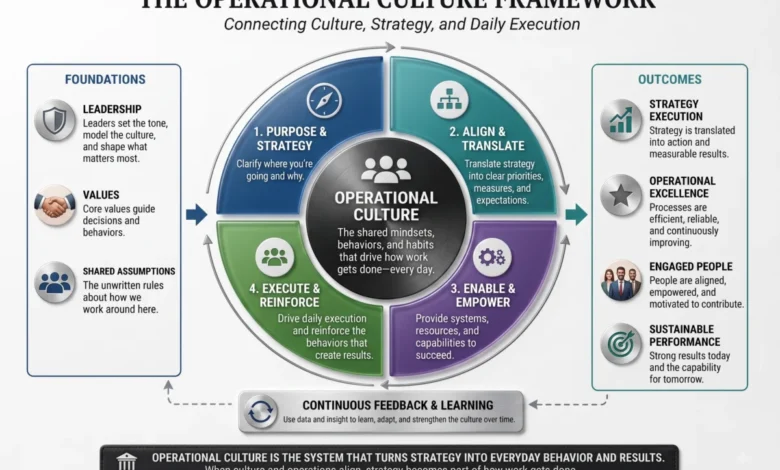
The Operational Culture Framework
To bridge the chasm between planning and execution, forward-thinking organizations are adopting a systematic approach known as the operational culture framework. Rather than viewing culture as a soft, intangible byproduct of corporate success, this model treats culture as a measurable, highly designed operational capability built upon four core pillars: clarity, accountability, collective intelligence, and adaptability.

1. Clarity
Clarity provides the foundational compass for any enterprise. Workers perform at their highest levels when they possess a crystal-clear understanding of what operational success looks like, how institutional priorities are established, and precisely how their daily tasks feed into the broader organizational mission. True clarity actively reduces cognitive friction and uncertainty, enabling smarter, faster decision-making across all tiers of the enterprise.
2. Accountability
Accountability transforms passive compliance into genuine psychological ownership. Effective leaders move away from punitive oversight and instead establish well-defined responsibilities, pair those duties with the actual authority required to act, and reinforce shared ownership for collective outcomes. In high-functioning operational cultures, accountability is woven into the regular rhythms of weekly operations rather than reserved for dreaded annual performance reviews.
3. Historical Context and Collective Intelligence
The third pillar, collective intelligence, acknowledges that optimal solutions rarely emerge from a single executive seated at the top of an organizational chart. Performance surges when enterprises deliberately harvest expertise across diverse functions and build structured channels for surfacing dissent and specialized knowledge.
However, true collective intelligence cannot exist without deep psychological safety—the shared, institutionalized belief that it is entirely safe to speak truth to power. Without psychological safety, frontline warnings are suppressed until minor issues cascade into institutional crises. A classic historical cautionary tale is found in the case of Eastman Kodak. In 1975, engineers at Kodak invented the very first digital camera. The company possessed the technical intelligence, the foresight, and the financial resources to dominate the digital revolution decades before the market demanded it. Yet, Kodak’s operational culture lacked the structural adaptability and collective intelligence to cannibalize its own highly lucrative film business. By the time leadership finally acted, nimble competitors had already captured the market.
4. Adaptability
Adaptability ensures that an enterprise learns faster than its external environment changes. As management expert John Kotter has frequently noted, true adaptability requires restructuring an organization for continuous evolution rather than treating change management as a stressful, one-time corporate event.
Practical Diagnostics for Leadership Teams
Before launching yet another expensive strategic initiative or sweeping culture campaign, executives and administrators can diagnose their internal friction by evaluating four targeted questions mapped directly to the operational culture framework:
- Do employees at every level clearly understand how their daily work directly advances the institutional mission? (Clarity)
- Are decision-making rights pushed down to the individuals closest to the actual work, or do bureaucratic approval layers slow down momentum? (Accountability)
- Are there formalized, safe channels for surfacing dissenting views and tapping cross-functional expertise before critical decisions are finalized? (Collective intelligence)
- Does the organization systematically learn, adapt, and adjust its operational routines following both successes and setbacks? (Adaptability)
If leadership answers “no” to any of these diagnostic queries, they have pinpointed the exact structural bottleneck sabotaging their strategic execution.
Broader Implications for the Modern Workplace
As artificial intelligence and rapid technological automation continue to reshape the modern workspace, the human challenge of leadership has only intensified. Technology evolves at an exponential rate, but the fundamental duty of leaders remains remarkably constant: they must cultivate environments where human beings can perform at their absolute peak.
Ultimately, strategy is only as powerful as the operational infrastructure supporting it. By shifting the focus away from abstract cultural ideals and toward intentional operational design, organizations can finally transform strategic plans from static documents into dynamic, everyday realities. Strategy succeeds not when a plan is brilliantly conceived, but when leaders build the everyday conditions that allow people to execute it consistently, collaboratively, and with unwavering purpose.