The Problem of Boundary Creep in Production Pipelines
The challenge of maintaining clean code is particularly acute in data engineering and machine learning pipelines. For instance, a function designed to load embeddings from a local store, fetch a vocabulary from an external API, and transform data batches may start with ten lines of logic. Within weeks, the addition of exception handling, retry logic for network stability, timing metrics for observability, and cache layers for performance can expand the function to three times its original size.
When this boundary logic is manually pasted into each function, the inconsistencies arise. One developer might use a for loop for retries, while another uses a while loop. One might log performance using time.perf_counter(), while another uses datetime.now(). This heterogeneity makes the codebase difficult to audit, test, and debug. The decorator pattern serves as a structural solution to this problem, allowing developers to encapsulate cross-cutting concerns into reusable components that are applied declaratively rather than imperatively.
Understanding the Mechanics of Python Decorators
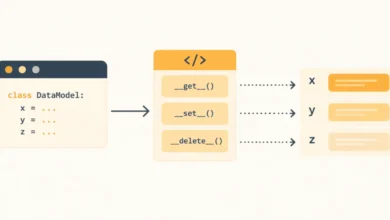
At its core, a decorator is a higher-order function that takes a function as an argument and returns a new function (a wrapper). The Python interpreter treats the @decorator syntax as syntactic sugar for function reassignment. When a function is defined with a decorator, Python executes the decorator at import time, replacing the original function object with the result returned by the decorator.
The efficacy of a decorator relies on the concept of closures—the ability of an inner function to retain access to the scope of its enclosing function, even after that enclosing function has finished execution. This allows the wrapper to "remember" the original function, as well as any configuration parameters passed to the decorator, without needing global variables or external state management.
Establishing the Standard Template
To avoid common pitfalls—such as losing the original function’s metadata (like its name or docstring) or failing to forward arguments correctly—developers must adhere to a standard implementation template:
import functools

def decorator_template(func):
    @functools.wraps(func)
    def wrapper(*args, **kwargs):
        # Pre-execution logic
        result = func(*args, **kwargs)
        # Post-execution logic
        return result
    return wrapper
The use of functools.wraps is non-negotiable in production environments. It ensures that the wrapper assumes the identity of the original function, maintaining the integrity of documentation generators, debuggers, and static analysis tools. Without it, stack traces would report all decorated functions as "wrapper," rendering error logs essentially useless.
Timing and Observability: Capturing Performance Metrics
For developers needing to monitor execution time without altering the function’s contract, the timed decorator provides a surgical approach. By using time.perf_counter(), which offers the highest available resolution for measuring short durations, engineers can accurately profile functions.
The implementation should utilize a try...finally block. This ensures that even if a function fails or raises an exception, the performance data is recorded and reported before the exception is propagated to the caller. This provides vital insights into whether a system failure was caused by a hang or an instantaneous crash, maintaining system observability without interfering with error flow.
Robust Retry Strategies as Decorator Factories
Retry logic is a classic example of a "boundary concern" that requires configuration. A static retry limit is rarely sufficient for diverse network conditions. By creating a decorator factory—a decorator that accepts arguments—engineers can define custom behaviors for specific functions.
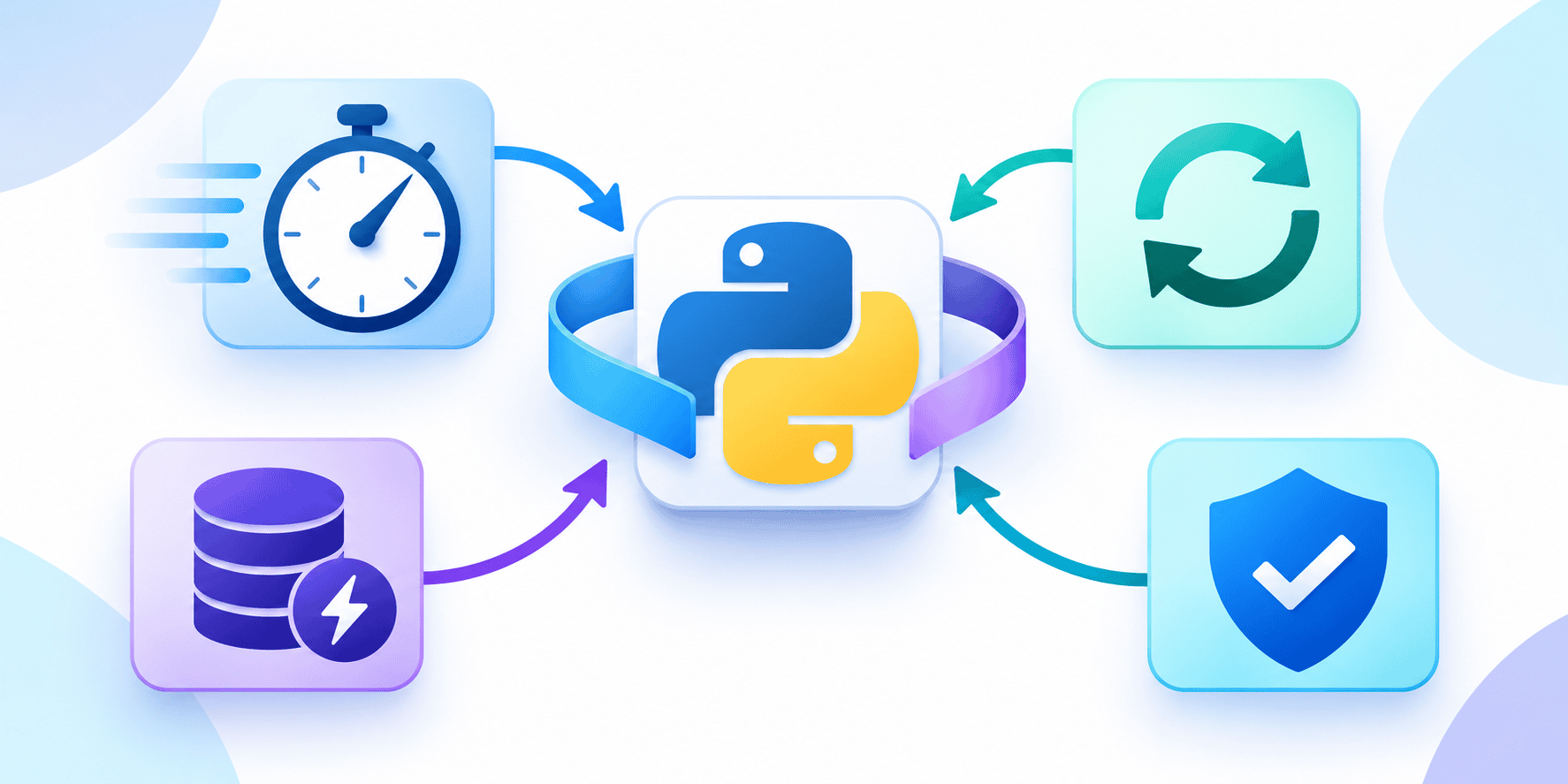
A well-architected @retry decorator must handle three critical aspects:
- Specific Exceptions: It should only intercept transient errors, such as
TimeoutErrororConnectionError. AKeyErrororTypeErrorindicates a bug and should not be retried. - Backoff and Jitter: While simple
time.sleep()calls work for basic scripts, production systems often benefit from exponential backoff to avoid overwhelming downstream services. - Transparency: The decorator must re-raise the final exception if all attempts are exhausted, ensuring that the caller is aware of the persistent failure rather than receiving a silent
None.
Caching and Memoization in Production
The standard library’s functools.lru_cache is the industry standard for memoization. It automatically manages a cache of function results based on input arguments, providing significant performance gains for CPU-intensive, deterministic functions.
However, professional application requires strict adherence to its constraints. Because the cache relies on dictionary keys, all arguments passed to the function must be hashable. Furthermore, developers must be wary of "cache poisoning" or memory leaks. In a long-running process, an unbounded cache (maxsize=None) can lead to significant memory consumption. Monitoring cache_info() and implementing cache clearing strategies are essential for maintaining system stability.
Input Validation and Defensive Programming
Input validation is the final line of defense for a function. Using the inspect.signature module, developers can build a decorator that validates arguments against predefined rules before the function body is ever executed.
This approach is superior to manual checks because it allows the validation logic to be abstracted away from the function’s purpose. By binding arguments to the function signature using sig.bind(), the decorator can handle positional and keyword arguments uniformly, applying default values and ensuring that inputs adhere to specified invariants (e.g., ensuring a size parameter is a positive integer).
Implications and Best Practices
The transition from manual boundary code to decorators represents a maturation of the codebase. However, it requires a disciplined approach to avoid over-engineering.
Chronology of Implementation:
- Phase 1 (Ad-hoc): Developers paste logic into functions.
- Phase 2 (Refactoring): Common patterns are identified and moved into helper functions or closures.
- Phase 3 (Standardization): Decorators are implemented using
functools.wrapsto ensure metadata preservation. - Phase 4 (Observability): Infrastructure is added to monitor the performance of the decorators themselves, ensuring the "boundary code" does not become the primary source of latency.
Summary of Boundary Patterns:
| Pattern | Primary Use Case | Risk Factor |
|---|---|---|
| Timing | Profiling performance bottlenecks | Misuse of time.time() instead of perf_counter() |
| Retry | Mitigating transient network failures | Retrying non-idempotent operations (e.g., payments) |
| Caching | Memoizing deterministic function results | Memory leaks from unbounded caches |
| Validation | Ensuring input integrity | Over-complicating schema validation |
In conclusion, decorators are a powerful abstraction, but they must be wielded with caution. When used correctly, they enhance the clarity and maintainability of code by separating the "what" (business logic) from the "how" (infrastructure concerns). When misused, they create hidden behaviors that are difficult to trace. The ultimate test of a decorator is whether it makes the function’s boundary clearer to the next developer who reads the code. If the decorator introduces more mystery than it removes, the original code—or a simpler, explicit approach—is likely the better path forward.