Dockfin: Bridging the Gap Between Cost-Effective Self-Hosting and Enterprise-Grade PaaS Convenience

For many independent developers and small engineering teams, the current landscape of application hosting presents a difficult dilemma: the ease of managed platforms like Heroku or Vercel, or the fiscal efficiency of managing raw infrastructure. While managed Platform-as-a-Service (PaaS) providers offer an unparalleled developer experience, they often impose significant "convenience taxes" that scale exponentially with the complexity of an application. As teams expand their footprint to include multiple environments, databases, and continuous integration pipelines, the monthly costs often become disproportionate to the actual compute power consumed.
Dockfin, a newly introduced, MIT-licensed open-source project, seeks to disrupt this dichotomy by offering a self-hosted PaaS that provides the operational simplicity of a managed cloud environment while keeping the infrastructure under the developer’s direct control. Developed by Foisal Islam, the project is designed to bridge the gap between "do-it-yourself" server administration and high-abstraction deployment services.
The Economic Drivers of the Self-Hosted Movement
The proliferation of managed cloud services has fundamentally altered how applications are deployed over the last decade. By abstracting away the underlying operating system, networking, and security configurations, platforms like Vercel and Heroku lowered the barrier to entry for solo developers. However, recent market data suggests that as projects grow, the cost of these services often becomes a primary concern for startups and hobbyists alike.
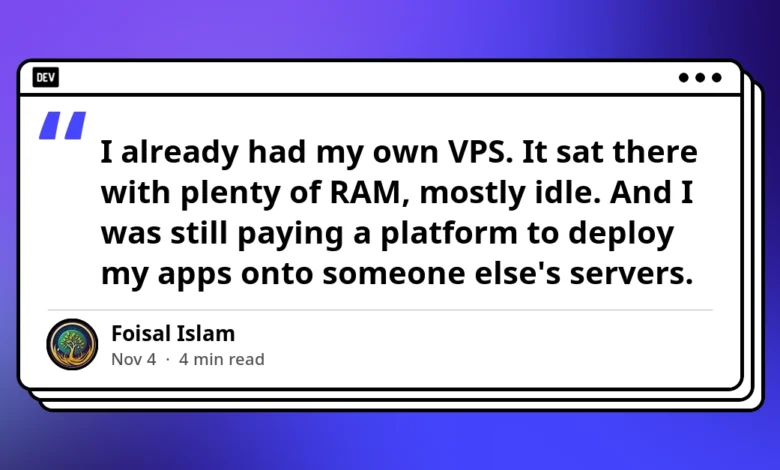
A standard Virtual Private Server (VPS) today can be provisioned for as little as $5 to $10 per month, offering significant RAM and CPU resources. Conversely, a managed PaaS can easily charge ten times that amount for equivalent traffic and database capacity. Many developers find themselves in a situation where they possess underutilized compute power on private servers while simultaneously paying a premium for a "magic" deploy button on a third-party platform.
Dockfin enters the market as a solution for those who possess the hardware—or the capacity to rent it cheaply—but lack the time or desire to manually configure complex Docker orchestration, reverse proxies, and TLS certificate management. By automating the "plumbing" of a server, Dockfin attempts to offer a middle ground where the user retains data sovereignty and cost control without sacrificing productivity.
Technical Architecture and Installation
Dockfin is engineered to be as unobtrusive as possible, shipping as a single Docker image that integrates a Go-based API with a modern React dashboard. The installation process is streamlined to minimize the time-to-first-deploy, requiring only a single command executed on a fresh Ubuntu or Debian instance.
Upon execution, the automated script performs a comprehensive setup: it ensures Docker is present, handles the generation of security keys, initializes a persistent PostgreSQL database for state management, and launches the Dockfin dashboard on port 8000. Crucially, the platform reserves ports 80 and 443 for the reverse proxy, allowing the system to handle incoming traffic with minimal configuration.
Unlike some centralized platforms that store metadata in a proprietary cloud, Dockfin maintains all operational state within the user’s own infrastructure. Because the system communicates with servers via Secure Shell (SSH), it is capable of orchestrating multiple machines from a single unified dashboard, providing a multi-node management capability that is often missing from smaller, single-server deployment tools.
Prioritizing Operational Stability: The "Deploy Freeze" and Beyond
A recurring criticism of automated CI/CD pipelines is the risk of "deploy accidents"—instances where an automated update is pushed during a critical period, such as a product launch or an active server incident. Dockfin addresses this through a native "Deploy Freeze" feature.
This functionality allows administrators to halt all automated deployments for specific environments. When a freeze is active, Git webhooks are ignored rather than rejected, preventing the common issue of build logs becoming cluttered with failed retry attempts. This ensures that the state of the production environment remains static during high-stakes periods, while still allowing authorized users to manually override the freeze for urgent hotfixes or maintenance tasks.
Furthermore, the platform emphasizes transparency and recoverability. Every deployment generates live-streamed logs, allowing developers to monitor the progress of their build in real-time. In the event of a failure or a regression, the system provides a one-click rollback mechanism. This feature set reflects a maturation in self-hosted tooling, shifting focus from merely "getting code to the server" to ensuring that the process is predictable, observable, and reversible.
The Role of the CLI in Developer Workflow
While the React dashboard provides a visual interface for managing projects and services, Dockfin places a significant emphasis on its command-line interface (CLI), dfin. The project designers recognized that modern DevOps workflows are heavily reliant on automation and scripting.
The dfin CLI is built with a "script-first" philosophy. Every command—from server configuration to environment variable management—supports a --json output flag. This allows developers to integrate Dockfin into existing CI/CD pipelines, such as GitHub Actions or GitLab CI, enabling a seamless transition from code commit to deployment on a private server. By providing a programmatic interface to the control plane, the project aims to satisfy power users who prefer the speed of the terminal over the overhead of a graphical interface.
Competitive Analysis and Market Position
In the current open-source landscape, Dockfin faces direct competition from projects like Coolify, which has gained significant traction for its similar "Heroku-alternative" value proposition. While both projects aim to provide a self-hosted PaaS, their design philosophies differ in focus.
Dockfin distinguishes itself through its emphasis on a streamlined, Go-centric control plane and a specific feature set tailored for safe, risk-averse deployments. While projects like Coolify offer a broader range of pre-built integrations, Dockfin targets users who prioritize stability, scriptability, and minimal resource consumption. The project is transparent about its limitations; it does not currently attempt to be a universal replacement for all managed cloud services. Instead, it positions itself as a robust tool for developers who have a baseline familiarity with server management but wish to automate the repetitive aspects of their workflow.
Future Development and Road Map
The development roadmap for Dockfin indicates a clear trajectory toward further abstraction. The primary objective for the coming months is the introduction of an "App Marketplace." This feature is intended to move the platform beyond a simple deployment runner and into the territory of a service orchestrator. By implementing a separate catalog service that the Dockfin API can query, users will eventually be able to deploy common software—such as WordPress, Ghost, or Redis—with a single click, without requiring a full system update of the Dockfin core.
This modular approach to app management suggests that the maintainer is looking to reduce the maintenance burden of the project itself, allowing for community-contributed templates rather than hard-coding every supported integration into the platform’s core logic.
Broader Implications for Infrastructure Management
The emergence of projects like Dockfin highlights a growing trend in the developer community: the "re-decentralization" of web infrastructure. As managed platforms continue to increase pricing or introduce restrictive terms of service, developers are increasingly seeking tools that allow them to leverage the raw, low-cost power of the internet’s backbone—the independent VPS.
For the industry at large, this shift represents a move toward greater technical literacy and autonomy. While managed services will always have a place for teams that require zero-touch infrastructure, the availability of mature, self-hosted PaaS solutions like Dockfin ensures that the barrier to entry for robust, professional-grade deployment pipelines remains low. By providing the tools to manage infrastructure as code without the overhead of enterprise-level cloud bills, Dockfin serves as a practical response to the rising costs of modern application development.
As the project enters its public testing phase, the primary challenge for the developer will be to maintain the balance between simplicity and the growing demand for advanced features like automated database backups, log aggregation, and ingress security. However, if the initial reception is any indication, there is a substantial audience of developers ready to reclaim their infrastructure, one VPS at a time.