Best and Worst States for Business 2026: How Seismic Shifts in Energy, Talent, and Infrastructure are Remapping the American Economy

As the United States approaches its semiquincentennial, the 2026 Chief Executive Best & Worst States for Business survey reveals a nation in the midst of a profound economic realignment. The annual ranking, based on comprehensive feedback from hundreds of CEOs across the country, indicates that the traditional drivers of state competitiveness—primarily tax incentives and low costs—are being superseded by a more complex set of requirements: grid reliability, talent pipelines, and regulatory speed. While the top of the leaderboard remains stable, with Texas and Florida maintaining their long-standing dominance, a new tier of "fundamentalist" states is rising through the ranks by prioritizing unglamorous but essential infrastructure.
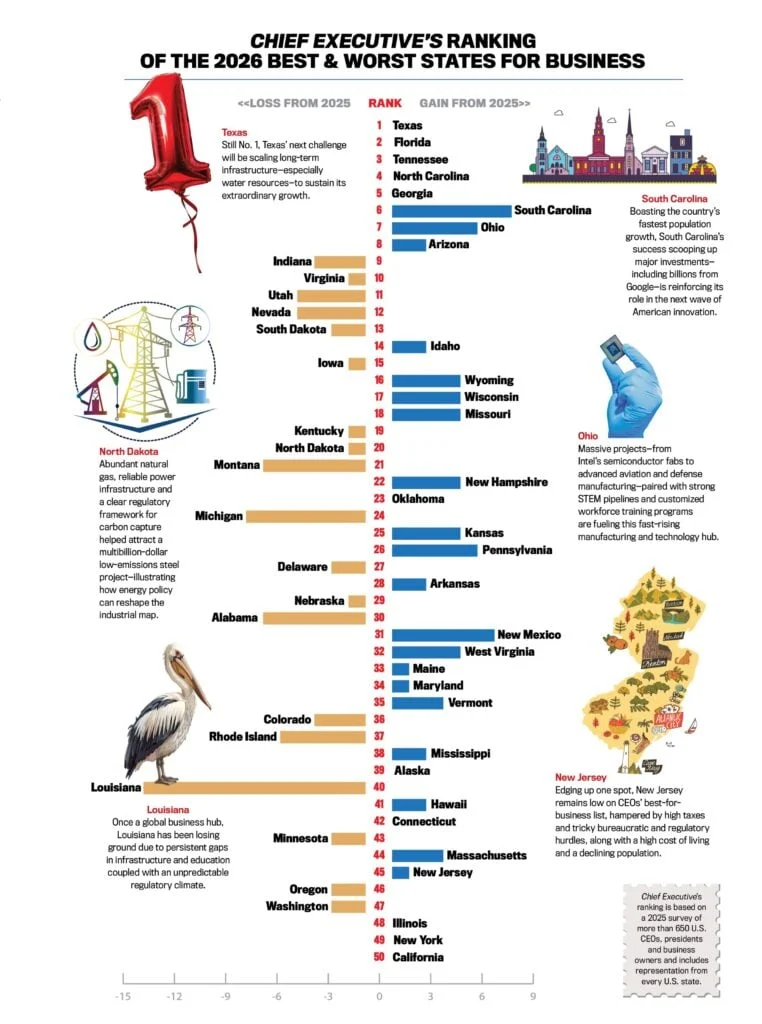
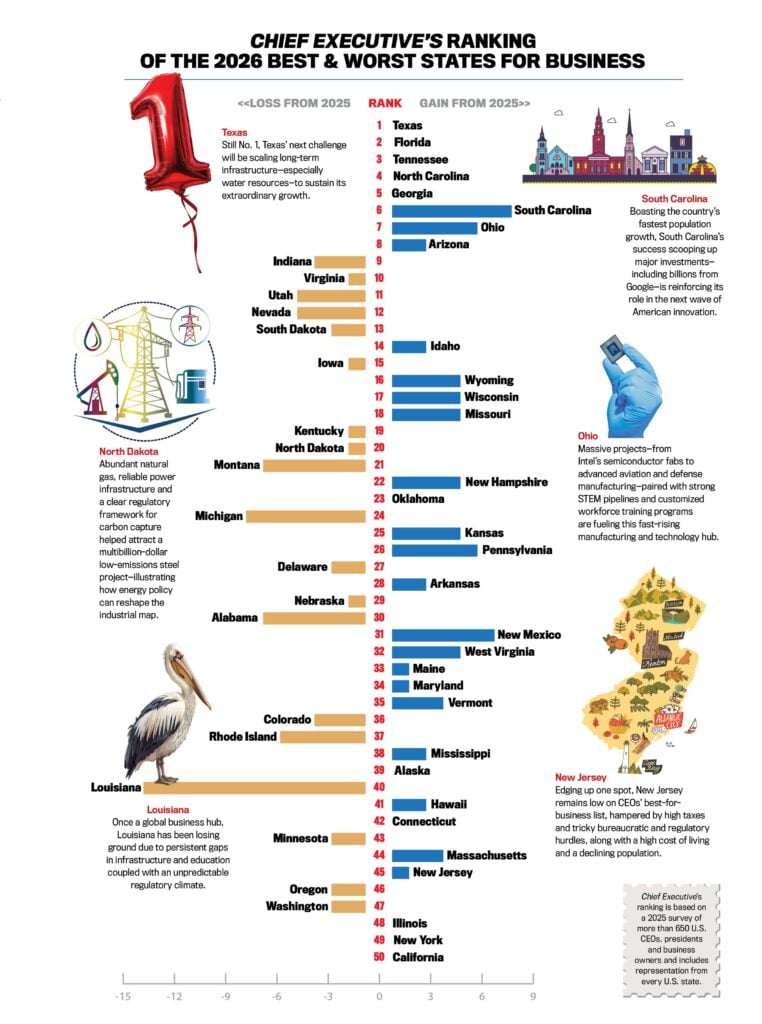
The 2026 rankings see Texas secure the No. 1 spot for the 22nd consecutive year, followed by Florida at No. 2. Tennessee, North Carolina, and Georgia round out the top five, cementing the Sunbelt’s status as the nation’s primary engine of growth. However, the most significant movement occurred just below the top tier. South Carolina climbed seven places to reach No. 6, while Ohio ascended five spots to No. 7, becoming the highest-ranked Midwestern state in the history of the survey. These shifts reflect a growing recognition among corporate leaders that "winning the future" requires more than just a favorable tax climate; it requires a relentless execution of industrial basics.
The Long-Term Evolution of State Competition
To understand the current shifts, one must look at the trajectory of investments like Google’s presence in South Carolina. When the tech giant first established a data center in Berkeley County’s Moncks Corner in 2007, it was a modest foray into the Southeast. Nearly two decades later, that initial "flag-planting" has evolved into a $13.5 billion commitment through 2027. This evolution was not accidental. State leaders spent years focusing on the "unglamorous work" of power generation, workforce training, and permitting, ensuring the state was prepared when the global AI infrastructure wave arrived.
Ruth Porat, President and Chief Investment Officer of Alphabet and Google, noted that the company’s expansion is built on a 15-year foundation designed to secure success during the next wave of American innovation. This sentiment is echoed across the country as states like Ohio and North Dakota pivot toward high-tech and low-emission industries. Ohio has successfully assembled a portfolio that includes Intel’s massive chip fabrication plants, Joby Aviation’s air-taxi manufacturing, and Anduril’s defense technology hubs. Meanwhile, North Dakota has leveraged its natural resources and regulatory clarity to land low-emissions steel projects that legacy industrial states failed to secure.
Demographic Shifts and the "Secret Sauce" of In-Migration
The most powerful force remapping the long-term business landscape is the movement of people. According to U.S. Census Bureau estimates released in early 2025, South Carolina’s population grew by 1.5 percent between July 2024 and July 2025—roughly three times the national rate. This marked the second consecutive year the state led the nation in growth.
Economists argue that this in-migration is the "secret sauce" of economic development. Dr. Joseph Von Nessen, a research economist at the University of South Carolina’s Darla Moore School of Business, suggests that headline growth is less important than the composition of who is moving. A state drawing young engineers and tech founders creates a different economic trajectory than one fueled primarily by retirees. For CEOs, the influx of working-age talent is a critical factor in mitigating wage pressure and ensuring long-term employee retention.
In Texas, the ability to draw talent from high-cost coastal areas remains a primary competitive advantage. Natasha August, founder of the Dallas-based creator platform RM11, noted that the state’s relative affordability makes both hiring and retention significantly easier than in traditional tech hubs. This demographic dividend allows companies to stay lean while reinvesting capital into innovation rather than just meeting the high cost of living for their workforce.
Talent as an Operating System
The survey results highlight a shift in how CEOs view workforce development. States that are climbing the rankings no longer treat talent as a static asset but as an "operating system" that must be constantly upgraded. Utah, which has seen a reversal of its historic "brain drain," is a prime example. Steven Boal, CEO of Matia Mobility, moved his company from the San Francisco Bay Area to Salt Lake City, citing the state’s demographics and the active commercialization of technology at the University of Utah and BYU.
South Carolina and Ohio have built sophisticated systems to link education directly to industrial needs. South Carolina’s "readySC" and "Apprenticeship Carolina" programs are cited by Commerce Secretary Harry Lightsey as best-in-class examples of workforce alignment. Similarly, JobsOhio CEO J.P. Nauseef points to community college programs that are bespoke-designed around the five- to ten-year forecasts of major employers. This level of customization was instrumental in landing Intel’s multibillion-dollar investment, as the state could guarantee a pipeline of certified technicians before the first ribbon was cut.
Energy Certainty: The New "Go/No-Go" Screen
In the 2026 economic environment, energy has moved from a utility concern to a primary strategic screen. The rise of data centers, electric vehicle (EV) supply chains, and high-intensity manufacturing has made grid reliability a "go/no-go" factor for site selection.
North Dakota’s rise in the rankings is largely attributed to its "energy certainty." Jim Bougalis, CEO of North American Iron, chose Minot, North Dakota, for a multibillion-dollar low-emissions pig iron facility over traditional steel-producing states. The decision was driven by the state’s abundant natural gas, grid reliability, and a decade-old framework for carbon storage. Bougalis noted that companies do not necessarily need "fast or loose" regulations; they need predictability.

South Carolina’s nuclear-dominant grid—where more than half of the state’s electricity is generated by reactors—has become a significant draw for advanced manufacturers like Eaton. The power management company recently invested $340 million in a new manufacturing facility for three-phase transformers, part of a broader $1 billion investment push in the state since 2023.
Infrastructure and the "Time-to-Market" Challenge
Infrastructure in 2026 is defined by throughput and time. Arizona provides a live case study in what happens when growth outpaces the systems meant to support it. After slipping in previous rankings due to grid and infrastructure strain, the state has moved aggressively to catch up. The Arizona Corporation Commission recently approved nearly 5,000 megawatts of new generation and storage, while the Arizona Department of Transportation (ADOT) began a $410 million widening of the I-10 corridor between Phoenix and Casa Grande. These "steel-and-concrete" improvements helped Arizona climb back to No. 8 in the rankings.
However, growth brings new constraints. In Texas, water resources are becoming a significant point of pressure. Experts like Larry Gigerich of Ginovus consultants suggest that Texas must develop a 50-year water plan to sustain its current growth trajectory. Meanwhile, Ohio has focused on "preparedness," assembling an inventory of development-ready industrial sites where zoning, utilities, and environmental due diligence are already complete, allowing CEOs to bypass years of pre-development delays.
The "Handshake State" and Regulatory Speed
The final differentiator in the 2026 survey is the concept of "business friendliness" as an operational reality rather than a political slogan. CEOs are increasingly favoring states that offer "concierge-style" coordination across agencies. Michigan, despite slipping seven places to No. 24, is attempting to redefine its value proposition through a unified "Team Michigan" approach, focusing on "recession-resilient" industries like life sciences and technology while maintaining its automotive core.
The term "handshake state" has become synonymous with South Carolina’s approach, where local and state leaders coordinate to ensure commitments are kept. In Florida, founders cite a lack of "red tape" and a supportive regulatory environment as reasons for choosing cities like Orlando over traditional tech hubs. Thomas Aronica, CEO of Biller Genie, noted that Orlando provides the scale necessary for recruitment without the "bloated burn" and high costs of "brand-name" hubs.
Analysis: The Competitive Map of the Next Century
The 2026 Best & Worst States for Business survey suggests that the "Great Realignment" of the American economy is accelerating. The states that are winning are those that have stopped competing solely on price and started competing on capacity. As global futurist Jim Carroll noted, some states are acting as if the future is optional, while others are building the conditions that make investment inevitable.
The broader implication for the U.S. economy is a shift toward a "distributed innovation" model. While the coasts remain influential, the interior of the country—from the Sunbelt to the revitalized Midwest—is capturing an increasing share of the capital intensive industries that will define the next 50 years. The winners of this era will be determined by their ability to execute on the fundamentals: a reliable 24/7 grid, a workforce that scales with technology, and a regulatory environment that moves at the speed of innovation. As the nation marks its 250th year, the constructive rivalry between states remains one of its most productive engines, ensuring that even as the map shifts, the drive for competitive advantage continues to fuel American growth.