How Bayer Crop Science built an agentic decision engine on Amazon Bedrock AgentCore with AWS Unified Operations

The complexity of modern agricultural science has reached a point where data volume often outpaces the ability of human researchers to synthesize it. At Bayer Crop Science, plant breeding decisions rely on a sophisticated tapestry of information, including genomics, granular field trial results, satellite imagery, and intricate environmental datasets. To manage this, the company developed the Connected Decision Engine (CDE), a centralized platform designed to handle hundreds of machine learning (ML) model configurations across diverse crops and global regions. However, as the platform matured, the primary challenge shifted from raw computational power to operational visibility. Researchers and data scientists faced a "navigation tax," where piecing together the rationale behind a specific model’s output required manual intervention across a fragmented ecosystem of APIs, documentation, and system logs.
To solve this, Bayer launched the Agentic Decision Engine (ADE), a sophisticated, multi-agent natural language interface designed to sit atop the CDE. By leveraging Amazon Bedrock AgentCore, Bayer has effectively automated the interpretation of complex agricultural data, allowing the platform to resolve approximately 80 percent of user inquiries without the need for manual engineer intervention.
The Evolution of Decision Support in Agriculture
The history of Bayer’s digital transformation in agriculture is rooted in the need for repeatability and governance. In the early stages of the CDE development, the goal was simple: provide a consistent environment where data scientists could deploy, orchestrate, and monitor ML workflows. This ensured that a trial conducted in Brazil could be compared against a similar model run in the United States with total confidence in the underlying methodology.
However, by 2025, the sheer scale of the CDE led to a new bottleneck. When a workflow failed or a result appeared anomalous, the "time-to-insight" expanded significantly. A breeder attempting to understand a specific phenotyping failure would previously need to manually correlate data from logs, dashboards, and metadata stores. Recognizing this inefficiency, the engineering team began the development of ADE in late 2025, with a clear mandate: move from a "system-centric" interface to a "task-centric" one. The resulting architecture allows users to query the platform in plain language, with a supervisor agent intelligently routing requests to the appropriate specialist.
Architectural Foundations and the Role of AgentCore
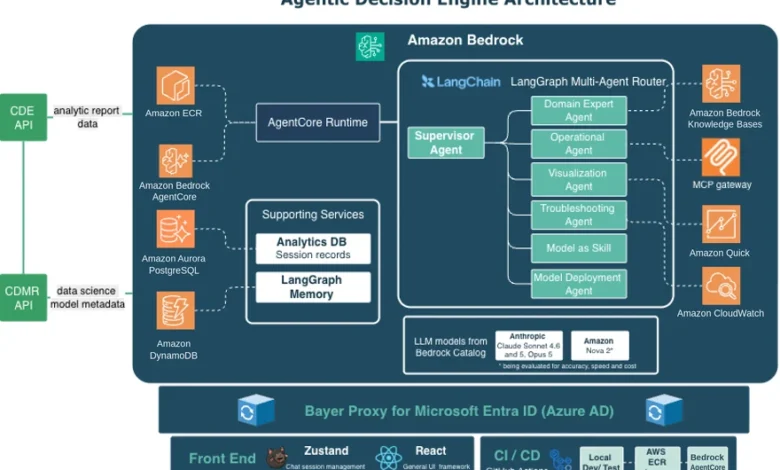
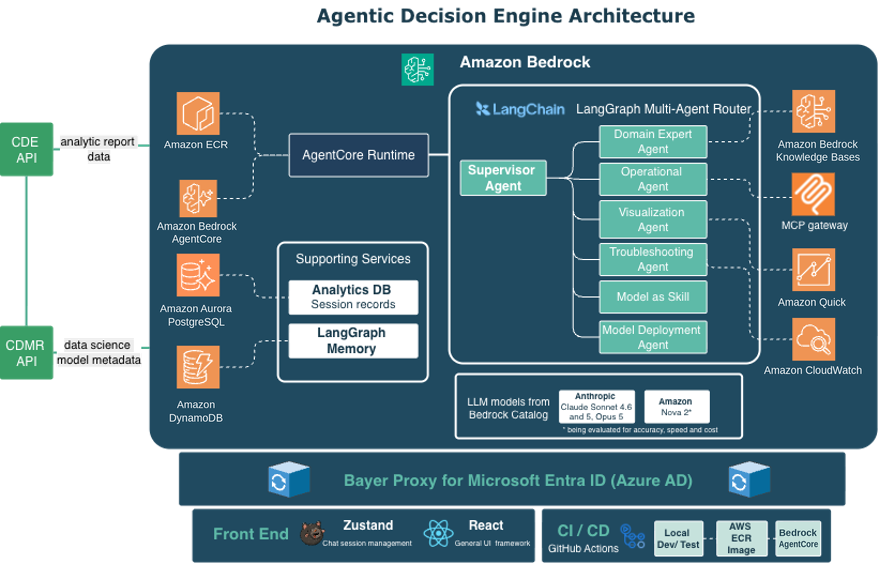
The ADE operates on a four-tier architecture that separates user experience from data processing. At the front end, a React-based web portal acts as the gateway. Once a user submits a query, it is authenticated through Microsoft Entra ID before reaching the orchestration layer. The decision to utilize Amazon Bedrock AgentCore was strategic; rather than building a custom infrastructure for session isolation and tool management, the Bayer team leveraged the managed runtime provided by AWS.
This decision offered three critical advantages:
- Managed Runtime: The team gained session isolation by default, ensuring that individual user interactions remained private and contained.
- Gateway Security: By using AgentCore Gateway, the team moved authentication and authorization logic out of the agent code itself, adhering to the principle of least privilege.
- Framework Flexibility: Because AgentCore is framework-agnostic, the team was able to integrate LangGraph for its robust state management and checkpointing capabilities, which are essential for multi-step, complex agricultural workflows.
Strategic Design Decisions for Industrial Scale
The path to production for ADE was not a linear sprint but a series of calculated architectural choices, often made in collaboration with the AWS Unified Operations team. This engagement provided Bayer with a designated Technical Account Manager (TAM) and a generative AI Domain Specialist Engineer (DSE). This partnership was instrumental in navigating five critical design milestones.
First, the team externalized orchestration state to Amazon DynamoDB. By refusing to treat the runtime as inherently stateless, the team ensured that if a system restart or a scale-out event occurred, the agent could seamlessly resume a multi-step workflow without losing context.
Second, the team implemented a multi-layered identity strategy. By separating user identity (Entra ID) from service-to-service authorization (IAM) and downstream tool access (AgentCore Gateway), Bayer ensured that the "token contract" at every hop was secure. This granular approach prevents the common pitfall of propagating overly permissive tokens across a network.
Third, the team adopted a rigorous stance on model selection. During the development cycle, the team tested newer, high-reasoning model versions but found that their specific requirements for tool-calling and structured output were not yet optimized for the new models. Consequently, the team opted for stability over novelty, reinforcing the principle that in production environments, model choice must be treated as an interface contract rather than a simple upgrade.
Fourth, the team took control of the "tool surface." Instead of exposing all 500+ model configurations as tools to every agent, they implemented a scoped tool catalog. By using semantic tool search within the AgentCore Gateway, agents only "see" the tools relevant to their specific domain, thereby reducing token consumption and minimizing the model’s decision space.
Finally, the team recognized that as certain capabilities—such as data visualization—grew in complexity, they needed to be promoted from simple tools to autonomous agents. Today, the Visualization Agent is a fully realized entity that can decide whether to generate a new chart using Matplotlib or retrieve a pre-existing dashboard from Power BI, depending on the user’s needs.
Observability and the "Transport vs. Task" Success Metric
A significant challenge in the development of ADE was defining what constituted a "successful" interaction. In a traditional system, an HTTP 200 OK status indicates success. In an agentic system, an HTTP 200 merely indicates that the request was processed, not that the agent provided a correct or useful answer.
To address this, the engineering team implemented a more nuanced observability framework. By adding custom metrics in CloudWatch to monitor for "task failures"—such as tool call errors, model timeouts, or logical inconsistencies in the final response—the team was able to gain visibility into the health of the agentic chain. This shift in perspective allowed the team to distinguish between transport success and task success, a critical distinction for any enterprise-grade AI system.
Furthermore, cost attribution was handled with extreme precision. Because a single user request might involve multiple calls to various models and tools, the team utilized application inference profiles and request-level telemetry to map spending to specific agents. This data revealed, for instance, that the Visualization and Operational agents were the highest consumers of tokens, allowing the team to optimize prompt caching strategies. By caching stable prompt prefixes, they achieved a 20 to 30 percent reduction in input-token costs.
Security, Launch, and Future Interoperability
Security remains the bedrock of the ADE deployment. Each of the 22 specialist agents operates under strict IAM roles, ensuring that, for example, the Troubleshooting Agent has read-only access to operational logs and cannot modify the underlying CDE configurations. The team also underwent a comprehensive "Well-Architected" review using the AWS Generative AI Lens, which identified and closed gaps in image traceability and vulnerability scanning before the platform was fully deployed to the user base.
Since its launch to a gated group, ADE has been adopted by over 100 users, including breeders, data scientists, and researchers. The impact has been tangible: a diagnostic task that previously required an hour of manual investigation now takes less than 10 minutes.
Looking forward, Bayer is not resting on its successes. The team is currently exploring hybrid cloud agent interoperability. As the number of agents grows, the challenge will be to enable these systems to discover and communicate with one another across disparate environments without the need for manual configuration.
Broader Implications for Enterprise AI
The case of Bayer Crop Science serves as a roadmap for large-scale enterprises looking to transition from experimental generative AI to operational, agentic systems. The success of the ADE project highlights that the real heavy lifting of AI integration happens in the "boring" parts of the stack: identity management, state persistence, cost attribution, and observability.
By avoiding the temptation to rely solely on the "intelligence" of the models and instead investing in a robust, governed, and highly observable agentic framework, Bayer has created a sustainable platform that empowers its researchers. As AI continues to integrate into industrial workflows, the Bayer model—characterized by tight collaboration between internal domain experts and cloud service providers—is likely to become the standard for how high-stakes, data-intensive industries harness the power of autonomous agents. The project concludes with a clear lesson: AI does not need to replace the underlying analytics platform; it simply needs to make the platform speak the language of the human user.