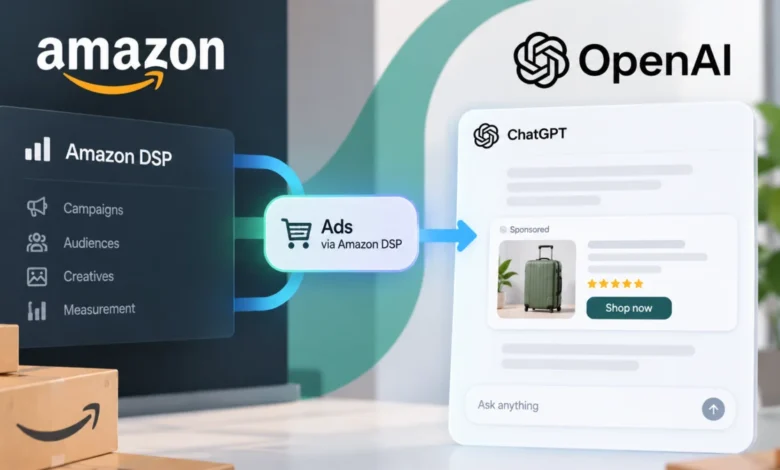
Amazon has officially partnered with OpenAI to allow advertisers utilizing the Amazon Demand-Side Platform (DSP) to seamlessly extend their marketing campaigns into ChatGPT. This strategic collaboration marks a significant milestone in the evolution of conversational artificial intelligence advertising, providing brands with a streamlined gateway to tap into the rapidly expanding ad inventory of one of the world’s most prominent AI platforms.
The initiative bridges the gap between traditional programmatic retail media and emerging conversational interfaces. Under the terms of the pilot program, ChatGPT Ads inventory will be accessible directly through the Amazon DSP as a managed service. Amazon will actively assist participating brands in establishing, configuring, and optimizing their campaigns to ensure high efficacy within the AI chatbot environment.
At the time of launch, the integration is restricted exclusively to the United States market. Among the select group of early U.S. advertisers participating in the pilot is Delta Vacations, signaling early confidence from major travel and service brands in the potential of conversational commerce and AI-driven ad placements.
Mechanics of the Amazon-OpenAI Ad Integration
The technical and operational framework of the partnership introduces a distinct division of labor between the two tech giants. While Amazon functions as the commercial gateway, managing the buying relationship and campaign optimization, OpenAI maintains strict authority over the final delivery and placement of ads within ChatGPT.
Advertisers can purchase ChatGPT inventory utilizing flexible pricing models, specifically cost-per-click (CPC) and cost-per-mille (CPM) bases. Furthermore, Amazon is introducing sophisticated product feed ads that automatically generate dynamic ad assets by pulling information directly from an advertiser’s existing product catalog.
When users interact with ChatGPT, these advertisements will appear as clearly designated text and image units positioned neatly beneath organic responses. In adherence to advertising transparency standards, every unit will carry explicit sponsored labels, ensuring users can easily distinguish between organic AI output and paid promotional content.
Despite purchasing through Amazon’s interface, advertisers will not dictate the precise contextual placement of their ads within a specific chat thread. OpenAI’s proprietary systems retain absolute control over how and where ads are served, ensuring that the conversational user experience remains uninterrupted and contextually relevant.

Measurement, Data Insights, and Audience Targeting
For brands navigating this new frontier, comprehensive measurement is critical. Advertisers testing the initial integration will be furnished with aggregated performance data. Key reporting metrics include total impressions, click volume, cost per result, CPM, and CPC.
Beyond standard campaign metrics, the partnership opens up intriguing possibilities regarding data utilization. Amazon’s vast repository of consumer shopping data and streaming media metrics could potentially merge with ChatGPT’s conversational context. Advertisers eager to pair deep behavioral purchasing insights with intent-driven AI prompts may find this dual-layered data approach exceptionally valuable.
This capability is expected to broaden the appeal of ChatGPT Ads to nonendemic advertisers—companies that do not necessarily sell physical goods on Amazon’s marketplace, but nonetheless rely on Amazon DSP to locate, target, and convert audiences across the digital ecosystem.
Strategic Implications and Industry Context
The collaboration addresses mutual strategic objectives for both Amazon and OpenAI. For OpenAI, partnering with Amazon provides immediate access to a massive, established base of sophisticated advertisers, accelerating the commercial scalability of ChatGPT Ads without requiring OpenAI to build an enterprise-grade demand-side sales infrastructure from scratch.
For Amazon, the partnership reinforces the dominance of Amazon DSP as an indispensable omnichannel tool. By granting its clients direct access to conversational AI inventory, Amazon positions itself at the forefront of the next major paradigm shift in digital marketing. As consumers increasingly turn to generative AI tools for research, product discovery, and decision-making, traditional search engines and social media platforms face mounting competition for user attention and advertising dollars.
Industry analysts note that conversational advertising represents a fundamentally different paradigm compared to traditional banner ads or sponsored search results. In a chat interface, context is paramount. Ads must align with the user’s immediate conversational intent to avoid feeling intrusive. By leveraging Amazon’s retail intent signals alongside OpenAI’s natural language understanding, the partnership aims to strike a delicate balance between commercial monetization and user experience.
Looking Ahead: What to Watch in the Pilot Phase
As the initial U.S. pilot unfolds, digital marketing professionals and media buyers are monitoring several critical indicators to gauge the long-term viability and success of the program:
- Geographic Expansion: Industry observers will be watching to see how quickly OpenAI and Amazon plan to roll out the DSP integration to international markets outside the United States.
- Advertiser Demand: The volume of adoption and the diversity of sectors participating in the pilot will test whether nonendemic brands find conversational AI to be a cost-effective performance channel.
- User Reception: Consumer reactions to sponsored text and image units within AI chats will heavily influence how aggressively OpenAI chooses to scale its advertising inventory in the future.
- Platform Independence: Future developments will determine whether OpenAI eventually opens similar DSP integrations with other retail media networks or ad-tech giants, or if its partnership with Amazon remains exclusive.
Ultimately, the Amazon-OpenAI alliance establishes a new benchmark for cross-platform cooperation in the age of generative AI. By separating the commercial transaction layer from the delivery mechanism, both companies have engineered a pragmatic approach to monetizing conversational interfaces while preserving the core integrity of the user experience.