The Best Tech Gadgets Under $50 Prove You Don’t Need to Break the Bank for Quality Innovation

In an era defined by skyrocketing hardware costs, persistent memory supply crunches, and premium pricing models across the consumer electronics landscape, outfitting a modern digital lifestyle can feel financially daunting. Flagship smartphones routinely push past the thousand-dollar threshold, high-end laptops command small fortunes, and even mandatory accessories like charging blocks and cables have seen incremental price hikes. Yet, beneath the tier of heavily marketed luxury flagships lies a robust and fiercely competitive market of budget-friendly hardware. Consumers willing to look beyond high-profile product launches can find a wealth of reliable, high-performance tech devices priced strictly under $50.
While certain product categories—such as primary computing machines, full-sized tablets, and current-generation home gaming consoles—necessitate a higher baseline investment to ensure baseline longevity and usability, the sub-$50 bracket has evolved far beyond cheap novelties. Today, this price tier hosts refined audio equipment, precise tracking ecosystems, versatile smart home automation tools, and essential power accessories that often rival their more expensive counterparts in everyday utility.
Audio Solutions That Defy Their Price Tags
Portable audio has historically presented a compromise between fidelity, durability, and cost. However, advances in digital signal processing and battery chemistry have allowed manufacturers to deliver exceptional sound reproduction at remarkably low price points.
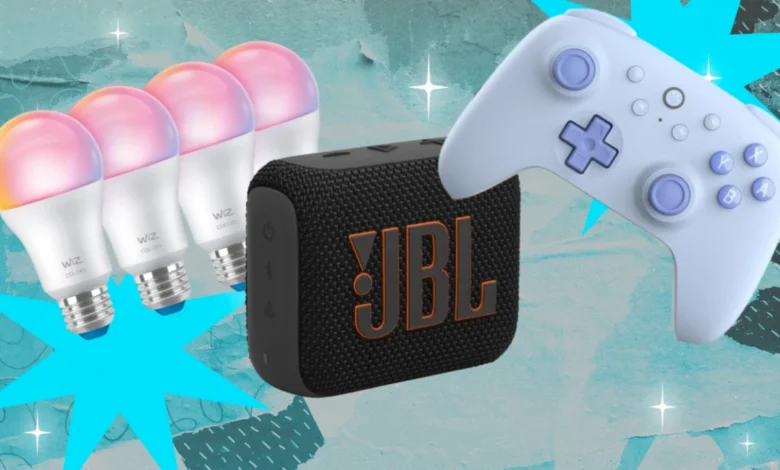
The JBL Go 4 exemplifies this shift in the ultra-portable speaker category. Designed for rugged, on-the-go deployment, the device delivers a surprisingly robust acoustic profile relative to its compact physical footprint. Equipped with an IP67 certification for dust and water resistance, the speaker is engineered to withstand environments that typically damage consumer electronics, such as sandy beaches or poolside areas. Furthermore, JBL’s proprietary multi-speaker pairing architecture allows users to synchronize multiple units using a single hardware control, facilitating impromptu multi-room or group audio setups. For consumers monitoring the market closely, iterative hardware releases like the Go series frequently see promotional discounts or markdown cycles that push newer iterations well beneath the fifty-dollar ceiling.
For buyers prioritizing longevity over maximum physical ruggedness, the Anker Soundcore 2 remains a cornerstone of budget audio engineering. While it foregoes the advanced dust-proofing of its JBL competitors, it compensates with an expansive battery architecture capable of delivering up to 24 hours of continuous playback on a single charge. Like its peers, it supports wireless pairing configurations, offering scalable sound output for small gatherings without demanding a premium financial commitment.
In the realm of personal listening, the shift toward wireless form factors has driven innovation down to budget tiers. The Anker Soundcore P31i earbuds challenge the industry assumption that active noise cancellation (ANC) and advanced firmware features are exclusive to high-end models. Delivering up to 10 hours of standalone playback—scaling to 50 hours with the inclusion of the charging case—the earbuds also incorporate fast-charging capabilities that yield three and a half hours of use from a brief 10-minute charge. Uniquely for this price point, the hardware includes live translation capabilities spanning roughly 100 languages, alongside an IP55 rating that shields the components from sweat and light precipitation.
Apple-centric consumers seeking seamless ecosystem integration have increasingly gravitated toward the Beats Flex wireless earphones. Although their standard retail price sits slightly above the fifty-dollar threshold, consistent market tracking demonstrates that these earbuds regularly trade at or below $49. By incorporating Apple’s proprietary W1 chip, the Beats Flex provide many of the frictionless pairing, automatic device switching, and audio-sharing capabilities found in high-end AirPods and premium Beats hardware, maintaining a twelve-hour battery life and an ergonomic cable-connected design.
For purists rejecting wireless latency and battery degradation entirely, wired solutions continue to offer distinct advantages. The Sennheiser CX 80U USB-C earbuds bypass digital-to-analog compression algorithms and battery constraints altogether, delivering uncompressed audio directly through modern smartphone and tablet ports. Similarly, Apple’s classic wired EarPods remain a resilient staple for consumers seeking straightforward plug-and-play functionality, integrated microphones, and reliable analog audio reproduction for under twenty dollars.
Location Tracking and Ecosystem Integration
The market for Bluetooth and ultra-wideband item trackers has expanded rapidly, transforming how consumers secure everyday valuables such as luggage, keys, and wallets. Apple’s AirTag established a dominant benchmark within the iOS ecosystem by leveraging the global Find My network, allowing users to passively locate lost items using ambient signals from passing Apple devices. Featuring user-replaceable batteries with a one-year lifespan and Precision Finding capabilities on supported hardware, the AirTag retails officially at $30, with multi-pack bundles reducing the per-unit cost even further.

For Android users and consumers operating outside the Apple ecosystem, the Life360 Tile tracker series offers a versatile alternative. Ranging from the standard Tile tracker and the heavy-duty Tile Pro to the ultra-thin Tile Slim designed specifically for card slots in physical wallets, these devices provide robust cross-platform location tracking. Operating independently of Apple’s network, the Tile ecosystem accommodates both free foundational tracking services and optional subscription tiers for advanced safety alerts, keeping the hardware purchase securely within budget constraints.
Home Entertainment and Smart Ecosystems
Upgrading legacy television hardware or expanding smart home automation no longer requires comprehensive system overhauls. Media streaming sticks have democratized 4K display technology, turning older displays into modern, app-centric entertainment hubs.
Amazon’s Fire TV Stick 4K Plus leads this category by delivering high-definition streaming support paired with advanced high dynamic range formats, including Dolby Vision, HDR10, HDR10+, and HLG. Beyond traditional media consumption apps, the device supports cloud gaming platforms such as Amazon Luna, Xbox Cloud Gaming, and NVIDIA GeForce NOW, alongside Wi-Fi 6 connectivity and smart home integration via Alexa. While stripped-down HD models offer even lower entry costs, the 4K Plus model maximizes functional longevity while strictly honoring budget limitations.
In the smart home arena, WiZ has emerged as a leading provider of accessible home automation. By offering individual smart light bulbs priced near the ten-dollar mark—with multi-pack configurations reducing the marginal cost per bulb—WiZ enables comprehensive lighting automation, color tuning, and scheduling without the high costs traditionally associated with proprietary ecosystem hubs.
For television viewers seeking to bypass traditional cable subscription fees entirely, modern over-the-air digital antennas represent a legally compliant, cost-effective alternative. Devices such as the Daant TV Antenna allow households within range of broadcast towers to receive uncompressed local high-definition network signals—including major networks like NBC, CBS, and Fox—completely free of recurring monthly fees after the initial hardware purchase.
Power Management and Gaming Accessories
As mobile hardware demands faster power delivery and higher battery capacities, efficient power accessories have become critical daily carry items. The Iniu 10,000mAh portable charger bridges the gap between compact form factor and high-output performance, supporting 45W fast-charging protocols capable of rapidly replenishing modern flagship smartphones. Furthermore, its inclusion of a detachable, braided USB-C cable addresses a common failure point found in cheaper power banks with fixed, integrated cords.
For stationary environments, multi-port wall chargers have streamlined desktop organization. The Anker 65W Max 3-Port USB-C charger block utilizes Gallium Nitride (GaN) semiconductor technology to deliver high-wattage output across two USB-C ports and one legacy USB-A port, enabling simultaneous charging for laptops, tablets, and mobile phones from a single compact wall socket. Wireless charging alternatives, such as the Anker 622 magnetic charging stand, provide desk-bound iPhone users with MagSafe-compatible alignment and structural elevation for hands-free media consumption during power replenishment.
Finally, the peripheral market has seen significant disruption from third-party manufacturers aiming to undercut the high pricing of first-party console controllers. The 8BitDo Ultimate 2C controller provides Nintendo Switch and PC gamers with a durable, responsive layout featuring modern hall-effect joysticks and additional programmable triggers. By bypassing the steep markups associated with official branded hardware, third-party innovators are ensuring that enthusiast-grade ergonomics remain accessible to budget-conscious consumers.
Market analysts note that as consumer electronics manufacturers continue to segment their product lines into ultra-luxury flagships and value-driven essentials, the quality ceiling for sub-$50 technology will likely continue to rise. Through rigorous manufacturing efficiencies and competitive pressures, budget hardware is increasingly shedding its historical reputation for obsolescence, offering consumers durable, high-performance alternatives that prove sophisticated technology does not inherently require a prohibitive financial investment.