The Thin Line Between Employee Development and Surveillance in the Age of AI Learning Platforms

The rapid evolution of corporate learning and development (L&D) ecosystems has fundamentally transformed how organizations track, measure, and analyze employee progress. Modern enterprise learning platforms capture an unprecedented volume of behavioral data, documenting not merely course completion rates, but precise engagement metrics including search queries, module drop-offs, exercise retry counts, and interactions with artificial intelligence tools. While these sophisticated insights allow learning leaders to design hyper-personalized development pathways and identify enterprise-wide skills gaps, they have simultaneously introduced profound ethical and operational complexities. Chief among these challenges is a critical systemic drift: the gradual transition of data originally gathered to foster professional growth into a permanent performance record utilized for administrative evaluation, talent mobility, and promotional decision-making.
Background Context and Technological Evolution
To understand the current friction between corporate data collection and employee privacy, one must examine the trajectory of workplace technology over the past decade. Traditional learning management systems (LMS) functioned primarily as compliance repositories, tracking mandatory training completions and annual certifications. These legacy architectures operated in functional silos, disconnected from core human resources information systems (HRIS), performance management tools, and internal talent marketplaces.
However, the integration of advanced analytics, machine learning algorithms, and generative AI tutors has dismantled these operational boundaries. Modern workplace infrastructure is designed for frictionless interoperability. Skills-inference engines embedded within digital learning suites now evaluate diagnostic assessments, parse practice modules, and automatically synchronize derived competency scores into broader talent profiles by default.
This technological convergence has accelerated rapidly between 2023 and 2026, driven by enterprise demand for agile workforce planning and continuous skills mapping. Industry analysts note that while talent marketplaces have successfully improved internal mobility by matching workers with short-term projects and stretch assignments, their reliance on continuous data feeds from learning environments has blurred the traditional boundary between formative assessment and summative judgment. Consequently, metrics that were once ephemeral indicators of a worker’s learning curve are increasingly weaponized as permanent markers of capability or deficiency.
The Mechanics of Data Drift and Algorithmic Inference
The core vulnerability in contemporary L&D architectures lies in the phenomenon of data drift—the process by which information collected in one specific context migrates to another without explicit employee consent or awareness.
Consider the operational lifecycle of a typical diagnostic assessment within an AI-enhanced learning platform. When an employee completes a practice module and requires three attempts to pass, or abandons a leadership development track halfway through, these behavioral signals are captured by the system. Within the isolated ecosystem of a learning platform, this data serves a constructive purpose: it triggers targeted remedial content, adjusts the difficulty of subsequent exercises, or prompts an AI tutor to offer scaffolding support.
However, when these transactional metrics flow automatically into a centralized talent marketplace, their meaning is fundamentally altered. A multi-attempt history on a practice module ceases to be viewed as a sign of persistence and thorough comprehension-seeking; instead, it is refactored by the system into an algorithmic inference that the employee lacks baseline competency. Similarly, an aborted course is frequently misinterpreted as a lack of ambition or professional commitment, ignoring pragmatic realities such as shifting project deadlines or immediate operational priorities.
This automated translation of behavior into permanent performance records carries significant professional implications. Workforce analytics experts emphasize that artificial intelligence systems excel at pattern recognition but struggle profoundly with nuance and human context. When algorithms evaluate trial-and-error behavior—such as exploratory course browsing or vulnerability displayed during interactions with AI tutors—they risk penalizing employees for engaging in the very behaviors essential to professional mastery.
The Five-Stage Governance Framework
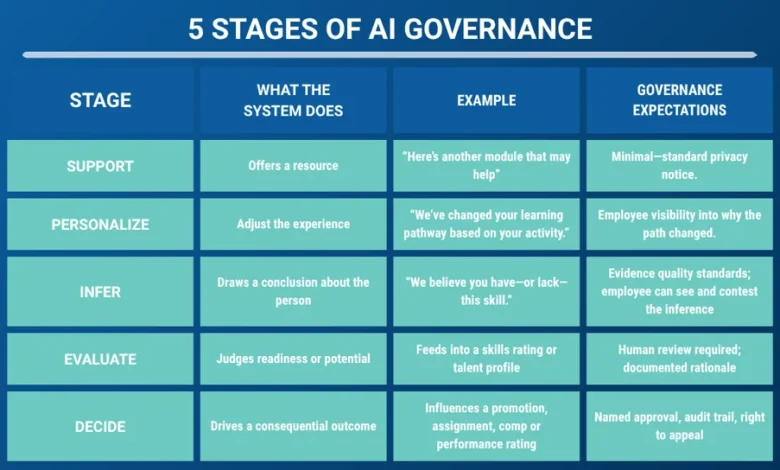
To address the risks associated with algorithmic overreach, enterprise learning leaders and governance boards are increasingly adopting structured classification models to regulate how learning data is processed and shared. Industry frameworks now categorize learning and HR technology use cases into five distinct operational stages, each requiring progressively stringent oversight:

- Support: Algorithmic tools recommend relevant courses, resources, or learning paths based on historical activity. This stage carries minimal administrative risk and requires basic data privacy compliance.
- Diagnose: Systems analyze assessment scores and interaction patterns to identify knowledge gaps or learning preferences.
- Recommend: AI platforms suggest internal career trajectories, mentorship pairings, or gig-economy projects based on inferred capabilities.
- Evaluate: Learning metrics and algorithmic inferences are formally integrated into performance reviews, talent planning discussions, or manager evaluations. This stage requires rigorous human oversight and verified data accuracy.
- Decide: System-generated scores and inferences directly influence high-stakes employment decisions, including compensation adjustments, promotions, targeted retention efforts, or workforce restructuring.
According to workplace compliance specialists, any automated process crossing the threshold into the "Evaluate" or "Decide" stages must incorporate mandatory human-in-the-loop validation. This requires a named human approver to review the underlying evidence and contextualize any system-generated scores before an employment action is finalized, preventing algorithmic black boxes from dictating organizational mobility.
The Vulnerability of Generative AI Interactions
The deployment of generative AI tutors and conversational learning assistants has intensified privacy concerns regarding employee data. Unlike traditional assessment modules, conversational AI invites unstructured, exploratory dialogue. Employees frequently use these tools to articulate professional insecurities, admit knowledge gaps, or express exploratory interest in career transitions outside their current department.
A typical interaction might involve an employee asking an AI tutor for clarification on a foundational management concept, accompanied by a candid admission of imposter syndrome or a desire to pivot into an entirely different functional role. While such interactions represent vital milestones in professional development, they create substantial governance dilemmas:
- Are these conversational transcripts accessible to corporate leadership or third-party platform vendors?
- Can natural language processing algorithms parse these chats to infer long-term career intentions or loyalty risks?
- Do these conversational inferences migrate automatically into HR profiles visible to direct supervisors?
Employment law and privacy advocates warn that if workers harbor anxieties that their exploratory questions or admissions of uncertainty will be logged, analyzed, and used in future performance reviews, the psychological safety of the learning environment will collapse. Employees will inevitably adapt by adopting defensive behaviors—asking sanitized, risk-free questions, avoiding challenging topics, or abandoning AI learning tools entirely. Paradoxically, highly sophisticated enterprise learning systems risk undermining the very intellectual honesty and vulnerability upon which effective skill acquisition depends.
Balancing Transparency, Mobility, and Data Minimization
Corporate governance experts emphasize that a complete structural separation between learning platforms and enterprise talent systems is neither practical nor desirable. Many employees actively advocate for their skill acquisitions and developmental milestones to be visible to management, ensuring they are considered for internal promotions, cross-functional projects, and strategic succession pipelines. Blanket data silos stifle internal mobility and disadvantage workers who quietly cultivate high-demand competencies outside their primary job descriptions.
Instead of absolute segregation, industry leaders advocate for employee-controlled data visibility, particularly at the "Evaluate" and "Decide" tiers. Modern vendor contracts must be scrutinized to ensure that data synchronization between learning systems and talent marketplaces is not enabled by default. Furthermore, organizations should implement granular data-element controls, empowering workers to selectively share verified achievements—such as formal certifications and completed qualifications—while ensuring that exploratory data, failed practice attempts, searches, and conversational transcripts remain ephemeral and distinct from permanent personnel files.
Strategic Implications and Organizational Accountability
As artificial intelligence deepens its integration into corporate infrastructure, the responsibilities of Chief Learning Officers and HR executives are expanding beyond content delivery into data stewardship and algorithmic ethics. Organizations must establish clear internal audits for any AI-enabled learning capability prior to enterprise-wide deployment.
Key evaluative metrics recommended by governance professionals include:
- Establishing precise inventories of what data is collected and the operational necessity for its retention.
- Maintaining a strict demarcation between raw behavioral data and algorithmic inferences.
- Defining clear boundaries regarding who accesses these inferences, their geographic and systemic travel pathways, and their retention lifespans.
- Providing transparent mechanisms for employees to review, challenge, and correct erroneous system-generated inferences.
Ultimately, enterprise leaders face a philosophical test regarding organizational trust. A reliable benchmark for ethical data governance is whether an organization would feel comfortable explaining its data collection and inference policies directly, plainly, and transparently to its workforce, unshielded by dense legal disclaimers. If that transparency induces organizational discomfort, it serves as a reliable indicator that the data practices require immediate recalibration.
As the workplace continues to digitize, the preservation of professional autonomy remains paramount. Modern technology provides organizations with the technical capability to capture nearly every facet of an employee’s professional journey. However, organizational leaders must recognize that optimal talent development requires deliberate spaces for imperfection. Preserving the freedom for workers to experiment, struggle, change direction, and acknowledge deficiencies without administrative penalty remains one of the most critical challenges facing contemporary enterprises.