ChartMogul and Crono Join Forces to Streamline B2B SaaS Outbound Sales and Revenue Operations

Modern software-as-a-service (SaaS) businesses operate in an increasingly unforgiving macroeconomic environment. In recent years, customer acquisition costs (CAC) have climbed significantly across the technology sector, driven by saturated digital advertising channels, heightened competition, and shifting buyer behaviors. Consequently, traditional inbound marketing strategies—while still foundational—are frequently insufficient on their own to sustain predictable pipeline growth, particularly for companies operating in crowded markets. This pressure has forced go-to-market leaders to reevaluate their growth playbooks, leading to a widespread industry resurgence in outbound sales. However, outbound sales in the mid-2020s bears little resemblance to the brute-force volume tactics of the past. Today’s outbound motion is increasingly sophisticated, shaped by artificial intelligence, deep data enrichment, hyper-personalization, and a renewed emphasis on craftsmanship over sheer volume.
Recognizing this operational shift, ChartMogul, a prominent subscription data and revenue management platform, has announced a strategic technology partnership and integration with Crono, an advanced outbound sales engagement platform. Announced by Sara Archer, Chief Revenue Officer at ChartMogul, the collaboration is designed to bridge the historical gap between top-of-funnel prospecting and downstream subscription revenue management. By connecting Crono’s outbound orchestration engine directly with the ChartMogul CRM, the two companies aim to eliminate data silos, streamline lead handoffs, and provide B2B sales teams with a unified view of the customer lifecycle from the very first touchpoint to long-term retention.
The Evolution of Outbound Sales in the SaaS Sector
To understand the strategic significance of the ChartMogul and Crono integration, one must examine the broader evolution of outbound sales methodology over the past decade. Historically, outbound sales—often synonymous with cold calling and mass email sequencing—suffered from a reputation of being intrusive and inefficient. In To Sell Is Human, author Daniel Pink argues that non-sales selling occupies a massive portion of everyday professional life, noting that professionals across all industries constantly attempt to move others, change minds, and secure attention. In the B2B tech sector, this reality manifests as a continuous need to initiate meaningful conversations with prospective buyers.
In the early days of the SaaS boom, low digital noise and inexpensive ad networks allowed companies to rely heavily on inbound channels. However, as the digital landscape became saturated, response rates to generic outreach plummeted. Organizations that attempted to scale outbound through sheer volume quickly ran into diminishing returns, damaged domain reputations, and frustrated prospects.
The turning point arrived with the mainstream adoption of artificial intelligence and advanced data enrichment tools. Modern outbound sales is no longer about sending ten thousand identical emails; it is about delivering precise, context-aware insights to the right buyer at the exact moment of need. As Archer notes in her analysis of contemporary sales strategy, effective outbound is fundamentally about starting a conversation through genuine value—whether via an insightful industry data point, a sharp perspective, or a genuinely helpful asset. Because modern AI allows small sales development representative (SDR) teams to research, target, and personalize at a scale previously reserved for enterprise-grade organizations, outbound has re-emerged as an essential, cost-effective component of the modern SaaS growth mix.
The Operational Challenge: Fragmented Go-to-Stack Infrastructure
Despite these technological advancements, B2B sales and marketing teams have long struggled with a persistent structural flaw: the disconnect between prospecting tools and revenue systems. Typically, an SDR team operates within a dedicated sales engagement platform—such as Crono—to build lead lists, execute multi-channel sequences, and monitor initial prospect engagement.
However, once a prospect demonstrates genuine interest and crosses the threshold from a cold lead to a qualified opportunity, a critical operational handoff must occur. Historically, this transition involved manual data entry, custom-coded webhooks, or clunky CSV exports to transfer contact and company records into a customer relationship management (CRM) system or subscription analytics platform. Too often, critical context was lost in transit. Sales reps had to toggle between disparate systems to understand a prospect’s history, while revenue leaders struggled to accurately attribute closed revenue back to the specific outbound campaigns that initiated the relationship. Furthermore, once the prospect converted into a paying customer, the initial outbound context was frequently orphaned, leaving customer success and finance teams blind to the exact origin of the account.
This operational friction not only wasted valuable selling time but also hindered accurate pipeline attribution and cohort analysis. Recognizing that modern SaaS teams could no longer afford these operational inefficiencies, ChartMogul opted to partner with an established outbound specialist rather than attempting to rebuild prospecting infrastructure internally.
How the ChartMogul and Crono Integration Works
The newly launched integration between ChartMogul and Crono is engineered specifically to eliminate these operational silos and automate the handoff between top-of-funnel prospecting and subscription revenue tracking.
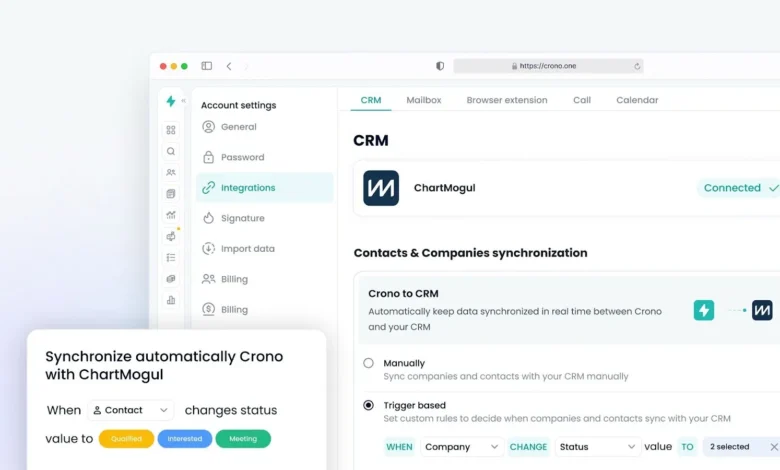
The workflow is designed around the natural progression of a B2B sales cycle. Sales development and account executive teams run their day-to-day outbound campaigns within Crono, leveraging its specialized environment for list building, sequencing, and multi-channel engagement tracking. When a prospect reaches a qualified status—such as when their engagement tag updates to "Interested"—the integration enables that specific company and contact record to be pushed directly into the ChartMogul CRM.
This synchronization can be executed flexibly according to team preferences. Organizations can configure the integration for manual, single-click synchronization for high-touch accounts, or establish fully automated, trigger-based sync rules that instantly populate the ChartMogul CRM the moment a qualification milestone is reached.
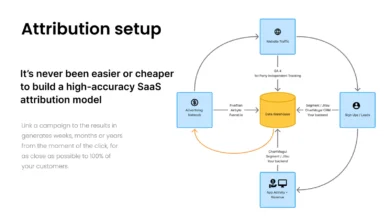
Once the record is successfully established within ChartMogul, the system automatically tags the account with Crono designated as the original source. This automated attribution ensures that go-to-market teams maintain end-to-end visibility over their pipeline, allowing revenue leaders to clearly trace which customer relationships originated through targeted outbound efforts rather than organic inbound or paid acquisition channels. By keeping prospecting and sequencing within an outbound-native engine while centralizing subscription data and relationship history within ChartMogul, organizations achieve a continuous, unified view of the customer lifecycle.
Market Implications and the Future of Revenue Operations
The partnership between ChartMogul and Crono reflects a broader architectural trend within B2B software: the shift away from monolithic, all-in-one platforms toward best-of-breed ecosystems connected by seamless, purpose-built integrations. For years, enterprise software buyers faced a false dichotomy between rigid all-in-one suites that compromised on feature depth and fragmented toolsets that created isolated data silos.
By integrating Crono’s outbound execution capabilities with ChartMogul’s robust subscription analytics and CRM infrastructure, the two companies are demonstrating how specialized platforms can interoperate to deliver superior business outcomes. For ChartMogul, which has long established itself as the gold standard for subscription data management, the integration expands its utility closer to the top of the funnel, enabling subscription businesses to measure the full economic impact of their outbound sales investments from day one. For Crono, the partnership provides its users with an immediate bridge to downstream revenue context, ensuring that successful outbound campaigns translate directly into measurable subscription growth.
Looking ahead, both organizations have indicated that the current release represents only the initial phase of their collaborative roadmap. While the launch version focuses squarely on core company and contact synchronization, future iterations are expected to incorporate deeper activity logging, granular engagement tracking, and advanced opportunity synchronization tailored to the evolving needs of high-growth SaaS revenue teams.
The integration is available immediately to joint users within the ChartMogul platform. As software companies continue to refine their go-to-market motions in an increasingly competitive landscape, tools that bridge the gap between initial outbound conversation and enduring subscription revenue are poised to become critical infrastructure for the modern tech sector.