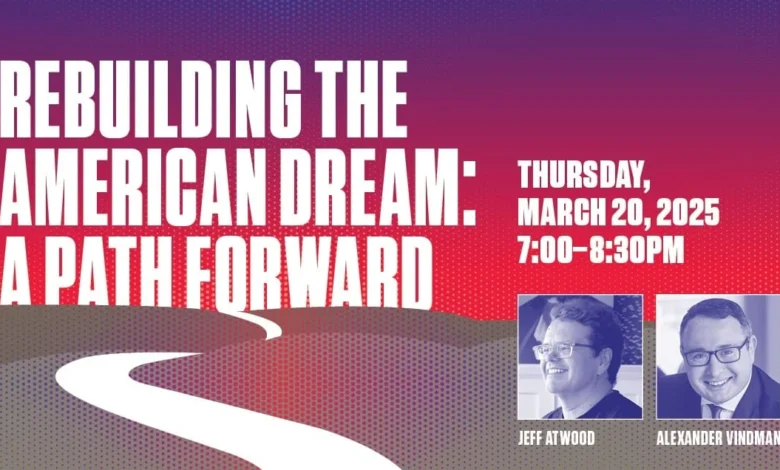
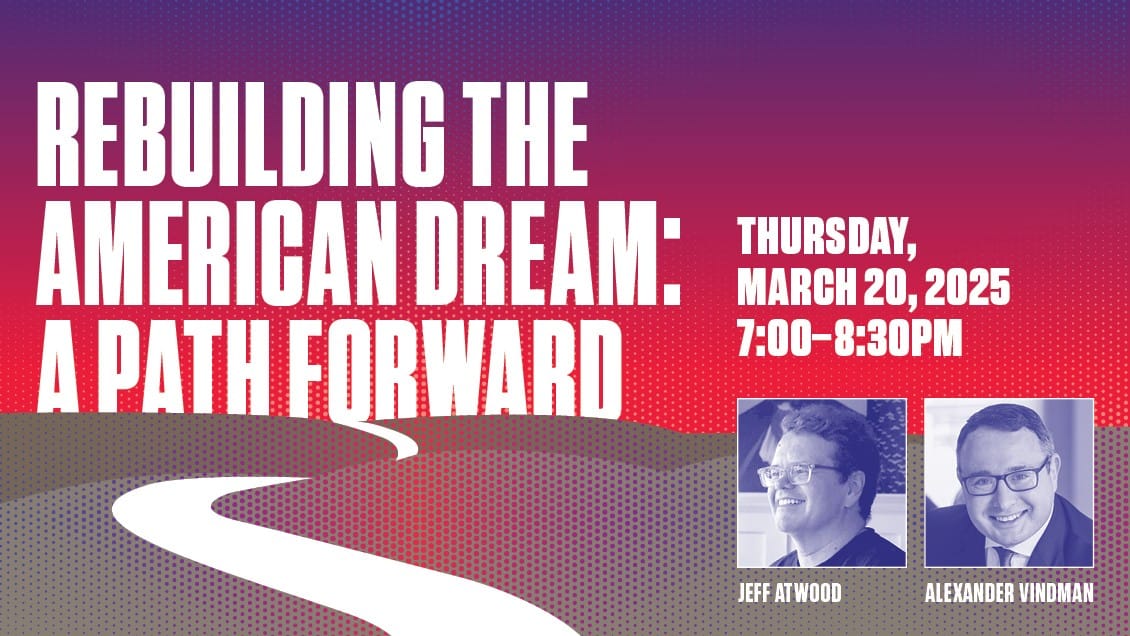
The historic Cooper Union Great Hall in New York City recently played host to an intersection of national security, civic leadership, and digital community-building. Jeff Atwood, renowned software developer and co-founder of Stack Overflow and Discourse, joined retired Lieutenant Colonel Alexander Vindman for a high-profile public discussion aimed at dissecting the modern challenges facing the American Dream. The event, which drew significant attention from civic organizers, technologists, and political observers alike, focused on moving beyond individual acts of charity toward systemic reforms capable of fostering long-term economic mobility, security, and civic participation in the United States.
Background and Context of the Cooper Union Event
The Cooper Union Great Hall is no stranger to pivotal moments in American history. Having hosted legendary addresses by figures such as Abraham Lincoln, Frederick Douglass, and Susan B. Anthony, the venue was deliberately chosen to frame the conversation around foundational American ideals. In an era marked by deep political polarization, institutional distrust, and economic uncertainty, the dialogue sought to bridge the gap between traditional democratic stewardship and contemporary digital connectivity.
The partnership between Atwood and Vindman represents an unconventional pairing of backgrounds. Vindman, a retired U.S. Army lieutenant colonel and former Director for European Affairs on the National Security Council, gained international prominence following his testimony during the 2019 congressional impeachment hearings. Atwood, conversely, built his reputation in the tech sector, designing decentralized platforms and community-governed software that dictate how millions of people interact, collaborate, and moderate content online.
Despite their disparate career paths, both speakers coalesced around a central thesis: that the American Dream requires active maintenance, structural integrity, and a willingness to confront institutional shortcomings.
Chronology and Evolution of the Dialogue
The path to the Cooper Union event began months prior, catalyzed by a series of essays written by Atwood on his long-running platform, Coding Horror, notably a piece titled Stay Gold America. In that writing, Atwood explored the concept of preserving foundational democratic values inspired by enduring cultural touchstones, while emphasizing that preservation demands proactive engagement rather than passive nostalgia.
Colonel Vindman, whose life trajectory embodies the immigrant narrative and high-stakes government service, resonated with these themes. Born in the Soviet Union, Vindman immigrated to the United States as a child, settled in Brooklyn, and ultimately dedicated more than two decades to military service. His decision to report concerns regarding executive branch foreign policy in 2019 ultimately derailed his military career, highlighting the personal cost of institutional integrity.
As preparations for the Cooper Union forum materialized, both participants recognized that their respective fields—national security and internet community architecture—share overlapping foundational challenges. Both systems rely on transparent rules, clear boundaries, verifiable accountability, and a shared commitment to the common good.
Supporting Data and Comparative Analysis on Democratic Engagement
To contextualize the discussion, policy analysts often point to declining metrics in social cohesion, civic participation, and institutional trust. According to data from various sociological research institutions, public trust in the federal government has hovered near historic lows over the past decade, with fewer than thirty percent of Americans expressing fundamental confidence in democratic institutions.
Simultaneously, the digital public square has transformed into the primary arena for political and social discourse. However, commercialized social media algorithms have frequently prioritized engagement metrics over constructive dialogue, leading to hyper-polarization. Atwood’s work with Discourse and Stack Overflow has long stood as an architectural counter-weight to this trend, demonstrating that self-governing digital spaces can foster high-quality, civil participation when equipped with proper moderation tools, reputation systems, and transparent community guidelines.
By juxtaposing Vindman’s defense of physical and constitutional borders with Atwood’s design of digital boundaries, the speakers provided a multi-layered analysis of modern governance. The dialogue underscored that whether managing a nation-state or a global software forum, the mechanics of maintaining a healthy community remain fundamentally analogous.
Statements and Analytical Implications
While the event did not feature formal policy announcements, the discourse generated considerable commentary among political scientists and technology ethicists regarding the future of civic infrastructure.
Observers noted that the conversation successfully pivoted away from generalized complaints about modern politics toward concrete structural questions. The core argument advanced during the panel emphasized the necessity of transitioning from episodic, individual philanthropy toward institutional frameworks that guarantee systemic opportunity. Proponents of this view argue that education reform, labor market protections, and digital literacy must be treated as foundational public utilities akin to local parks or public transit.
Furthermore, Vindman’s presence underscored the ongoing debate surrounding civil service protections and the role of non-partisan professionals within government agencies. His public commentary reinforced the principle that institutional resilience depends on individuals willing to uphold statutory norms under political pressure.
Broader Impact on Technology and Governance
The fusion of tech sector expertise with traditional geopolitical analysis points toward an emerging interdisciplinary approach to defending democratic norms. As misinformation, algorithmic manipulation, and institutional erosion continue to threaten democratic processes worldwide, civil society organizations are increasingly looking to decentralized models of governance pioneered in open-source software communities.
Atwood’s commentary at Cooper Union highlighted that digital platforms are no longer peripheral to society; they are the literal infrastructure upon which contemporary public opinion and community organization are built. Consequently, software architects and platform designers bear a civic responsibility comparable to that of traditional public administrators.
The event concluded with an open call for collaborative problem-solving, urging citizens to move past political cynicism and engage directly in the hard, unglamorous work of institutional reform. By streaming the event via the Cooper Union Great Hall’s digital channels, the organizers ensured that the conversation reached a global audience, cementing the historic venue’s legacy as a crucible for democratic thought.