Following a comprehensive analysis of the tech sector on a recent joint broadcast of 20VC and SaaStr featuring Harry Stebbings, Rory O’Driscoll, and industry leadership, several critical operational and financial trends have come to light. The discussions provided a deep dive into OpenAI’s valuation adjustments, Anthropic’s evolving quarterly growth trajectories, strategic market consolidations such as DoorDash’s acquisition of Instacart, and high-profile investment picks including Cognition, Baseten, and Serval. Distilling these market dynamics reveals ten fundamental decisions that business-to-business (B2B) and artificial intelligence (AI) founders must confront to maintain competitive margins, secure sustainable growth, and protect their enterprise value in an increasingly volatile landscape.
Model Mix Optimization and Inference Cost Management
The operational economics of running artificial intelligence applications have undergone a significant structural shift. During the development and scaling of SaaStr Connect, an AI-driven matching and recruiting application, management transitioned the system to Anthropic’s Haiku 5.5 alongside a diversified, lower-cost model mix. This single adjustment resulted in a 72% reduction in total operational costs for the exact same functional workflow, while simultaneously improving processing speed and output quality.
Since the beginning of 2025, despite continuous public announcements regarding falling token prices and benchmark improvements, many agentic workflows had not realized a proportional decrease in per-use operational expenses. This instance marked a tangible realization of these efficiency gains at the enterprise ledger level.
Founders face a distinct operational imperative regarding the frequency of model mix re-evaluations. Enterprises that established their foundational model architecture at launch and have not re-benchmarked their workflows are likely operating at a severe margin disadvantage. Competitors who regularly re-test production workflows against newly released, smaller-scale models can achieve vastly superior gross margins and underprice incumbent solutions. Production workflows should be re-benchmarked against real-world tasks immediately upon the release of new foundation models, as a 70% reduction in inference costs fundamentally alters gross margin profiles and justifies the engineering overhead required for migration.
Financial Transparency and the Evolution of Growth Metrics
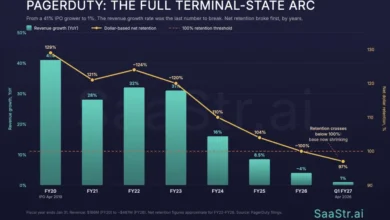
As technology enterprises scale past the hundred-million-dollar threshold, percentage-based growth rates naturally compress, even as absolute dollar additions reach historic highs. This phenomenon was recently illustrated in the financial reporting of enterprise AI leader Anthropic. Over the first three quarters of a recent fiscal year, the company’s GAAP revenue scaled from approximately $5 billion to $11 billion, and subsequently to $17 billion.
This financial progression generated contrasting market narratives. On one hand, quarter-over-quarter growth rates decelerated sharply, dropping from 100% down to 50% within a single quarter. Concurrently, the absolute dollar volume added each quarter remained remarkably consistent, keeping the firm on a trajectory for roughly a fivefold year-over-year expansion. Public markets frequently alternate between these analytical frameworks depending on broader macroeconomic sentiment.
To mitigate misinterpretations by boards of directors and institutional investors, leadership teams must adapt their reporting standards. Absolute net new Annual Recurring Revenue (ARR) should be presented prominently alongside traditional percentage growth metrics. When net new dollar generation remains stable or exhibits upward momentum, it serves as the primary indicator of business health. Proactively addressing decelerating percentage growth through absolute dollar contributions prevents external stakeholders from misinterpreting natural maturation as enterprise stagnation.
Navigating Pricing Pressure and Deflationary Token Economics
Market-wide deceleration in premium pricing tiers is increasingly driven by aggressive competitive discounting and rapid open-weight model proliferation. While primary market leaders maintain a relatively small fraction of total addressable spend within Fortune 500 enterprises—hovering near 0.1% for key players like Anthropic—aggressive discounting practices from competitors offering equivalent capabilities at a 30% reduction create severe downward pressure on market pricing.
When primary category leaders encounter structural ceilings on premium pricing models, downstream B2B and AI companies whose pricing structures are pegged as markups on underlying capabilities experience identical compression. Enterprises whose value proposition relies entirely on foundational model capabilities must anticipate a 30% to 40% deflation in pricing power over a twelve-month horizon. Consequently, pricing strategies must pivot away from raw token consumption toward measurable business outcomes and proprietary workflow ownership, as functional workflows do not suffer from the deflationary pressures inherent in foundational AI models.
The Autonomous Shift: Agentic Workflows vs. Traditional SaaS Interfaces
The software industry is witnessing a structural migration away from traditional graphical user interfaces (GUIs) toward programmatic, agent-driven architectures. Internal metrics at major digital operations indicate a growing obsolescence of software tools that lack programmatic integration capabilities. For example, operational environments utilizing dozens of automated agents driven via API-compatible platforms like Higgsfield and Opus have begun systematically phasing out software dependencies that require human-driven user interface navigation.
This operational shift is reflected in broader macroeconomic indicators, including reported growth slowdowns among prominent design platforms and workforce reductions across legacy digital service providers. The critical evaluation for any B2B software application is whether an autonomous agent can successfully execute core user functions without requiring human intervention through a traditional browser interface. Enterprises that fail to provide robust application programming interfaces (APIs) or Model Context Protocol (MCP) integrations risk obsolescence as autonomous agents systematically route workloads toward programmatic alternatives.
The True Cost-to-Serve for Persistent Consumer Agents
The economic realities of maintaining persistent, always-on consumer and enterprise agents have proven significantly more resource-intensive than initial industry assumptions suggested. While early-stage platforms such as Replit and Lovable have successfully utilized highly tuned virtual machine management to drive infrastructure costs down to approximately $4 to $5 per user per month, always-on agentic systems often exceed $20 per user monthly, with power-user consumption rates scaling exponentially higher.
These infrastructure realities have forced market participants to re-evaluate broad consumer subsidies, with industry leaders adjusting free-tier availability to manage compute expenditure. While technological advancement typically relies on the foundational bet that infrastructure costs will decline faster than capital depletion, enterprise operators must measure cost-to-serve metrics independently for their highest-tier users. Blended average metrics frequently obscure power users whose operational consumption exceeds their subscription value by a factor of five to ten.
Disintermediation Risks in Transactional Marketplaces
The proliferation of autonomous agents introduces severe structural threats to traditional transactional marketplaces and commission-based business models. While major marketplace operators have historically downplayed the immediate impact of automated agents on high-volume daily transactions, the underlying mechanics of agentic discovery threaten intermediary value propositions.
Autonomous agents possess the technical capability to bypass traditional digital marketplaces entirely, routing consumer demand directly to primary providers to eliminate platform take-rates and convenience fees. For instance, in food delivery and logistics, agents can identify direct-to-consumer merchant options that eliminate double-digit platform commissions, presenting consumers with vastly lower acquisition costs. Marketplace operators charging twenty percent or higher transaction fees must rigorously evaluate their value proposition against direct, agent-guided alternatives. Platforms that fail to articulate clear value beyond simple aggregation risk systematic disintermediation.
Expanding the Total Addressable Market vs. Taking Competitor Share
A central debate among venture capital investors involves distinguishing between vertical AI companies that expand the overall Total Addressable Market (TAM) and those merely capturing fractional share from entrenched legacy incumbents like Salesforce, ServiceNow, and Atlassian. Many specialized vertical AI startups function as efficient point solutions competing for minor slices of established enterprise spend within crowded competitive fields.
To evaluate whether an enterprise is genuinely expanding market potential or merely engaging in displacement, financial analysts utilize strict comparative metrics regarding Average Contract Value (ACV). If a mid-market enterprise allocates hundreds of thousands of dollars annually to an incumbent platform, an emerging AI alternative must command a significantly higher contract value—often twice the baseline or more—by resolving complex operational workflows that legacy systems can only track. Investments in B2B AI must be filtered through this comparative pricing discipline to ensure long-term defensibility against commoditization.
Acquisition Dynamics and Revenue Thresholds for Enterprise Exits
Founders navigating corporate development discussions frequently encounter a disconnect between initial inbound acquisition interest and finalized merger agreements. Large enterprise acquirers generally enforce strict internal revenue thresholds—frequently requiring target entities to approach $100 million in annual recurring revenue before deploying dedicated go-to-market and platform integration resources.
Below this operational threshold, major corporations typically engage in talent acquisitions or maintain passive observational postures, reserving premium platform integrations for entities possessing sufficient scale to visibly impact consolidated financial statements. While occasional exceptions occur at lower ARR tiers due to intense competitive pressures, founders should fundamentally plan for organic scale up to the $100 million revenue benchmark rather than relying on early-stage corporate development overtures.
Revenue Disclosure Standards and Market Signals
Transparency in financial reporting remains a critical determinant of market credibility within the technology sector. Recent capital raises characterized by public announcements of triple-digit percentage growth rates—such as Cohere’s reported 165% year-over-year ARR expansion—without concurrent disclosure of the underlying revenue base have drawn increased scrutiny from market analysts.
In a mature technological ecosystem where prominent infrastructure providers publish audited quarterly financials and transparent run-rates, growth percentages presented in isolation are frequently interpreted as indicators of an exceptionally small baseline revenue figure. To maintain institutional confidence during major capital liquidity events, enterprises must pair proportional growth metrics with absolute financial baselines, including verifiable ARR, gross revenue, or net new ARR additions.
Emerging Security Vulnerabilities in Agentic Infrastructures
The rapid deployment of automated tools and agent integrations has simultaneously expanded the threat surface for enterprise cybersecurity. Open-source penetration testing frameworks, initially engineered for defensive security validation and systems assessment, have increasingly been repurposed by sophisticated threat actors. Reports from major cybersecurity firms indicate that state-linked threat groups have leveraged automated LLM-driven testing suites to probe and compromise enterprise environments.
As organizations accelerate the adoption of Model Context Protocol endpoints and autonomous agent integrations, every newly deployed interface represents a potential vulnerability vector. Enterprises must subject agent-facing endpoints to rigorous, continuous penetration testing utilizing the identical open-source toolsets deployed by external adversaries, ensuring that internal security audits precede external exploitation attempts.