The Death of the Traditional B2B Hiring Ratio: How AI and Lean Growth Are Rewriting the Rules of Corporate Scale

For fifteen consecutive years, the blueprint for building a business-to-business (B2B) or Software-as-a-Service (SaaS) company relied on a single, unchallenged financial planning ratio. Conventional wisdom dictated that every $200,000 to $300,000 in new annual recurring revenue required the addition of precisely one full-time employee. This metric served as the foundational bedrock for executive leadership. Corporate boards routinely approved annual hiring plans against it, chief financial officers modeled long-term financial trajectories around it, and venture capitalists and founders raised millions—and sometimes billions—of dollars explicitly to fund this linear headcount expansion.
Today, that time-tested ratio continues to accurately describe the median older B2B and SaaS enterprise. However, it has ceased to represent the industry’s vanguard. By 2026, a select cohort of high-performing public B2B corporations, alongside AI-native pioneers like Anthropic and a handful of agile private operators, have decoupled revenue growth from headcount accumulation. These industry leaders are currently operating at five to thirty-five times the median revenue-per-employee baseline. Crucially, they are achieving this unprecedented efficiency while simultaneously growing their top-line revenue faster than the traditional market median.
This structural shift marks the dawn of a new operational era, forcing executive teams to fundamentally rethink their forecasting models, labor dynamics, and resource allocation ahead of the 2027 fiscal planning cycle.
The Baseline Divide: Traditional Metrics Versus Modern Outliers
To understand the magnitude of this transformation, one must first examine the established benchmarks that corporate boards have relied upon for over a decade. According to baseline data compiled by ICONIQ Capital, the typical, traditional B2B company generates approximately $237,000 in revenue per employee. Meanwhile, top-quartile growth companies reach an average of roughly $655,000 per employee.
While these figures once represented the upper limit of capital-efficient scaling, the modern enterprise landscape has completely shattered these parameters. A new class of market leaders is generating millions of dollars in revenue per worker, driven by aggressive automation, internal artificial intelligence adoption, and a disciplined approach to organizational bloat.
A rigorous analysis of recent financial filings, S-1 prospectuses, and quarterly earnings reports highlights the sheer scale of this divergence. While variations exist in reporting methodologies—such as annualized quarterly figures divided by the most recently disclosed headcount—the resulting productivity gap is far too immense to be written off as a statistical artifact.
Extreme Scale and Exceptional Efficiency: Case Studies in Modern Enterprise
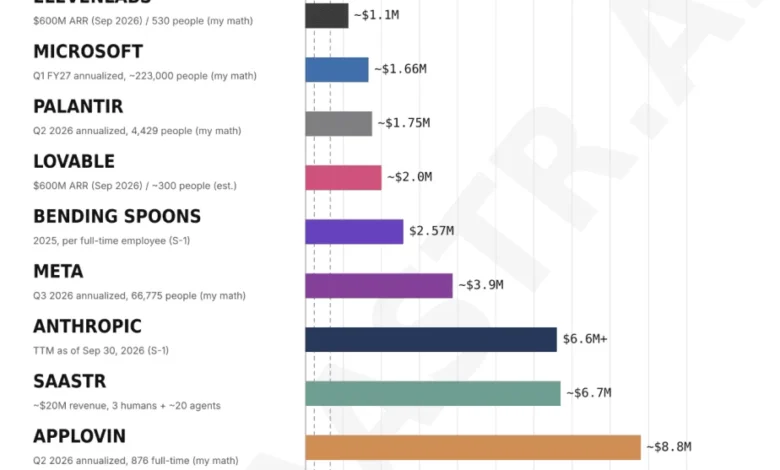
Among software enterprises, AppLovin has emerged as one of the most striking examples of this new operating model. During the second quarter of 2026, the company reported a staggering $1.92 billion in revenue—representing a 53 percent year-over-year increase—paired with an 84 percent adjusted EBITDA margin. These financial results were achieved with a remarkably lean workforce. At the close of the 2025 fiscal year, AppLovin maintained just 876 full-time employees, alongside a nominal group of 22 part-time workers and interns.
On an annualized basis, this translates to approximately $8.8 million in revenue generated per full-time employee. The company’s lean structure is partially the result of strategic repositioning; after divesting its consumer applications business in 2025, AppLovin concentrated entirely on its proprietary advertising platform. The remaining enterprise functions almost entirely as a high-margin software engine powered by a team of fewer than 900 individuals.
Artificial intelligence research powerhouse Anthropic has demonstrated a similarly dramatic trajectory. According to the company’s S-1 filing, Anthropic’s trailing twelve-month (TTM) revenue per employee exceeded $6.6 million as of September 30, 2026, marking a dramatic leap from the $1.4 million recorded just one year prior. Total revenue for the first half of 2026 surged to $16.3 billion, up from $1.2 billion during the corresponding period in 2025.
Notably, this financial expansion occurred alongside significant hiring. Anthropic’s internal workforce research indicates that its total headcount tripled over a twelve-month span. Yet, this growth was strategically concentrated. Technical roles shifted from 61 percent to 56 percent of the overall headcount, while customer-facing divisions, finance, and recruitment scaled at an accelerated pace. Crucially, administrative and clerical headcount remained virtually flat while the broader organization tripled in size, allowing the company to achieve a revenue-per-employee metric two to four times higher than what technology giants like Google and Meta achieved at comparable stages of their corporate lifecycles, adjusted for inflation.
Similarly, Palantir Technologies continues to redefine efficiency at scale. Palantir reported third-quarter 2026 revenue of $2.31 billion, a 96 percent year-over-year increase, accompanied by a 62 percent adjusted operating margin. Full-year financial guidance was subsequently raised to a range of $8.53 billion to $8.534 billion. Propelled by surging demand, U.S. commercial revenue reached $984 million—a 148 percent jump—surpassing its U.S. government sector revenue for the first time in the company’s history.
Based on its 4,634 full-time employees as of September 30, 2026, Palantir’s third-quarter performance annualizes to approximately $2.0 million per employee. Significantly, this milestone was achieved with virtually flat workforce growth; headcount increased by a mere 205 positions compared to the end of fiscal year 2025, even as quarterly revenue nearly doubled. By comparison, during the third quarter of 2025, Palantir’s annualized revenue per employee stood at approximately $1.07 million across a workforce of 4,414 people.

Established Cloud Leaders Prove Lean Operations Are Not Just for AI Startups
Skeptics might argue that extreme revenue-per-employee metrics are exclusive to generative AI pioneers or specialized tech conglomerates. However, recent developments among established, publicly traded B2B cloud infrastructure and software leaders demonstrate that disciplined headcount reductions can actively accelerate corporate growth.
Cloudflare entered 2026 with 5,156 full-time employees before announcing a strategic workforce reduction of approximately 20 percent in May. Rather than harming operational output, the restructuring coincided with accelerated top-line expansion. Year-over-year revenue growth climbed from 34 percent to 36 percent in the subsequent quarter, and further accelerated to 39 percent in the following period. Consequently, Cloudflare’s revenue per employee surged by roughly 40 percent, moving from approximately $496,000 to $690,000.
Internal disclosures indicate that this efficiency was supercharged by a more than 600 percent increase in internal artificial intelligence tool utilization over a three-month window. The majority of the workforce reductions targeted general and administrative (G&A) functions. By the time Cloudflare reported its third-quarter results in November, revenue held steady at a 39 percent growth rate on $782.5 million in quarterly sales, while total headcount closed at approximately 4,700. Notably, G&A expenses dropped by 14 percent year-over-year, while investments in sales and marketing increased by 2 percent.
A parallel transformation unfolded at Atlassian. In March, the collaboration software giant reduced its workforce by approximately 1,600 employees, with over 900 of those reductions occurring within research and development (R&D). Five months later, Atlassian reported that its cloud revenue had grown by 31 percent year-over-year to $1.213 billion—substantially outperforming the 23 percent growth guidance management had issued in February. Concurrently, the company’s net revenue retention rate remained robust, holding steady above 120 percent.
Meanwhile, European software investor and operator Bending Spoons has deployed an aggressive variation of the lean operational playbook. The company acquires established digital products, streamlines the underlying organizational structure, and operates them with deeply minimized teams. Bending Spoons reduced the workforce of file-transfer service WeTransfer by 75 percent following its acquisition.
This rigorous approach has driven dramatic financial gains: Bending Spoons’ revenue per full-time employee climbed from $1.12 million in 2023 to $1.64 million in 2024, and reached $2.57 million by the close of 2025. During the first quarter of 2026, the company posted an adjusted operating margin of 51.2 percent, up from 37 percent the previous year. This efficiency is underpinned by heavy automation; over 90 percent of the company’s code pull requests are written or co-written by artificial intelligence. While this model yields exceptional margins, it does come with trade-offs: Bending Spoons maintains a net revenue retention rate of 95 percent—notably lower than the 120-plus percent seen at Cloudflare and Atlassian—making it a strategy best suited for mature products with stable, predictable demand rather than nascent ventures requiring continuous market creation.
Micro-Teams and Autonomous Agents: The Extreme Frontier
At the outermost edge of this trend, micro-organizations are generating enterprise-grade revenue streams through the heavy deployment of autonomous AI agents. Media and events platform SaaSStre provides a striking case study of this emerging paradigm. The organization is on track to generate approximately $20 million in revenue with a core team of just three human employees, supported by a fleet of roughly 20 autonomous AI agents operating in production. This structural model yields an astonishing $6.7 million in revenue per human worker.
Within this architecture, a subset of six specialized agents handles the vast majority of day-to-day operational workflows. Autonomous AI sales development representatives (SDRs) manage approximately 90 percent of outbound prospecting. Meanwhile, an automated quote-to-cash agent has operated independently since its fourth transaction, registering only a single invoicing error to date. Across the enterprise, agents manage initial prospect outreach, continuous follow-up cycles, client renewals, automated invoicing, collections processing, and commission calculations.
Human intervention is strictly reserved for non-standard customer replies, complex pricing negotiations, high-touch relationship management, and overarching system auditing. Executive leadership notes that a typical thirteen-hour workday is now spent entirely reviewing, refining, and troubleshooting the output of autonomous agents rather than executing manual administrative tasks.
Strategic Implications for the 2027 Planning Cycle
The empirical data gathered across public markets, private tech giants, and micro-enterprises points to a permanent structural bifurcation in the B2B sector. The median enterprise will likely continue to adhere to the traditional planning ratio, hiring one person for every $237,000 in new revenue. However, market leaders are charting an entirely different course, adding a single employee only for every $1.75 million to $9 million of incremental revenue.
An analysis of where corporate restructurings have successfully yielded productivity gains highlights three primary functional areas:
- General and Administrative (G&A): Automated accounting, compliance monitoring, and streamlined internal tooling have drastically reduced the need for clerical and administrative headcount scaling.
- Research and Development (R&D): AI-assisted coding and automated testing suites have allowed engineering organizations to ship products faster with significantly smaller core developer teams.
- Sales and Marketing (S&M): Autonomous SDRs and data-driven outbound pipelines have transformed customer acquisition, enabling smaller sales teams to manage vastly larger pipelines.
For CFOs, founders, and boards drafting their 2027 operational budgets, the mandate is clear. The old linear relationship between headcount and revenue growth is no longer a universal law of business. Enterprises that fail to integrate intelligent automation and maintain rigorous capital efficiency risk finding themselves fundamentally uncompetitive against lean, AI-augmented rivals capable of generating millions of dollars in revenue per employee.