Debunking the Venture Capital Signaling Myth: How Seed Rounds Actually Impact Series A Success


The venture capital ecosystem has long been governed by an unwritten code of conduct laden with complex psychological theories, strategic maneuvering, and cautious prognostications regarding how early-stage funding choices affect future financing rounds. For decades, founders and investors alike have exchanged cautionary tales about the dangers of venture capital signaling. Conventional wisdom dictated that entrepreneurs should carefully avoid bringing institutional venture capital firms into their seed rounds out of fear that it would deter other investors from participating in subsequent Series A funding. The prevailing logic suggested that an insider venture firm held disproportionate information and influence, effectively creating an uphill battle for any outside firm attempting to compete for a piece of the company.
Conversely, venture capitalists were advised to steer clear of startups backed by rival firms, operating under the assumption that if a company possessed genuine potential, the original seed investor would inevitably preempt the next round. If the venture lacked promise, pursuing it would yield little reward while risking professional embarrassment. This intricate web of perceived signaling effects led to a broader hypothesis: if sophisticated founders understood these unwritten rules and intentionally excluded institutional investors from their seed caps tables, then venture firms participating in seed rounds must be fishing in an adversely selected pool of lower-quality enterprises. Consequently, accepting capital from a recognized venture firm during the seed stage was frequently interpreted by industry pundits as a subtle indicator of weakness. While these analytical frameworks provided endless fodder for debate and appeared logically sound on the surface, a comprehensive empirical investigation reveals that this modern-day court intrigue bears little resemblance to actual market behavior.
Unpacking the Research: Methodology and Data Collection
To determine whether the market genuinely reacts to these purported signals or simply focuses on fundamental business metrics, researchers at Matrix—specifically partner Jared Sleeper and his colleagues—undertook a rigorous data-driven study. The objective was to analyze the actual correlation between seed-stage funding histories and the successful execution of Series A rounds among high-quality startups.
Defining a reliable dataset required establishing strict parameters. The researchers focused on Series A transactions completed throughout the calendar year 2018, as recorded by Crunchbase, acknowledging that this methodology would inevitably overlook certain early-stage companies that successfully maintained a stealth operational posture. To isolate "higher quality" enterprises from the broader market noise, the study narrowed its scope to Series A investments led by the top 30 venture capital firms, defined arbitrarily by the researchers as the thirty most prominent firms relevant to their specific market vantage point. While acknowledging that alternative definitions and metrics could be applied, the analysts maintained that minor adjustments to these baseline criteria would not alter the fundamental conclusions of the study.

The resulting dataset encompassed roughly 70 companies that successfully secured Series A funding from top-tier institutions, offering a clear window into how institutional seed backing influences subsequent financing trajectories across different geographic regions, including the broader United States, the Bay Area, and the combined markets of Boston and New York.
Empirical Findings: What the Data Reveals About Market Behavior
When the empirical data was compiled and visualized, the results directly challenged the prevailing dogmas of venture capital signaling. The analysis demonstrated that the modern venture ecosystem largely disregards the complex network of signals and counter-signals that pundits frequently debate.
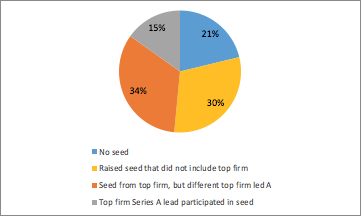
To evaluate whether venture capitalists systematically shy away from companies backed by rival institutions at the seed stage, the researchers analyzed the proportion of startups that raised their seed round from one prominent venture firm and subsequently secured their Series A lead from an entirely different top-tier institution. If the traditional signaling theory held true, this specific cohort—represented as the orange segment in the study’s comparative charts—should have been virtually nonexistent.
Instead, the data revealed that this cohort accounted for approximately one-fifth of all Series A rounds nationwide. Furthermore, in the fiercely competitive Bay Area ecosystem, these cross-firm investments represented a striking one-third of the total dataset, while accounting for 9 percent of transactions in the Boston and New York markets. Most notably, this cross-firm funding category proved larger than the segment representing companies that raised both their seed and Series A rounds from the exact same investor—referred to colloquially in the industry as "marrying your high-school sweetheart." High-quality companies that included a top-tier venture firm in their seed round proved more likely to have their Series A led by a different elite firm that did not participate in the seed stage, doubling that likelihood in the hyper-competitive Bay Area market.
Founder Behavior and the Rejection of Conventional Restrictions
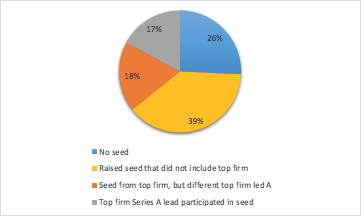
The empirical findings similarly shed light on how founders navigate early-stage fundraising advice. If entrepreneurs strictly adhered to the conventional wisdom advising them to exclude institutional venture firms from seed rounds to protect their Series A prospects, top-tier firms would rarely appear on the cap tables of successful early-stage companies.
However, the data indicates that founders are exercising independent judgment rather than bowing to rigid dogmas. Over one-third of the high-quality companies in the dataset—representing roughly half of all enterprises that raised a formal seed round—included a top-tier venture firm at the seed stage. In the Bay Area, this trend was even more pronounced, with approximately half of all high-quality companies, or 62 percent of those that raised a seed round, welcoming a prominent firm onto their cap table early on. When factoring in the growing proliferation of scout funds and closely affiliated micro-seed vehicles, the actual penetration of institutional capital in seed rounds is likely even higher.
Conversely, the data showed that early-stage fidelity is remarkably rare. Fewer than one in five startups successfully transition from their seed investor to a Series A lead with the same firm. The vast majority of entrepreneurs continue to survey the market, evaluate their options, and select Series A partners based on strategic alignment and valuation terms rather than sentimental loyalty to their earliest backers.
Industry Implications: Efficiency Over Palace Intrigue
The broader implications of this comprehensive market analysis point to an ecosystem that is substantially more rational and efficient than industry folklore suggests. While commentators and online pundits continue to dissect intricate signaling loops, active market participants operate within a high-velocity, highly competitive environment driven by fundamentals rather than psychological warfare.
Competent entrepreneurs actively seek out the most capable, value-adding partners at every stage of their company’s lifecycle. They demonstrate pragmatic flexibility, retaining early investors to lead subsequent rounds only when the ongoing relationship and proposed terms meet their standards, and transitioning to alternative leads when superior options emerge. At the same time, top-tier investors prioritize fundamental business evidence, market traction, and entrepreneurial capability over speculative signaling indicators when evaluating prospective investments.
Methodological Considerations and Future Outlook
While the study provides robust insights into the dynamics of institutional funding transitions, industry observers have noted certain methodological boundaries. Specifically, the analysis concentrated exclusively on companies that successfully achieved a Series A round led by a top-tier firm, omitting enterprises that failed to secure subsequent funding or consciously pursued alternative operational paths.
The researchers elected to narrow the scope to maintain analytical clarity, noting that separating negative signaling effects from underlying company performance or founder preferences for non-traditional funding routes within failed cohorts presents significant empirical challenges. Nevertheless, the prevailing evidence strongly indicates that Series A lead investors do not penalize companies for having institutional backing at the seed stage. As the venture capital asset class continues to mature and evolve, empirical studies of this nature serve as a vital reminder that data-driven market realities frequently dispel long-held industry myths.