The Missing Link in Go-To-Market AI: Why Autonomous Agents Can Automate the Funnel But Still Cannot Close Real Deals

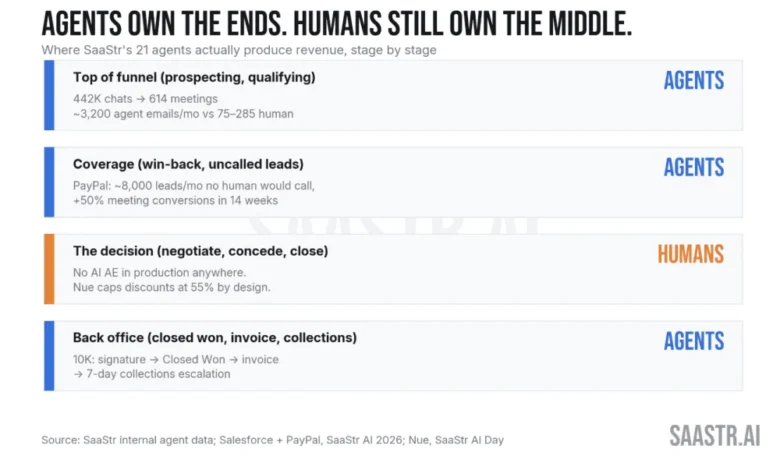
Artificial intelligence agents have rapidly transformed the architecture of modern enterprise revenue operations, yet a fundamental limitation persists in the hyper-automated go-to-market (GTM) landscape. While companies increasingly rely on swarms of autonomous agents to manage lead generation, customer support triage, and post-sale invoicing, the critical juncture of contract execution and deal-closing remains stubbornly anchored to human capital. This operational ceiling underscores a structural disconnect between top-of-funnel efficiency and the complex realities of enterprise negotiation.
At organizations like SaaStr, which operates twenty-one autonomous AI agents in production, artificial intelligence handles millions in revenue by booking meetings on weekends, resurrecting dormant leads, and automating billing processes. This proliferation of machine-driven workflows has compressed human team requirements significantly, allowing smaller teams to output the volume previously managed by much larger departments. Yet, industry data and operational metrics reveal that these systems fundamentally excel at deterministic, process-driven tasks while failing to navigate the non-linear, high-stakes environment of closing real commercial transactions.
The Anatomy of AI-Driven Revenue Operations
The current generation of commercial AI infrastructure has effectively conquered the operational mechanics of the early and late stages of the sales funnel. Inbound qualification agents, utilizing platforms such as Qualified and Salesforce Agentforce, now process hundreds of thousands of interaction chats and convert them into scheduled discovery meetings at scale. These systems remove the friction of human response latency, operating continuously without fatigue.
Win-back campaigns deployed via autonomous messaging layers have demonstrated remarkable engagement metrics, routinely achieving high open rates and response rates from prospective buyers who had previously ghosted sales representatives months prior. These agents excel at the rigorous discipline of persistent follow-up—a task historically undermined by human burnout and resource constraints. Furthermore, administrative and post-sale agents manage the conclusion of transactions seamlessly. Upon contract signature via platforms like PandaDoc, advanced AI administrative stacks automatically update customer relationship management systems, generate and transmit billing invoices through automated payment gateways like Bill.com, and execute collections reminders with structured escalation timelines.
However, industry executives emphasize that these capabilities represent operational efficiency rather than autonomous closing authority. The agents successfully open opportunities and process administrative settlements, but the pivotal decision-making moment—where a buyer commits capital—continues to require human intervention.
The Structural Divide: Qualification Versus Closing
To understand why autonomous agents cannot yet function as independent Account Executives (AEs), industry analysts point to the fundamental divergence between deterministic workflows and judgment-based negotiations. Qualification, follow-up scheduling, and quote-to-cash workflows are largely classification, scheduling, and data-routing problems. Autonomous software architectures are exceptionally well-suited to solve these computational challenges.
Conversely, closing a commercial agreement is fundamentally a problem of judgment under ambiguity, requiring authorized decision-making and psychological nuance. Four core elements separate these functions:
First, enterprise sales often involve multi-stakeholder dynamics where competing internal factions within a buying organization hold divergent priorities. An AI agent can parse text inputs from individual users, but it cannot read the unspoken political dynamics of a corporate board room or balance competing executive demands in real-time.
Second, negotiations frequently require creative concessions—structuring novel pricing tiers, custom service-level agreements, or non-standard legal indemnifications. These require strategic risk assessment rather than rule-based execution.

Third, competitive bake-offs often hinge on qualitative trust built through interpersonal rapport, executive sponsorship, and cultural alignment. Buyers committing substantial corporate budgets frequently seek reassurance from human peers who bear institutional accountability for the software selection.
Finally, procurement and security reviews introduce complex compliance hurdles that demand nuanced legal and technical interpretation, well beyond the deterministic output of current large language models.
Industry Metrics and GTM Team Compression
Recent data from venture capital firms Emergence and ICONIQ Capital illustrate how the deployment of AI agents has compressed sales organization structures unevenly across different roles. According to Emergence’s survey of over 560 B2B companies, 36 percent of organizations reported a decrease in Sales Development Representative (SDR) and Business Development Representative (BDR) headcount—the highest reduction rate across any sales function. In stark contrast, only 14 percent of companies reduced their reliance on sales engineers, while 28 percent actually increased their count of Account Executives.
ICONIQ Capital’s Go-to-Market survey echoes these findings, demonstrating that AI-forward companies operating between $10 million and $25 million in Annual Recurring Revenue (ARR) maintain significantly leaner GTM teams compared to their low-adoption peers, while simultaneously achieving higher quota attainment rates. However, as companies scale into higher revenue bands, this staffing gap narrows noticeably, proving that complex organizations continue to rely on human closers as deal sizes expand.
Furthermore, function-level adoption data indicates that while AEs are heavy daily users of AI tools—leveraging them for meeting preparation, account research, drafting communications, and pipeline management—they are utilizing the technology to augment their productivity rather than surrendering their core closing responsibilities.
The Rise of the Technical Account Executive
Rather than eliminating the Account Executive role entirely, the maturation of AI tools is fundamentally redefining the profile of the successful enterprise closer. Industry observers note a growing preference for forward-deployed, technical AEs who possess the engineering capability to directly deploy software solutions for customers during the sales cycle.
In this emerging model, traditional software demonstrations are replaced by immediate technical proofs of concept. AI-native companies are increasingly tilting their staffing ratios toward specialized technical talent, utilizing sales engineers to run primary customer relationships while relying on automated stacks to handle administrative burdens. The modern closer is thus evolving into a hybrid operator backed by an autonomous agent layer, rather than being entirely replaced by software.
Near-Term Horizons and the Future of AI Closing
While a fully autonomous, general-purpose AI Account Executive remains unrealized, industry leaders project that the first transactional iterations will likely emerge within standardized mid-market sectors characterized by fixed price books, transparent product catalogs, and short sales cycles. In environments where transactions can be completed entirely through asynchronous digital channels—such as standard software-as-a-service subscriptions governed by click-through terms—agents are poised to assume end-to-end closing responsibilities within the next 24 months.
Concurrently, developments in agent-to-agent commerce suggest an alternative pathway to autonomous transactions. As corporate systems increasingly interact via standardized API protocols and automated payment rails, software agents may soon execute purchases directly from other software agents, bypassing traditional human sales processes entirely for machine-consumed services.
Until these capabilities mature across complex enterprise segments, market leaders advise founders and revenue executives to construct their organizations around current operational realities: autonomous agents should dominate top-of-funnel prospecting and back-office administration, human professionals must retain ownership of strategic decision moments, and technical closing teams should be fortified with the most advanced productivity stacks available.
Related posts: