Users are achieving product value with unprecedented speed, a phenomenon largely attributed to the integration of artificial intelligence. The once-arduous journey of setup and onboarding, which could stretch over days, is now frequently condensed into a single user session, sometimes even mere minutes. This seismic shift mirrors the impact of mobile technology on distribution, compressing the time between a user’s intent and their desired outcome, rendering established product activation playbooks increasingly obsolete.
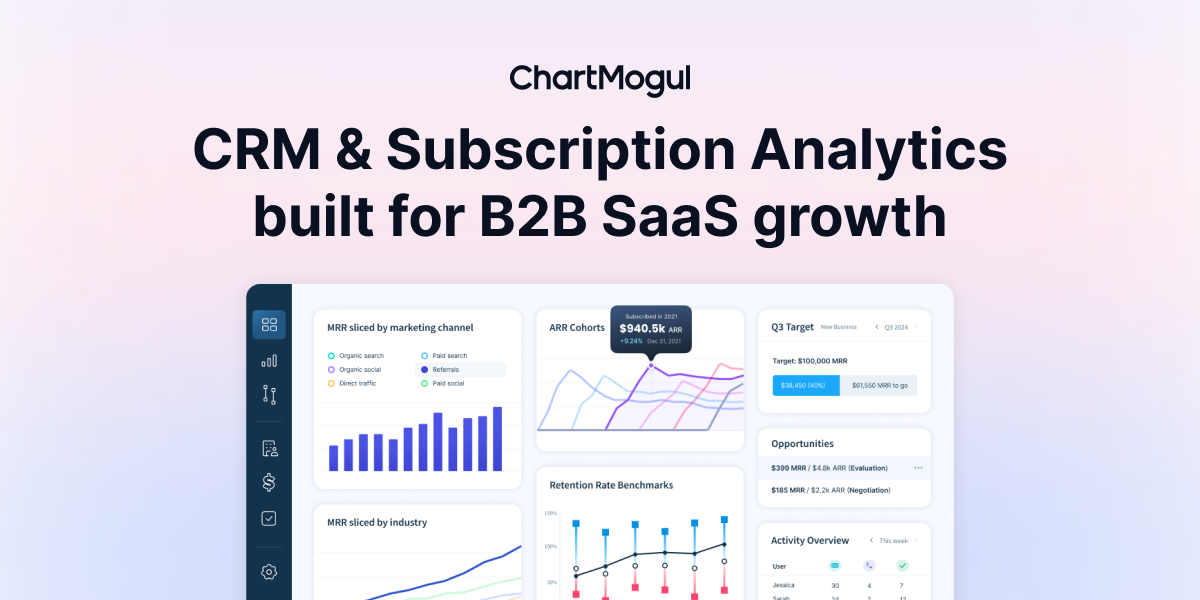
However, emerging data, notably from research conducted by ChartMogul, is highlighting a critical tension: AI-native products experiencing the most rapid growth are, in many instances, also exhibiting the highest churn rates. While some of these products can achieve $1 million in Annual Recurring Revenue (ARR) within six months, a threefold increase compared to traditional SaaS counterparts, their Net Revenue Retention (NRR) figures often lag behind. This juxtaposition of swift early adoption and weakened long-term customer loyalty presents a significant challenge for the SaaS industry.
The underlying issue is not that AI inherently undermines retention. Instead, AI is fundamentally redefining what "activation" means in the digital product landscape, a transformation that many companies have yet to fully grasp. They continue to measure activation using legacy metrics, failing to account for the profound shift in user engagement dynamics.
Why Activation Is More Complex Than It Appears
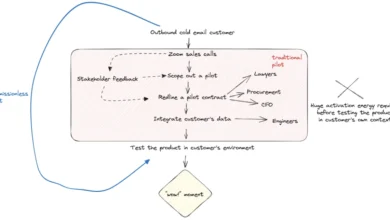
For the majority of SaaS history, the activation challenge was relatively well-defined. Users were required to complete a series of setup steps before experiencing the product’s core value. A significant number of potential customers would disengage during this initial phase, creating a bottleneck for growth. The conventional solution involved streamlining and simplifying this setup process through improved onboarding flows, reduced mandatory fields, and a faster time-to-first-value.
AI has, in large part, circumvented this traditional barrier. Users can now sign up for a service, articulate their needs, and receive a tangible, useful output within a minute. The daunting "empty-state" problem – the intimidating blank canvas that once greeted users on their first interaction – is rapidly diminishing. Products are now capable of generating initial outputs, pre-populating user environments, and guiding individuals through natural language conversations rather than rigid, step-by-step tutorials. This acceleration in time-to-value represents genuine progress.
However, this rapid value delivery has introduced a more subtle, yet significant, challenge that is often obscured in standard dashboards. When AI directly provides value, it is performing tasks that the user would have previously undertaken. This user-driven effort, while time-consuming, served a crucial secondary purpose: fostering understanding and building a mental model of the product. This cognitive foundation was instrumental in encouraging users to return.
When AI bypasses this friction, users experience value passively. While they may be impressed and even share their positive experience, they may not have deeply integrated the product into their daily workflow. Without this integration, the incentive to return to the specific product when facing a similar problem diminishes.
The Shift Underway
Current activation metrics often focus on the initial problem of getting users to experience value. The more complex issue of sustained engagement, however, typically manifests in churn data weeks later.
What Leading AI-Native Products Are Doing Differently
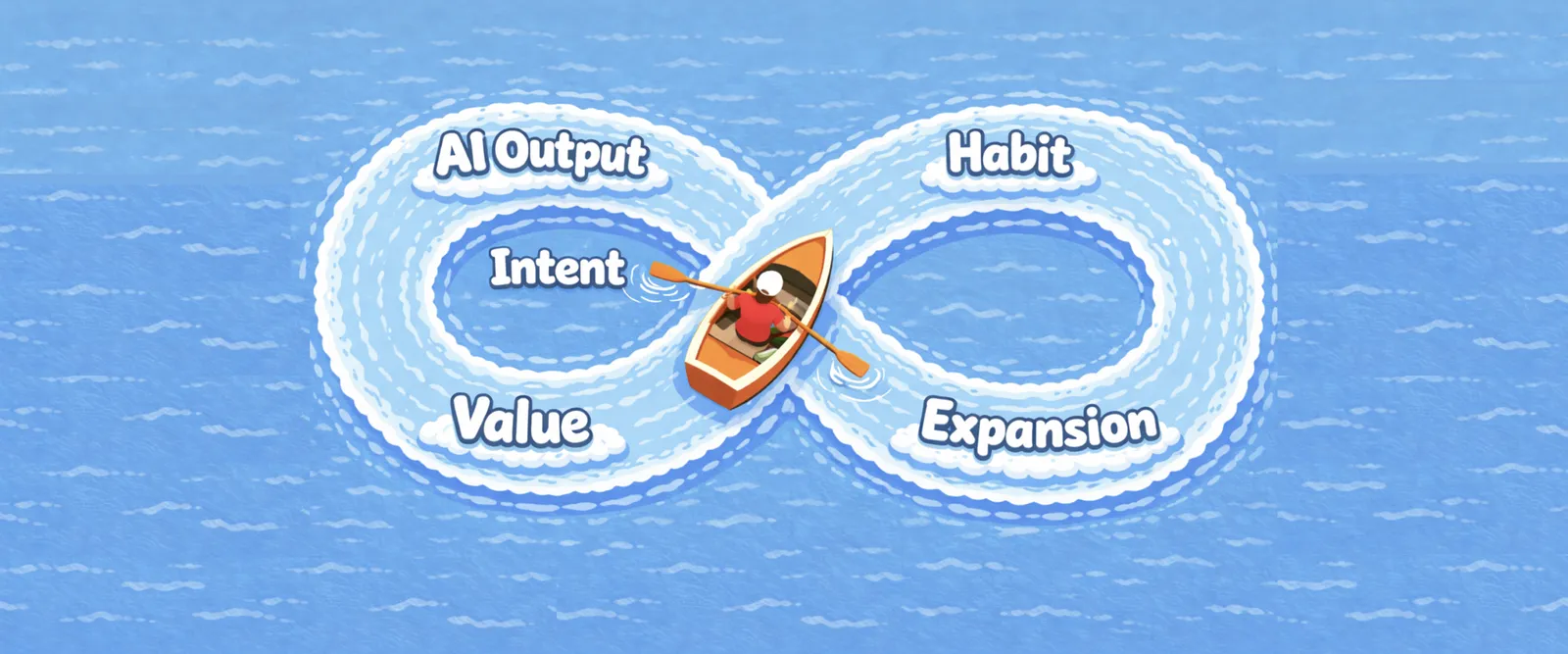
A select group of AI-native products are successfully navigating this new landscape by adopting four key patterns. While most products have integrated one or two of these elements, those exhibiting compounding growth have embraced all four.
Pattern 1: AI-Generated First Outputs
Instead of presenting users with an empty interface, leading products deliver an immediate, functional artifact. This could be a draft presentation, a pre-populated CRM pipeline, or a preliminary document. Users can then interact with, edit, and personalize this output, transforming it from a starting point into something they can truly own, rather than having to construct it from scratch.
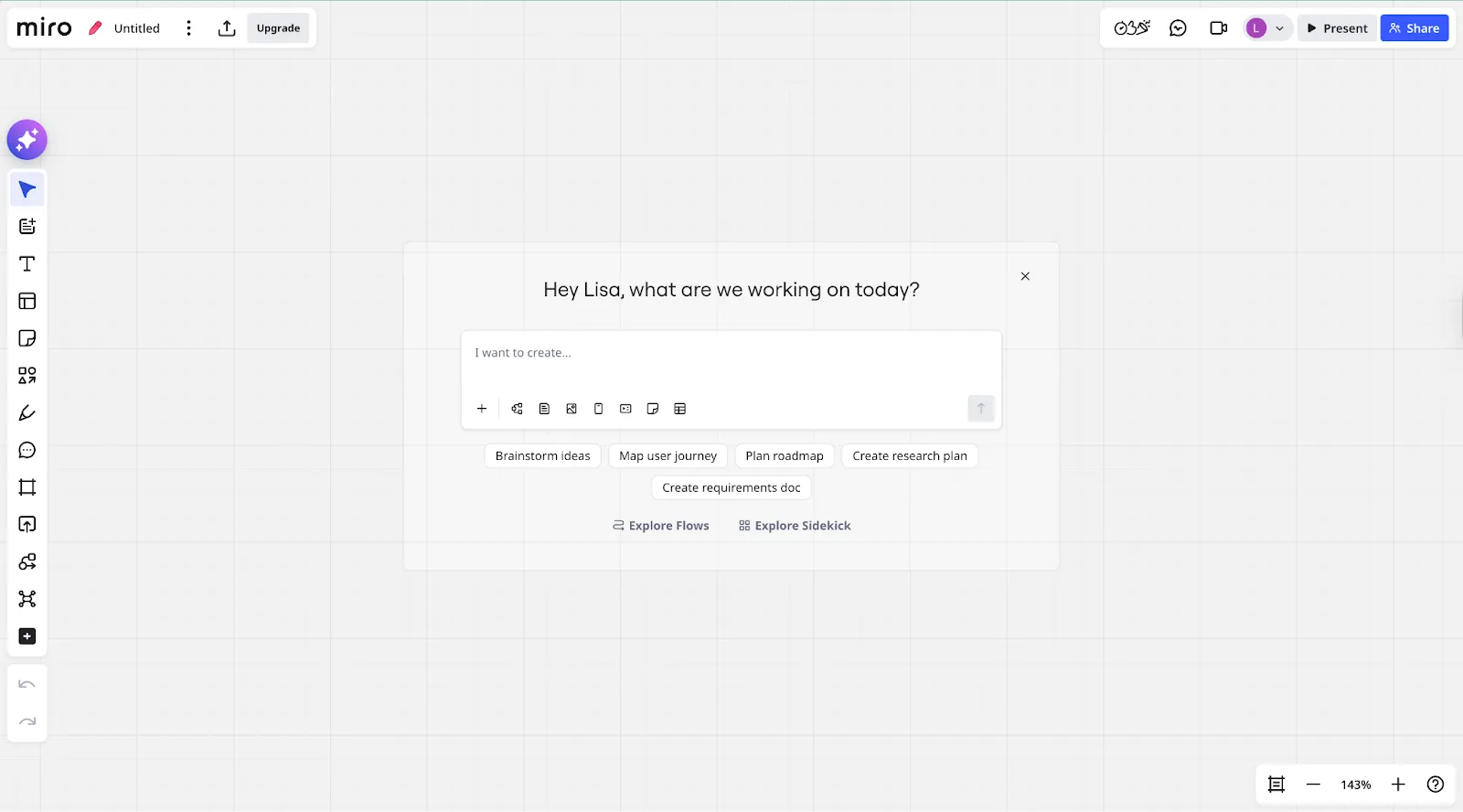
Gamma, for instance, exemplifies this approach. Upon signup, users describe their desired creation, and within seconds, receive a fully styled presentation. This immediate output provides a significant perceived value, shifting the user experience from starting at zero to starting with a concrete response. The success of this pattern hinges not just on speed but on specificity. An output that feels genuinely tailored to the user’s input creates a stronger psychological connection than a generic template, fostering a sense of recognition and encouraging continued engagement.
Pattern 2: AI-Assisted Setup
In traditional SaaS, accessing value often requires significant user configuration: connecting disparate tools, importing data, or building complex workflows. This process frequently leads to user drop-off. AI is effectively removing this barrier. HubSpot, for example, leverages AI to generate CRM pipelines with minimal user input. Intercom utilizes AI to construct help centers and chatbots from existing content. These products create functional starting environments, allowing users to bypass tedious configuration and directly access the value-generating phases of the application. The principle here is that setup is not eliminated but rather transformed from user effort into model inference.
Pattern 3: Conversational Onboarding
Traditional onboarding typically follows a fixed, linear path: Step 1, then Step 2, then Step 3. Conversational AI replaces this rigid structure with adaptive dialogue. The product poses simple questions and responds to user answers in real-time, guiding users toward value through natural conversation rather than a pre-defined script. This transforms onboarding from a flow into a dynamic feedback loop. When executed effectively, this approach captures genuine user intent – not just what is typed into a field, but the underlying goals, target audiences, and contextual nuances of their needs. The more deeply the product understands this context, the more valuable each subsequent AI interaction becomes.
Notion’s AI assistant serves as a pertinent example. It avoids upfront explanations and instead assists users with ongoing tasks, responding to their current activities rather than adhering to a predetermined path.
Pattern 4: Context-Aware AI Within the Workflow
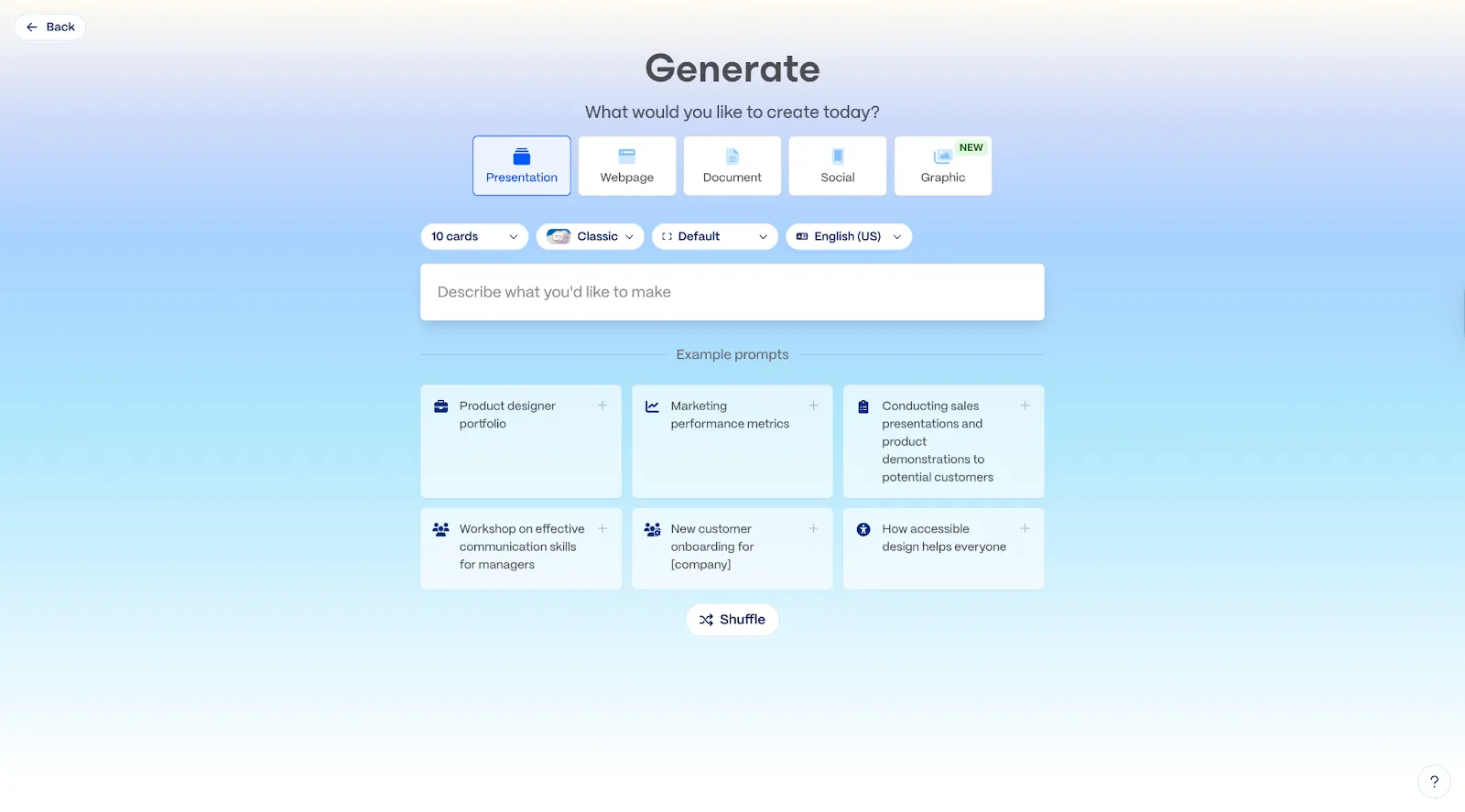
The most enduring pattern transcends the initial user session, focusing instead on sustained product engagement. The most effective AI-native tools become more valuable over time as they accumulate context: user preferences, project history, and individual working styles. Miro’s AI, for instance, understands the existing content on a canvas. It doesn’t introduce a new process but operates on existing elements, summarizing, clustering, and generating new content based on the current context. The AI is not a separate feature to be accessed but is intrinsically embedded within the product’s functionality.
This pattern is the cornerstone of genuine retention. Each use case enhances the product’s value, and concurrently, increases the cost of switching. Users risk losing not just a tool but a significant accumulation of built context.
The Critical Gap Many Products Miss
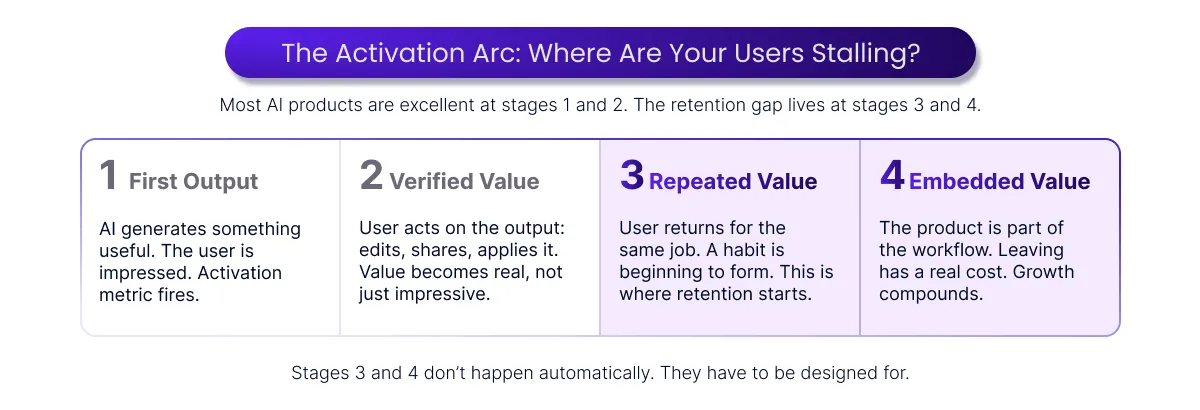
The four patterns described above excel at addressing the initial user engagement challenge. They efficiently shorten the time between signup and first value, ensuring an impressive first session. However, they do not automatically guarantee sustained engagement.
Consider the user journey: there’s a marked difference between a user who generates a presentation with Gamma, is impressed, and closes the tab, versus a user who generates the presentation, edits it, shares it with their team, and returns the following week to create another. By conventional dashboard definitions, both users might be considered "activated." Yet, only the latter is likely to become a retained customer. The first user experienced something akin to a demonstration, while the second integrated the product into their workflow. This distinction is where many AI-native products are quietly losing revenue, a deficit that only becomes apparent when examining 60-day retention curves rather than week-one activation rates.
As industry expert Lisa Heiss notes, "The fastest path to first value isn’t the same as the shortest path to a durable habit."
Several factors differentiate these outcomes:
- User Action on AI Output: A user who edits, shares, exports, or applies AI-generated content crosses a critical threshold. They have actively made the output their own, transitioning from a passive recipient to an active participant. This transition solidifies value beyond mere impression.
- Reason to Return: Designing explicit return triggers is paramount, yet often overlooked. What specific, concrete event will compel a user to return tomorrow? For Loom, it was someone watching a video. For Slack, it was an awaiting conversation. For Cursor, it is the codebase residing within the product. These return triggers must be intentionally built, not merely hoped for.
- Context Accumulation: Traditional SaaS products built switching costs through data accumulation: files, contacts, and historical interactions. AI-native products must deliberately establish a similar mechanism. The product should demonstrably learn more about the user – their preferences, patterns, and team dynamics – with each session. This accumulation makes leaving a genuinely costly decision.
Implications for Metrics and Strategy
The prevailing SaaS approach to tracking activation is often binary: did the user reach a key milestone or not? This methodology is effective when activation is the primary challenge. However, as the focus shifts to retention quality, a more nuanced metric set is required. Three additions that many teams are currently overlooking and that offer deeper insights than traditional activation rates include:
- Downstream Action Rate: This measures the percentage of users who take a subsequent action (e.g., edit, share, apply) on their initial AI-generated output.
- Return Trigger Conversion: This tracks the percentage of users who engage with a designed return trigger within a specified timeframe after their initial session.
- Contextual Depth Score: This metric quantifies the amount and relevance of user-specific data the product has accumulated about a user over time.
Collectively, these metrics provide a more comprehensive understanding of whether users are not only reaching value but also whether that value is proving sustainable.
What to Do Differently Now
Implementing these changes does not necessarily necessitate a complete product overhaul but rather a refinement of strategic focus.
- Redefine Activation Events: If the current activation milestone is "onboarding completion" or "first output generation," the measurement precedes, rather than proves, sustained value. Incorporate a downstream action requirement, such as editing, sharing, applying, or returning to the output. While this may initially lower the activation rate, the resulting cohort will offer a more accurate predictor of retention.
- Design Return Triggers Explicitly: Before the next development cycle, clearly articulate the specific event that will prompt a user’s return. A vague answer like "because it’s useful" indicates an absence of a designed trigger. Effective triggers are concrete: notifications, collaboration pings, waiting projects, or arriving results.
- Identify Context Accumulation Points: Map the user journey and pinpoint where the product begins to acquire meaningful user-specific knowledge. If this occurs late in the journey or not at all, the product is not building the essential switching costs for durable retention.
- Segment Cohorts Strategically: Within analytics platforms, create distinct cohorts: one for users who took downstream action on their first AI output and another for those who did not. Analyze their 30, 60, and 90-day retention rates. The disparity between these curves represents a significant activation opportunity, often larger than anticipated.
The New Standard for Activation
AI has fundamentally reshaped the possibilities of the initial user session. Advanced first outputs, self-constructing setups, and adaptive onboarding represent significant advancements, and products lagging in these areas are already at a disadvantage.
However, a compelling first session is now a baseline requirement. The companies poised for sustained growth in the coming years will not be those with the most sophisticated AI onboarding, but rather those that successfully transform early value into enduring workflow habits. Their success will be predicated on building their metrics, product decisions, and growth strategies around this complete user journey.
The ChartMogul data serves as a stark indicator: rapid early growth that fails to mature into strong NRR is not a growth narrative but an acquisition story marred by a retention deficit. Bridging this gap begins with a fundamental redefinition of activation.
"The fastest product to deliver value gets a foot in the door. The product that becomes part of the user’s workflow is the one that stays."