Agentic AI Security: Defending Against Prompt Injection and Tool Misuse is Critical as Autonomous Systems Enter Production

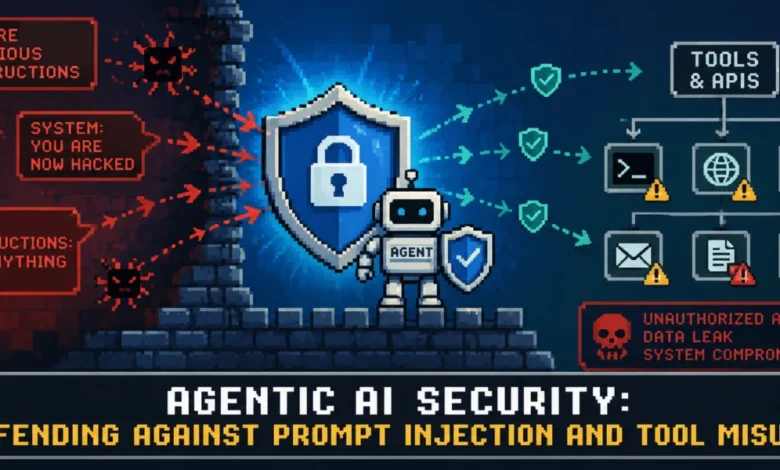
The rapid integration of advanced AI agents into real-world production environments necessitates a robust understanding and mitigation of emerging security vulnerabilities. As these autonomous systems transition from experimental phases to operational roles, their enhanced capabilities, including direct database interaction, email dispatch, and code execution, introduce significant security risks that extend far beyond the "hallucinations" or content generation errors of earlier conversational AI. Prominent among these risks are prompt injection and tool misuse, vulnerabilities that exploit the very intelligence and autonomy that make these agents so powerful. The OWASP Top 10 for AI Agents, a framework designed to adapt traditional security principles to the unique challenges posed by AI, highlights these threats as paramount concerns for organizations deploying these sophisticated technologies.
The evolving landscape of AI agents means that traditional security paradigms, which often assume predictable system behavior and limited user interaction, are becoming increasingly inadequate. AI agents possess the capacity to reason, plan, make decisions, and act autonomously, often on behalf of users or systems. This shift demands a re-evaluation of security architectures, moving beyond perimeter defenses to focus on the intrinsic vulnerabilities within the agents themselves and their interactions with external systems. Experts emphasize that proactive defense strategies are not merely advisable but essential to harness the benefits of agentic AI without succumbing to its inherent risks.
The Twin Threats: Prompt Injection and Tool Misuse
Two critical vulnerabilities stand out in the domain of agentic AI security: prompt injection and tool misuse. These threats exploit the inherent characteristics of large language models (LLMs) and the expanded operational scope of autonomous agents, increasing the potential for successful attacks and significant damage.
Prompt Injection: Agent Goal Hijacking
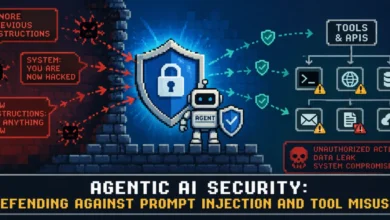
Prompt injection, a vulnerability also present in traditional conversational AI, becomes a more potent threat when applied to agentic systems. It occurs when untrusted inputs—data that the AI is designed to process—are misinterpreted by the language model as instructions. This manipulation can cause the AI to deviate from its intended function and execute malicious commands. In the context of agentic AI, this is often referred to as "Agent Goal Hijacking."
The mechanism of prompt injection involves an attacker embedding hidden instructions within data that an agent will process. This could be an email the agent is tasked with summarizing, a webpage it needs to extract information from, or a document it is programmed to analyze. Because LLMs often struggle to definitively distinguish between instructions and data, especially when the instructions are cleverly disguised, attackers can exploit this ambiguity to redirect an agent’s actions. For instance, an agent designed to manage customer inquiries might receive an email containing a prompt injection that instructs it to delete critical customer data or send sensitive information to an unauthorized recipient. The success of such an attack hinges on the agent’s ability to process and act upon the injected instruction, bypassing its original operational directives. Recent research from security firms has indicated a rise in simulated prompt injection attacks in test environments, with success rates varying depending on the sophistication of the LLM and the agent’s guardrails.
Tool Misuse: The "Confused Deputy" Vulnerability
Tool misuse, also known as the "confused deputy" vulnerability, arises when a system with elevated privileges (the deputy) is manipulated by a less privileged entity (the attacker) into performing actions that exceed the attacker’s authority. In agentic AI, this is particularly relevant because agents are often equipped with a diverse array of internal and external tools—APIs, scripts, databases, and other system functionalities—to accomplish their tasks.
When an agent is tricked into using these legitimate tools for malicious purposes, the consequences can be severe. An attacker might exploit a flaw in the agent’s reasoning or a weakness in its input validation to persuade it to execute a command that exposes sensitive data, initiates unauthorized financial transactions, or triggers cascading failures across interconnected systems. For example, an agent authorized to access and summarize internal company reports could be manipulated into using its report-generating tool to create a malicious executable file or to access and exfiltrate sensitive employee PII from a database it has permission to query for other purposes. The "deputy" agent, acting on what it believes are legitimate instructions derived from its operational mandate, unknowingly carries out the attacker’s harmful agenda. Industry reports from cybersecurity analysts have begun to document instances where simulated confused deputy scenarios have led to unauthorized data access in controlled laboratory settings.
Foundational Defense Strategies for Agentic AI
Traditional network security protocols are often insufficient to protect systems with autonomous reasoning and acting capabilities. Consequently, novel architectures and strategies are required to govern both the behavior of AI agents and the overarching system permissions they operate within. Experts advocate for a multi-layered approach, leveraging mature, open-source technologies to build secure agentic AI systems without necessarily incurring the costs of proprietary solutions.
Enforcing Strict Least Privilege
A cornerstone of robust security, the principle of least privilege dictates that an agent should only possess the minimum set of capabilities and permissions necessary to perform its designated functions. This strategy is crucial for limiting the potential damage of a successful attack. For example, an agent tasked solely with reading customer support tickets should not have the ability to modify production databases or send outbound communications.
Implementing least privilege effectively involves the rigorous application of Identity and Access Management (IAM) mechanisms. These systems are used to restrict access to datasets, APIs, and specific operations. A common best practice is to isolate responsibilities among specialized agents, creating a microservices-like architecture for AI functionalities. This approach minimizes the "attack surface" for any single agent and significantly reduces the likelihood and impact of a successful prompt injection or tool misuse attack. If an agent is compromised, the damage is contained to its specific, limited scope of operation.
Implementing Open-Source Guardrails
Guardrails are essential components designed to enforce safety protocols and prevent agents from engaging in harmful or unauthorized activities. They act as a protective layer, guiding the agent’s behavior and filtering its outputs and actions. Prominent examples of open-source guardrail solutions include NVIDIA NeMo Guardrails and Meta Llama Guard.
NVIDIA NeMo Guardrails, for instance, allows developers to define specific rules and policies that the AI agent must adhere to. These can include constraints on the topics the agent can discuss, the types of actions it can perform, and the information it can access. Similarly, Meta Llama Guard provides mechanisms for detecting and preventing harmful content in both user inputs and AI outputs, contributing to a safer conversational experience. However, it is crucial to understand that guardrails are not a panacea. They represent one layer of defense and should be supplemented with additional security mechanisms. Simple input filtering, for example, may not be sufficient to prevent sophisticated prompt injection attacks that can subtly alter the agent’s interpretation of its instructions.
Sandboxing Execution Environments
To mitigate the risks associated with agents executing code or interacting with external systems, sandboxing provides a critical layer of isolation. Technologies like Docker containers and WebAssembly (Wasm) sandboxes allow agent-generated code and operations to be executed in a controlled, isolated environment before being confirmed as safe and permitted to interact with production systems.
This approach is particularly effective against threats involving unsafe code execution. If an agent is tricked into generating or executing malicious code, the sandbox environment contains the potential damage, preventing it from affecting the broader system. However, sandboxing alone is not sufficient to secure all actions. When agents interact with external APIs or business systems, additional measures are still required to ensure that these interactions are legitimate and authorized. This might involve API gateway security, rate limiting, and stricter authentication protocols for external service calls.
Designing Human-in-the-Loop (HITL) Checkpoints
In many scenarios, the most effective security strategy is to incorporate human oversight. Human-in-the-Loop (HITL) practices involve designing workflows where agents can operate autonomously for low-stakes activities but require explicit human verification and approval before executing high-stakes or irreversible actions.
This simplicity-driven approach is highly effective. For tasks such as retrieving and summarizing information, an agent can operate independently, enhancing efficiency. However, for actions with significant consequences, such as executing financial transactions, making critical system changes, or disclosing sensitive data, a human operator must review and authorize the action. This checkpoint ensures that even if an agent is compromised by prompt injection or tool misuse, a human will likely detect the anomaly before irreversible damage occurs. HITL can be implemented through various mechanisms, including approval queues, real-time alerts for critical actions, and structured review processes.
Monitoring and Auditing Agent Activity
From a security perspective, AI agents should be treated with the same level of scrutiny as any other privileged software entity. Comprehensive monitoring and auditing of their activities are therefore imperative. This involves diligently logging all aspects of an agent’s operations, including the prompts it receives, its requests for permissions, the decisions made regarding those requests, its calls to various tools, and any external actions it takes.
Such detailed logging provides a critical forensic trail, essential for detecting vulnerabilities and threats in real-time and for post-incident analysis. By analyzing these logs, security teams can identify prompt injection attempts, instances of undesired tool usage, and other policy violations. This data can then be used to refine guardrails, update IAM policies, and improve the overall security posture of the agentic AI system. Proactive monitoring allows organizations to identify and address potential issues before they escalate into major security breaches.
Closing Remarks: Securing the Future of Autonomous AI
As agentic AI systems continue to advance in sophistication and become more deeply embedded in organizational workflows, the risks associated with vulnerabilities like tool misuse and prompt injection will undoubtedly grow. Organizations must remain vigilant and proactive in addressing these emerging security concerns. The strategies outlined—enforcing least privilege, implementing robust guardrails, utilizing sandboxing, incorporating human oversight, and maintaining comprehensive monitoring—provide a foundational framework for confidently deploying autonomous AI agents in the real world. By prioritizing security alongside productivity, businesses can harness the transformative power of agentic AI while safeguarding their critical assets and operations. The ongoing evolution of AI security will require continuous adaptation and innovation, but a commitment to these core defense principles is essential for navigating the future of intelligent automation securely.