The Cognitive Science of Verbal Processing
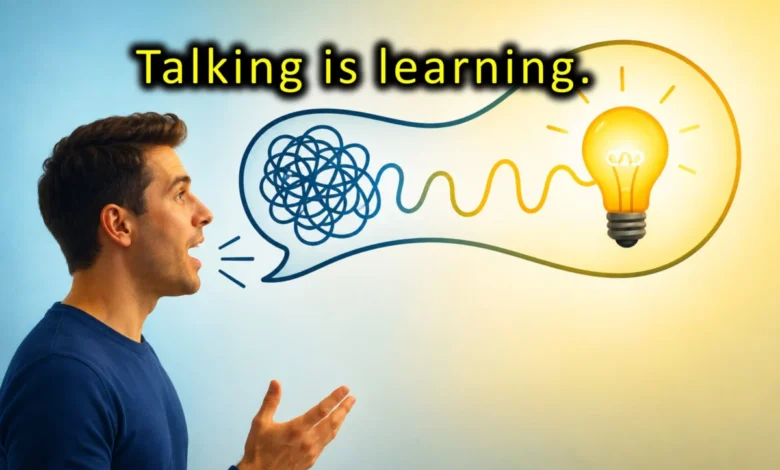
The assertion that talking is learning is supported by extensive research in cognitive science and educational psychology. The "Generation Effect," a phenomenon first identified by researchers in the late 1970s, suggests that individuals remember information more effectively when they produce it themselves—such as by speaking it aloud—rather than passively receiving it. When a professional "learns out loud," they are forced to organize scrambled thoughts into a coherent structure, a process that often reveals gaps in logic or creates new "lightbulb" moments of clarity.
Furthermore, social constructivism, a theory pioneered by psychologist Lev Vygotsky, posits that learning is an inherently social process. In a professional context, this means that the dialogue between a coach and a subordinate is the primary site of professional development. However, this process is frequently obstructed by defensive mechanisms. As organizational experts note, the moment an individual begins to defend themselves or their position, the learning process ceases. Defense is the antithesis of curiosity; it closes the mind to new information and prioritizes ego preservation over growth.
The Evolution of Management: A Chronological Shift
The transition toward a dialogue-based leadership model marks a significant departure from the historical trajectory of management theory.
- The Era of Scientific Management (Late 19th Century – 1920s): Under Frederick Taylor’s "Taylorism," workers were viewed as cogs in a machine. Communication was strictly top-down, and "talking" on the job was often viewed as a distraction from productivity.
- The Human Relations Movement (1930s – 1950s): Following the Hawthorne Studies, management began to recognize the importance of social factors. However, communication remained largely focused on morale rather than collaborative learning.
- The Rise of Knowledge Work (1960s – 1990s): Peter Drucker’s identification of the "knowledge worker" necessitated a more collaborative approach, but the "boss as expert" model still dominated.
- The Modern Coaching Culture (2000s – Present): In the era of rapid digital transformation, no single leader can possess all the answers. The role of the leader has evolved into that of a facilitator who ensures that the collective intelligence of the team is harnessed through open conversation.
Tactical Implementation: Becoming a Leader People Talk To
To leverage talking as a learning tool, leaders must actively dismantle the barriers that prevent employees from speaking candidly. According to industry analysis, there are three primary tactical shifts that high-performing leaders employ to create a "safe" environment for verbal processing.

Clarifying Context and Intent
One of the most common inhibitors of open dialogue is the ambiguity of the conversation’s purpose. When a subordinate is called into a meeting, they often feel pressured to present "finished" ideas. To counter this, effective leaders clarify the context immediately. By asking, "Are we exploring ideas or making decisions?" the leader provides the psychological safety necessary for the employee to share "half-baked" concepts. This distinction is vital; exploration requires a wide-lens approach where "crazy" thoughts may lead to brilliance, whereas decision-making requires a narrow-lens focus on feasibility and execution.
Acknowledging the "Power Gap"
The "Boss Effect" is a well-documented phenomenon where the mere presence of a high-ranking executive causes others to self-censor. Research suggests that in meetings where a senior leader speaks first, the range of ideas discussed is significantly narrower than in meetings where the leader remains silent until the end.
To mitigate this, modern leaders are increasingly vocal about their own influence. Statements such as, "I know my voice carries extra weight, so I’m putting my opinion on ice for now," serve to neutralize the power dynamic. By "test-driving" ideas without the threat of immediate judgment from authority, teams can reach higher levels of innovative thinking.
The Linguistic Shift: From "Why" to "What" and "How"
The language of leadership is shifting toward inquiry that promotes reflection rather than defensiveness. Traditional "Why" questions—such as "Why do you think that?"—can often be perceived as accusations, triggering a fight-or-flight response in the brain’s amygdala. When a person feels accused, they stop learning and start defending.
In contrast, replacing "Why" with "What" or "How" keeps the prefrontal cortex engaged. Asking, "How did you come up with this idea?" or "What’s important to you about this?" invites the speaker to walk the listener through their logic. This not only helps the leader understand the subordinate’s perspective but also helps the subordinate understand their own thought process more deeply.

Supporting Data: The Impact of Psychological Safety
The business case for creating environments where talking is encouraged is backed by substantial data. Google’s "Project Aristotle," a multi-year study into team effectiveness, found that "psychological safety"—the belief that one will not be punished or humiliated for speaking up with ideas, questions, concerns, or mistakes—was the single most important factor in a team’s success.
Furthermore, Gallup’s "State of the American Manager" report indicates that employees whose managers hold regular meetings with them are almost three times as likely to be engaged as employees whose managers do not. Engagement is directly correlated with the frequency of meaningful conversation. When employees feel they have a "channel" to talk through their challenges, their retention rates increase, and their productivity rises.
Reactions from the Field: The Leader as Facilitator
Industry experts and executive coaches are increasingly vocal about the necessity of this shift. "The greatest mistake a leader can make is thinking they need to be the smartest person in the room," says Sarah Jenkins, a senior consultant in organizational development. "The smartest person in the room is actually the ‘room’ itself—the collective dialogue. A leader’s job is simply to make sure that dialogue happens without fear."
Similarly, feedback from internal corporate surveys across Fortune 500 companies suggests a growing demand for "listening leaders." Employees frequently cite "being heard" as a more significant motivator than minor salary increases. This underscores the reality that talking is not just a cognitive tool for the speaker, but a validation of the speaker’s value to the organization.
Broader Impact and Implications for the Future of Work
As artificial intelligence and automation take over routine tasks, the uniquely human capacity for complex problem-solving and creative collaboration becomes more valuable. These capacities are developed and refined through conversation. Organizations that fail to foster a culture where "talking is learning" risk falling behind in an economy that prizes agility and continuous upskilling.

The implications extend to remote and hybrid work environments as well. Without the "water cooler" conversations that naturally facilitate verbal processing, leaders must be even more intentional about opening digital channels for conversation. The rise of "virtual office hours" and "unscheduled brainstorms" reflects an attempt to replicate the learning-by-talking model in a decentralized landscape.
Ultimately, the goal of modern leadership is to create a "Fearless Organization," a term coined by Harvard professor Amy Edmondson. In such an organization, the "permission to learn out loud" is a standard operating procedure. When leaders stop being the source of all answers and start being the facilitators of all questions, they unlock the true potential of their workforce. Talking is indeed learning, and in the high-stakes world of global business, those who talk together, grow together.