The Leadership Triangle Navigating Modern Organizational Complexity Through Essential Core Competencies

In an era defined by rapid technological shifts, workforce volatility, and persistent economic uncertainty, the demands placed upon corporate leadership have reached unprecedented levels of complexity. As organizations grapple with the integration of artificial intelligence, the transition to hybrid work models, and shifting employee expectations regarding purpose and well-being, many executives find themselves searching for sophisticated solutions to increasingly intricate problems. However, recent analysis into organizational dynamics suggests that the most prevalent leadership failures often stem not from a lack of technical expertise, but from the neglect of fundamental responsibilities.
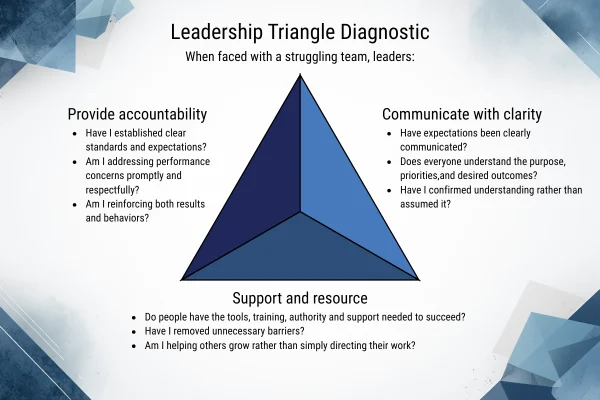
Industry experts and leadership consultants are increasingly pointing toward a streamlined framework—the Leadership Triangle—as a critical tool for navigating this modern landscape. Developed in part from the research of Dr. Justin Irving, a prominent scholar in leadership studies, this model emphasizes three core competencies: clear communication, support and resourcing, and consistent accountability. This framework serves as both a developmental roadmap for Chief Learning Officers (CLOs) and a diagnostic tool for identifying the root causes of team dysfunction and declining performance.
The Context of Modern Leadership Disruption
The emergence of the Leadership Triangle comes at a time when traditional management models are being tested by external pressures. According to data from the 2023 Global Leadership Forecast, only 11% of organizations report having a "strong" leadership bench, the lowest rate in over a decade. This decline coincides with a significant shift in the "psychological contract" between employers and employees. Workers today prioritize transparency, professional development, and psychological safety over traditional hierarchical command-and-control structures.
Furthermore, the rise of remote and distributed teams has exacerbated existing communication gaps. Research by the McKinsey Global Institute indicates that high-performing teams are those where leaders prioritize "soft" skills as much as strategic output. In this environment, the Leadership Triangle provides a stabilizing structure that allows leaders to remain grounded in essential practices while managing high-level strategic pivots.
Pillar One: Communication with Clarity
The first responsibility identified within the Leadership Triangle is the creation of clarity through successful communication. While communication is often cited as a basic skill, its effective execution remains elusive in many corporate environments. A study by the Harris Poll found that 91% of employees say their leaders lack communication skills, specifically citing a failure to provide clear directions or acknowledge achievements.
Clear communication in a leadership context is not measured by the volume of information disseminated, but by the level of understanding achieved among subordinates. For a leader to be effective, they must ensure that every team member can answer fundamental questions regarding their role: What are the primary objectives? Why are these priorities important? How will success be measured?
Leadership development experts argue that many executives fall victim to the "illusion of transparency," a cognitive bias where individuals overestimate how well others understand their intentions and goals. When leaders fail to bridge this gap, the resulting ambiguity often manifests as anxiety, reduced engagement, and a decline in operational efficiency. For organizations, the implementation of this pillar requires a shift from top-down announcements to a culture of active listening, feedback loops, and consistent storytelling that aligns the team with the company’s broader mission.
Pillar Two: Support and Resourcing
Clarity alone is insufficient if a workforce lacks the tools to execute the vision. The second side of the Leadership Triangle focuses on the leader’s responsibility to support and resource their followers. This competency aligns with the principles of servant leadership, a philosophy which posits that the primary role of a leader is to create the conditions that enable others to thrive.
In many modern organizations, a "resource-demand" imbalance has become a primary driver of burnout. Employees are frequently given ambitious targets—often communicated with clarity—but are forced to pursue them without adequate time, training, or budget. This disconnect creates a culture of frustration and disengagement. Support and resourcing can take several forms, including:

- Financial and Technical Resources: Providing the necessary software, hardware, and budget to complete tasks efficiently.
- Time and Prioritization: Protecting employees from "scope creep" and ensuring they have the bandwidth to focus on high-priority objectives.
- Skill Development: Investing in continuous learning and coaching to bridge competency gaps.
- Emotional Support: Fostering an environment of psychological safety where employees feel comfortable taking calculated risks.
Data from the Society for Human Resource Management (SHRM) suggests that organizations that prioritize employee development and support see a 24% higher profit margin than those that do not. By shifting the mindset from "How do I get better results?" to "How do I help my people succeed?", leaders can foster a culture of collective achievement that transcends individual performance.
Pillar Three: The Necessity of Accountability
The final side of the Leadership Triangle is accountability, often cited as the most difficult competency for leaders to master. Many leaders excel at communicating expectations and supporting their teams but hesitate when it comes to addressing underperformance or behavioral issues. However, without accountability, the first two pillars are undermined.
Accountability is defined in this framework not as a punitive measure, but as an act of stewardship. It involves providing honest, timely feedback to ensure that individual behaviors remain aligned with organizational standards. When accountability is absent, high-performing employees often feel demoralized, as their efforts are not distinguished from those who fail to meet expectations. Furthermore, a lack of accountability can lead to a "culture of mediocrity" where standards are gradually lowered to accommodate the lowest common denominator.
Industry reactions to this pillar suggest that the "Accountability Gap" is a primary reason for failed change initiatives. Leaders who avoid difficult conversations often do so to prevent conflict, yet the long-term result is usually an increase in organizational tension and a decrease in trust. Effective accountability requires "care and candor"—challenging individuals to reach their potential because the leader is invested in their professional growth.
A Systematic Approach to Talent Management
The Leadership Triangle’s utility extends beyond individual coaching; it offers a framework for systemic organizational improvement. Chief Learning Officers and talent management professionals are increasingly integrating these three pillars into various stages of the employee lifecycle:
- Selection and Onboarding: Evaluating candidates based on their demonstrated ability to communicate, support, and hold others accountable.
- Performance Management: Structuring reviews to assess not just "what" was achieved, but "how" the leader utilized the triangle to achieve it.
- Succession Planning: Identifying future leaders who possess a balanced mastery of all three competencies, rather than those who excel in only one area.
By embedding these principles into the corporate culture, organizations can move away from isolated, "one-off" leadership training programs toward a coherent system of development. This systemic approach ensures that leadership effectiveness is not dependent on the charisma of a single individual but is a standardized expectation across the entire management tier.
Impact Analysis: Long-term Organizational Health
The long-term implications of adopting a balanced leadership framework are significant. Organizations that successfully implement the Leadership Triangle report higher levels of employee retention, as workers feel both directed and supported. Furthermore, the clarity provided by the model allows for faster decision-making and greater agility in the face of market disruptions.
From a financial perspective, the reduction in "hidden costs" associated with poor leadership—such as high turnover, low productivity, and the legal risks of unaddressed workplace conflict—contributes directly to the bottom line. Analysts suggest that as the global economy becomes more volatile, the ability of a leader to return to these "fundamentals" will be the primary differentiator between organizations that merely survive and those that thrive.
The Leadership Triangle serves as a reminder that in the face of overwhelming complexity, the most effective response is often a return to the basics. By consistently demonstrating clarity in communication, providing robust support and resources, and maintaining firm accountability, leaders can build the trust and performance levels necessary to navigate the challenges of the 21st-century business landscape. As organizations look toward the future, the integration of these three core competencies will remain essential for fostering a resilient, engaged, and high-performing workforce.