Unlocking Advanced Reasoning in AI Models: Amazon Nova 2 Introduces Self-Distilled Reasoning (SDR) to Enhance Customization Without Costly Annotation

The landscape of artificial intelligence customization is undergoing a significant evolution with the introduction of Amazon Nova 2’s innovative Self-Distilled Reasoning (SDR) technique. This groundbreaking approach promises to dramatically improve the performance of customized AI models, particularly in complex domains like coding and mathematics, by addressing a critical bottleneck in traditional fine-tuning processes. For organizations seeking to leverage the power of advanced AI models like the Amazon Nova 2 family for their specific needs, SDR offers a cost-effective and efficient pathway to unlock enhanced reasoning capabilities without the prohibitive expense of generating high-quality, human-annotated reasoning traces.
At the heart of this advancement lies the challenge of Supervised Fine-Tuning (SFT). While SFT is a powerful method for adapting large language models to specific tasks or datasets, it often necessitates the creation of detailed "chain-of-thought" (CoT) reasoning traces. These traces are essentially step-by-step explanations of how a model arrives at an answer, mimicking human-like logical progression. However, producing these traces for extensive training datasets is frequently impractical and prohibitively expensive. Consequently, many developers resort to training models with only input-output pairs, inadvertently sacrificing the model’s inherent reasoning prowess. This is particularly problematic for models like Amazon Nova 2, where reasoning is a core capability that significantly boosts performance on challenging problems.
SDR emerges as a direct solution to this dilemma. It leverages the existing reasoning capabilities of a base model, such as Amazon Nova 2 Lite, to generate synthetic reasoning traces for datasets that lack them. These generated traces are then used to augment the training data, effectively "teaching" the model to reason with itself. This process, rooted in the concept of self-distillation, allows the model to internalize and refine its own problem-solving strategies, leading to improved accuracy and a remarkable preservation of general knowledge.
The Reasoning Suppression Problem and the Need for a New Approach
The effectiveness of reasoning in advanced AI models is well-documented. Amazon Nova 2 and similar frontier models demonstrate substantial performance gains, particularly in areas requiring complex logical deduction, such as coding and advanced mathematics, when reasoning capabilities are active. However, the SFT process, when applied to datasets devoid of explicit reasoning steps, can inadvertently suppress these vital abilities.
This phenomenon, termed "reasoning suppression," occurs because the standard SFT training objective calculates loss across both reasoning and output tokens. In the absence of supervision for generating coherent reasoning traces, the model learns to prioritize tokens that directly contribute to the final output, effectively bypassing its internal reasoning mechanisms. This behavior can be likened to "shortcut learning," where models exploit superficial correlations in data rather than developing robust, generalizable reasoning skills.
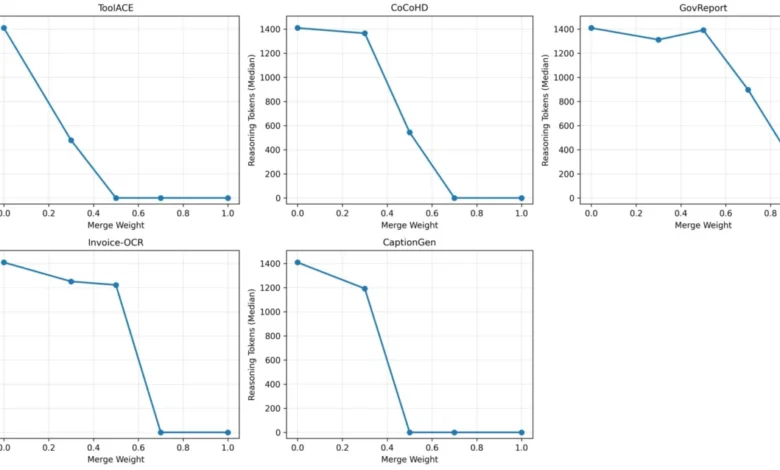
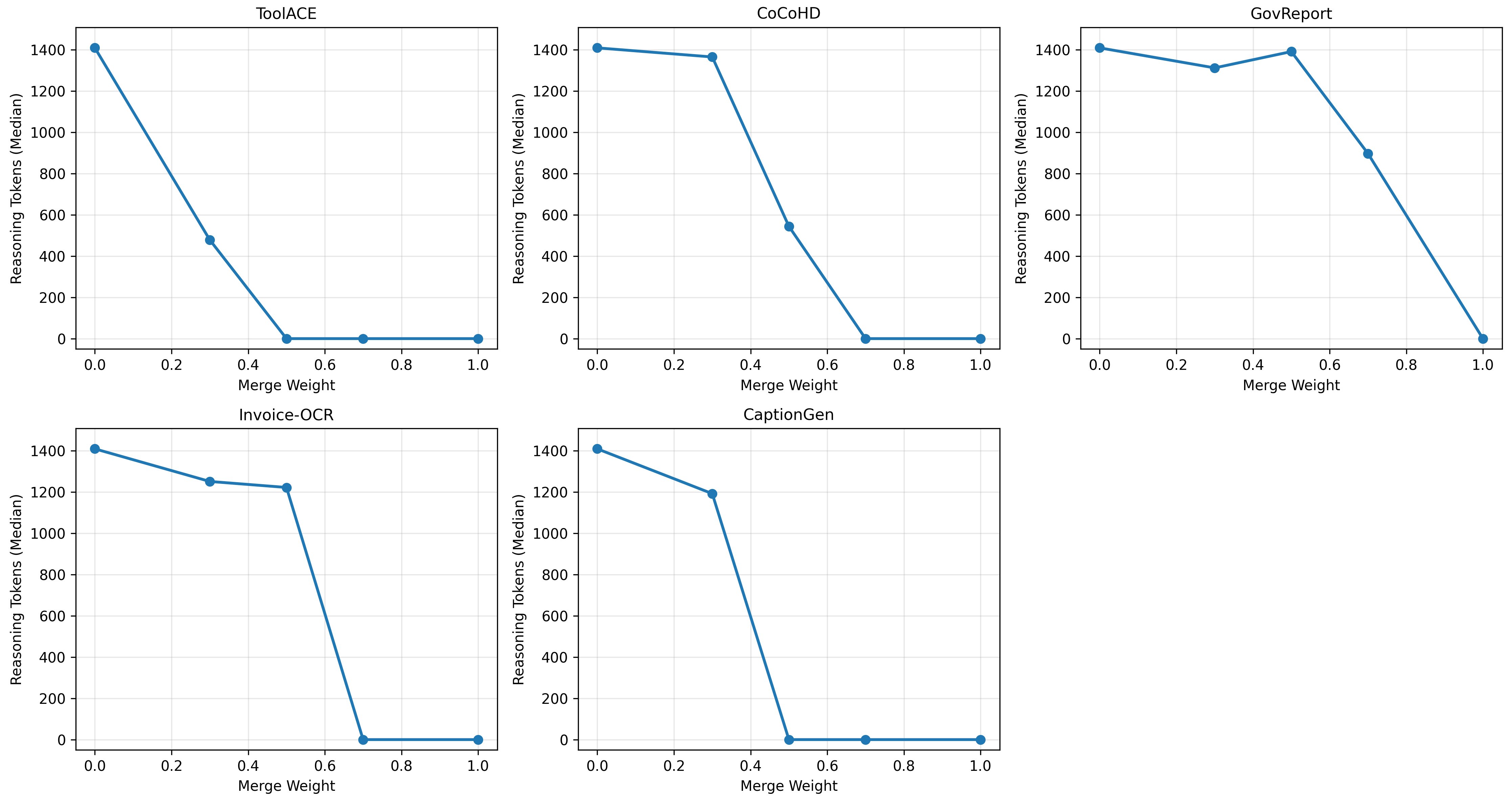
Empirical evidence underscores the critical role of reasoning. Experiments have shown that models trained with reasoning enabled during both training and inference consistently outperform those trained without, even on tasks where the training data itself did not explicitly include reasoning. A comparison on the LLaVA CoT dataset, for instance, revealed significant performance improvements as the "merge weight"—a parameter influencing the blend between a fine-tuned model and its base version—increased, highlighting the value of retaining the base model’s reasoning abilities.
Model Merging: A Partial Solution with Trade-offs
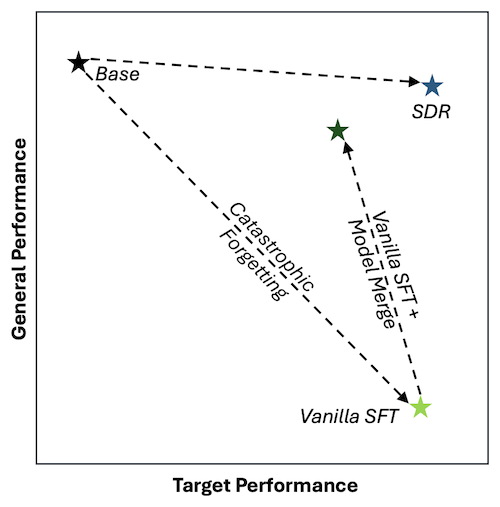
Historically, addressing the loss of general capabilities after domain-specific fine-tuning has relied on techniques like model merging. This approach involves taking a fine-tuned model checkpoint and blending it back with the original base model. The idea is to interpolate between the specialized knowledge gained during fine-tuning and the broad, foundational knowledge of the base model. While model merging can indeed recover some lost general performance, it often comes at the cost of diminishing the specific gains achieved during fine-tuning. This creates a delicate balancing act, a trade-off between target performance and general capabilities that can be difficult to optimize.
The inherent challenge with model merging is that it often leads to "catastrophic forgetting," a phenomenon where a model rapidly loses previously acquired knowledge when trained on new data. In the context of AI customization, this means that while a model might become proficient in a new domain, its ability to perform well on general tasks, such as mathematical problem-solving, can drastically decline. For example, studies have indicated that vanilla SFT can cause mathematical performance to plummet from an average of 70 percent to as low as 6 percent. Model merging attempts to mitigate this, but SDR offers a more integrated and effective solution.
Introducing Self-Distilled Reasoning (SDR): A Paradigm Shift
SDR represents a novel approach that re-imagines the fine-tuning process by integrating the model’s own reasoning capabilities directly into the training loop. Instead of relying on external, expensive human annotations, SDR utilizes the base Amazon Nova 2 Lite model to generate chain-of-thought reasoning traces for each data point in the SFT dataset. These generated traces are then prepended to the original input-output pairs, creating an augmented dataset. The fine-tuning process then proceeds with reasoning mode enabled, allowing the model to learn from both the generated reasoning steps and the final desired outputs.
This self-distillation process offers several compelling advantages:
- Zero Annotation Cost: SDR eliminates the need for human annotators to create reasoning traces, significantly reducing the cost and time associated with data preparation.
- Internal Consistency: The generated reasoning traces are derived from the base model itself, ensuring consistency with its problem-solving style and internal representations.
- Scalability and Flexibility: The technique is applicable to existing SFT datasets across various domains and allows for the use of different teacher models if desired.
- Mitigation of Catastrophic Forgetting: By providing explicit supervision for reasoning steps, SDR helps preserve the model’s general capabilities, preventing the significant performance drops often seen with traditional SFT.
Constructing Reasoning Traces: Basic vs. Guided Approaches
The effectiveness of SDR hinges on the quality of the generated reasoning traces. Amazon Bedrock provides mechanisms to construct these traces through two primary approaches:
Basic Reasoning
This method involves prompting the base model to generate reasoning in a forward, natural manner, as it would during inference. The prompt template guides the model to "think through the question naturally and show your reasoning," with clear instructions to format its response using <thinking> and <answer> tags. This approach mimics the model’s inherent problem-solving process.
Guided Reasoning
When ground-truth answers are available, a "guided reasoning" approach can be employed. Here, the model is prompted to reconstruct plausible reasoning that leads to a provided answer. This "hindsight learning" technique requires the model to work backward from the solution, explaining how it might arrive there without assuming prior knowledge of the answer. Similar to basic reasoning, it uses specific formatting tags, and a crucial secondary filtering step is applied to ensure the answer isn’t inadvertently leaked into the reasoning trace, thus maintaining the integrity of the learning signal.
The implementation pipeline involves querying Amazon Bedrock to obtain these reasoning traces. For instance, a Python script utilizing the boto3 SDK can automate this process. The pipeline reads the SFT training data, generates CoT traces using either basic or guided reasoning prompts, and then assembles the final dataset with reasoningContent blocks that encapsulate the generated reasoning.
Experimental Validation: SDR’s Impact on Performance
Extensive experiments have been conducted to validate the efficacy of SDR across various benchmarks, including MedMCQA, CoCoHD, and Invoice-OCR, all of which are datasets that typically lack reasoning traces. These experiments rigorously compare SDR against vanilla SFT and model merging.
The results consistently demonstrate that SDR significantly outperforms traditional methods. A key finding is the preservation of general capabilities, particularly in mathematics. While vanilla SFT can cause math performance to plummet from a base score of 70 percent to near zero, SDR manages to recover this performance, often maintaining scores in the high 60s. This is achieved without the need for model merging, which, while helpful, introduces a trade-off between target performance and general capability.
For example, in experiments on the MedMCQA dataset, vanilla SFT with reasoning disabled during inference and without merging resulted in a target accuracy of 63.8 percent and a math control score of a mere 0 percent. When SDR with basic reasoning traces was applied (training reasoning enabled, inference reasoning enabled, no merging), target accuracy rose to 66.6 percent, and math performance was recovered to an impressive 67.9 percent. Guided reasoning also showed strong results, achieving 65.7 percent target accuracy and 59.6 percent math performance.
Similarly, on the CoCoHD dataset, vanilla SFT without merging led to a target accuracy of 61.3 percent but a catastrophic drop in math performance to 6.3 percent. SDR with basic reasoning traces yielded 55.4 percent target accuracy and 73.8 percent math performance, while SDR with "supervised" (guided) reasoning achieved 61.3 percent target accuracy and 65.8 percent math performance.
The Invoice-OCR benchmark also showed compelling results, with SDR consistently outperforming vanilla SFT in preserving general capabilities while achieving competitive or superior target performance.
Ablation Studies: The Fragility of Reasoning and SDR’s Resilience
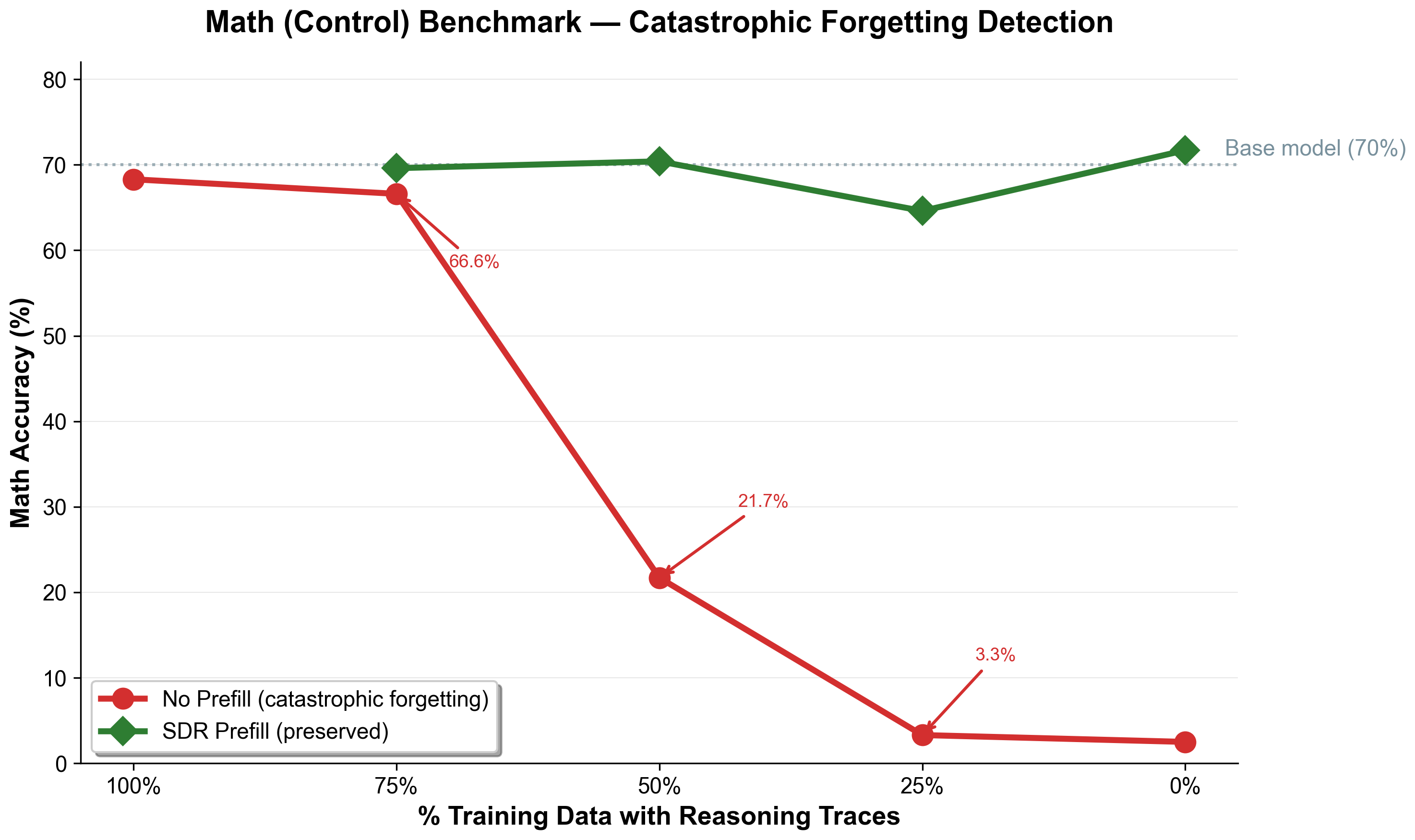
Further ablation studies explored the impact of partial or missing reasoning traces in SFT datasets. These studies revealed that reasoning data is indeed fragile. When the proportion of reasoning data in an SFT dataset dropped below 75 percent, catastrophic forgetting on the math control benchmark became severe, with performance collapsing from 66.6 percent to as low as 2.5 percent.
Crucially, SDR demonstrated its resilience in these scenarios. By pre-filling missing reasoning traces with traces generated by the Nova 2 Lite model, SDR maintained math performance between 65 percent and 72 percent, irrespective of the percentage of original reasoning data included. This indicates that SDR acts as a robust inductive bias, effectively preventing the loss of general reasoning skills even when the primary training data is incomplete.
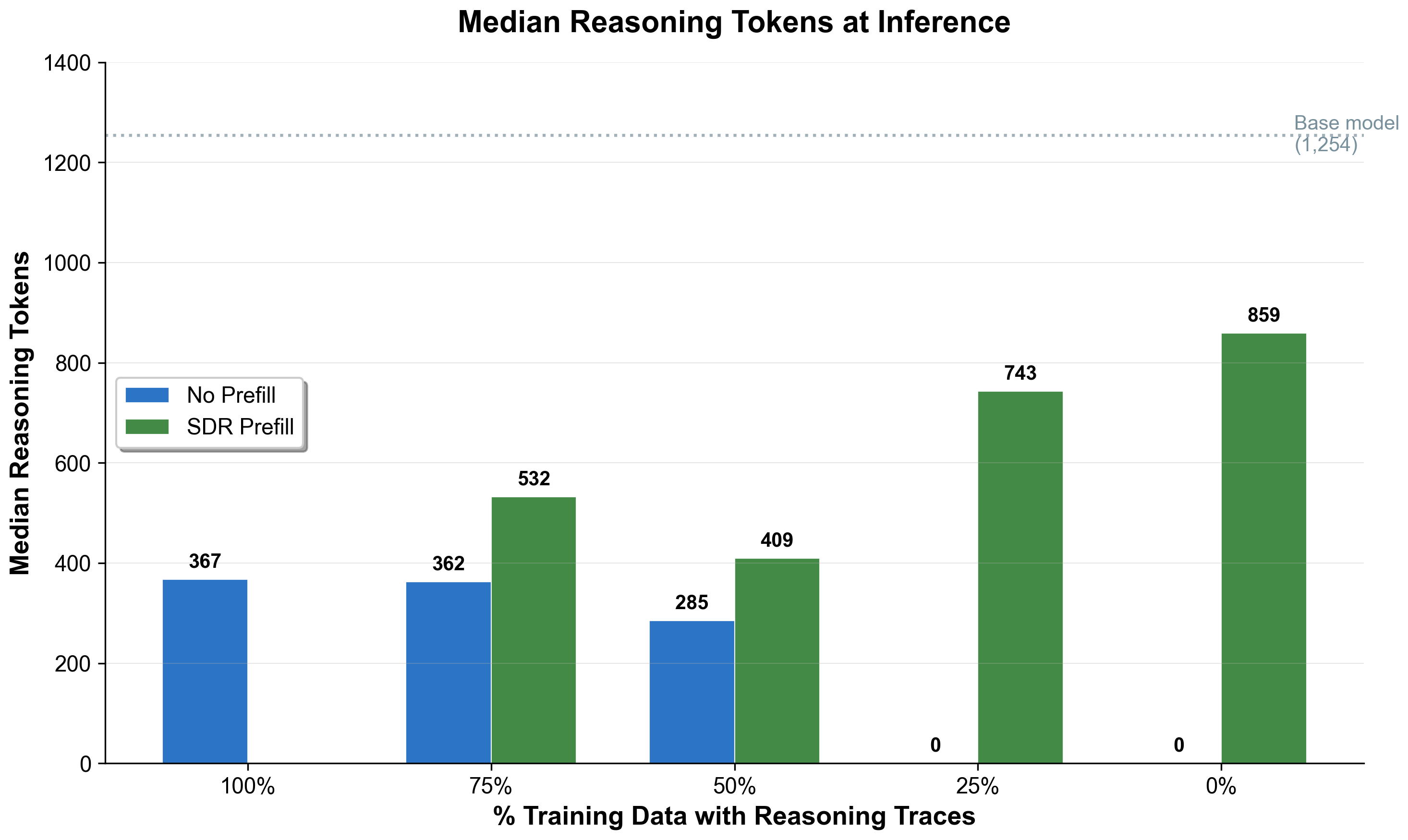
Moreover, SDR influences the model’s reasoning behavior at inference time. Models trained with SDR prefill, even with zero percent reasoning data in the original training set, produced a significantly higher number of reasoning tokens compared to models trained without SDR, which generated zero reasoning tokens and had evidently forgotten how to reason step-by-step. This "teaching" effect of SDR ensures that the model continues to employ its reasoning mechanisms.
Implications for AI Customization and Future Directions
The advent of Self-Distilled Reasoning marks a significant step forward in making advanced AI customization more accessible and effective. The ability to achieve state-of-the-art performance without the burden of expensive data annotation fundamentally changes the economics of AI deployment.
The findings have profound implications for practitioners:
- Prioritize Reasoning Mode: Maintaining consistent reasoning modes during both training and inference is paramount for optimal performance.
- Address General Capability Degradation: Without intervention, domain-specific SFT can erode general reasoning abilities. SDR offers a robust solution.
- Optimize Model Merging: While model merging can recover lost skills, SDR provides a more integrated approach that avoids the need for complex tuning of merge weights and the associated trade-offs.
The research also highlights the nuances of self-distillation. While a stronger teacher model might intuitively seem better, experiments suggest that a large gap between the teacher and student models can sometimes hinder distillation. For Amazon Nova 2 users, using traces generated by the Nova 2 Lite model for fine-tuning Nova 2 Lite models appears to offer the most balanced outcome, preserving both target and general performance effectively.
Looking ahead, SDR presents a powerful inductive bias for continual learning scenarios, where preserving previously acquired skills while learning new ones is essential. Future research may explore combining SDR with data mixing techniques and fine-tuning merge weights to further optimize multi-skill preservation.
The practitioner’s decision guide provided by AWS offers clear recommendations based on data composition and latency constraints. For instance, in default SFT jobs exhibiting performance regression, SDR is recommended for the best balance of performance, while model merging is suggested for latency-sensitive applications. For scenarios with partial reasoning data, SDR acts as a crucial gap-filler, and for continual learning, combining SDR with data mixing and light merging is advised.
In conclusion, Self-Distilled Reasoning (SDR) is not merely an incremental improvement; it is a transformative approach that democratizes access to high-performance, reasoning-enabled customized AI models. By leveraging the inherent capabilities of models like Amazon Nova 2 and applying intelligent self-distillation techniques, organizations can now unlock unprecedented levels of performance and adaptability without the traditional cost barriers. This innovation is poised to accelerate the adoption of advanced AI across a wider spectrum of industries, driving new possibilities and efficiencies.