The Strategic Imperative: Crafting a Powerful PMO Mission Statement for Organizational Success


A Project Management Office (PMO) mission statement is far more than a mere organizational formality; it is a foundational document that dictates the strategic direction, operational priorities, and ultimate value proposition of the PMO within an enterprise. In an increasingly project-driven world, where organizations navigate complex initiatives and rapid change, the clarity and intentionality provided by a well-articulated mission statement are indispensable. It serves as a guiding star, ensuring that the PMO’s efforts are consistently aligned with overarching corporate objectives, fostering cohesion, and enabling the delivery of tangible results. The process of crafting such a statement, while requiring thoughtful deliberation and careful planning, is a critical investment in the PMO’s effectiveness and longevity.
The Evolving Role and Strategic Mandate of the PMO
Historically, Project Management Offices often began as administrative hubs, primarily focused on standardizing project documentation and reporting. However, the modern PMO has evolved significantly, transitioning into a strategic entity that drives organizational change, ensures portfolio optimization, and cultivates project management excellence. This evolution underscores the heightened importance of a clear and compelling mission statement.
Contemporary PMOs come in various forms, each with a distinct focus:
- Supportive PMOs: Primarily act as a repository of best practices, templates, and training resources, offering guidance and support to project managers.
- Controlling PMOs: Emphasize compliance, ensuring adherence to established methodologies, governance frameworks, and reporting standards.
- Directive PMOs: Take direct control of projects, assigning project managers and actively managing project lifecycles.
Regardless of its specific operational model, every PMO faces the challenge of demonstrating its value and securing ongoing executive buy-in. A robust mission statement directly addresses this by articulating its unique contribution to the organization. Research consistently highlights that PMOs with clearly defined mandates and strong executive sponsorship achieve higher success rates in project delivery and strategic alignment. For instance, studies by the Project Management Institute (PMI) often correlate PMO maturity, which includes having a clear mission, with improved project performance metrics such as on-time and on-budget delivery, and greater realization of benefits. Without such a statement, a PMO risks becoming an isolated functional unit, struggling to justify its existence or gain the necessary resources and influence.
The Indispensable Value of a PMO Mission Statement

The development of a clear and concise mission statement for a Project Management Office yields numerous strategic and operational benefits, acting as a powerful tool for internal guidance and external communication.
-
Strategic Alignment and Direction: A mission statement explicitly links the PMO’s activities to the broader organizational strategy. It clarifies how the PMO contributes to achieving corporate goals, whether through enhancing operational efficiency, driving innovation, or facilitating market expansion. This alignment is crucial for prioritizing projects, allocating resources effectively, and ensuring that project outcomes directly support the enterprise’s strategic objectives. Without this explicit link, there is a significant risk of projects being initiated and executed in silos, detached from the organization’s core mission.
-
Enhanced Communication and Stakeholder Engagement: The mission statement serves as an invaluable communication tool, providing a succinct explanation of the PMO’s purpose and value to diverse stakeholders, including senior leadership, business unit heads, and project teams. It helps in managing expectations, securing executive sponsorship, and demonstrating the PMO’s return on investment. A well-communicated mission statement can foster a deeper understanding of the PMO’s role, promoting collaboration and reducing resistance to its initiatives.
-
Focus and Decision-Making Framework: For the PMO team itself, the mission statement acts as a constant reference point for decision-making. It helps PMO leaders and staff to evaluate new initiatives, resolve conflicts, and prioritize tasks, ensuring that all efforts are channeled towards fulfilling the stated purpose. This focused approach prevents scope creep within the PMO’s own operations and ensures that its resources are deployed on high-impact activities.
-
Team Cohesion and Motivation: A shared mission instills a sense of purpose and direction among PMO personnel. It clarifies their collective impact, fostering team spirit and motivating individuals to contribute to a common goal. When team members understand how their daily tasks contribute to the PMO’s overarching mission and, by extension, the organization’s success, morale and productivity naturally improve.
-
Accountability and Performance Measurement: By clearly defining what the PMO aims to achieve, the mission statement provides a benchmark against which its performance can be measured. This enables the PMO to establish relevant key performance indicators (KPIs) and metrics, facilitating objective evaluation of its effectiveness and continuous improvement initiatives. A PMO that can clearly articulate its mission is better positioned to demonstrate its value and justify its existence through measurable outcomes.
Core Elements of a Robust PMO Mission Statement
To be truly effective, a PMO mission statement must be carefully constructed, incorporating several key components that collectively define its identity and purpose.
-
Core Purpose: This is the fundamental reason for the PMO’s existence. It answers the questions: "What do we do?" and "Why do we exist?" The purpose should reflect the specific type and maturity of the PMO. For a supportive PMO, the purpose might revolve around "providing best practices and guidance." For a directive PMO, it might be "ensuring successful project delivery and strategic portfolio execution." Clarity here avoids ambiguity and sets the foundation for all subsequent activities.
-
Values: These are the guiding principles and beliefs that dictate how the PMO operates. While often drawing from broader corporate values, PMO-specific values can further refine behavior and decision-making. Examples include "transparency," "collaboration," "excellence in execution," "continuous improvement," "integrity," or "stakeholder focus." These values should not merely be words on a page but should actively inform the PMO’s processes, interactions, and culture. Co-creating these values with the PMO team ensures ownership and genuine adherence.
-
Goals and Desired Impact: This component outlines the specific outcomes the PMO aims to achieve and the difference it seeks to make within the organization. These are typically measurable and directly linked to the PMO’s purpose and strategic alignment. Examples could include:
- "Improve on-time project delivery rates by X%."
- "Enhance project portfolio visibility and control for executive leadership."
- "Foster a culture of project management professionalism and capability across all departments."
- "Optimize resource allocation to strategically important initiatives."
- "Reduce project failure rates by Y% through robust governance and support."
Goals should be ambitious yet attainable, providing a clear trajectory for the PMO’s efforts and demonstrating its contribution to organizational success.
The Interplay of Mission, Vision, and Values
While often used interchangeably, it is crucial to distinguish between a mission statement, a vision statement, and core values, as they collectively form a comprehensive strategic framework for the PMO.
- Mission Statement: Defines the PMO’s current purpose and what it does now to achieve its objectives. It describes the "what" and the "why" of the PMO’s existence.
- Vision Statement: Articulates the PMO’s future aspiration – where it wants to be or what it hopes to achieve in the long term. It paints a picture of the desired future state, inspiring and guiding long-range planning.
- Values: Represent the ethical and operational principles that guide the PMO’s actions and behaviors in fulfilling its mission and moving towards its vision. They define "how" the PMO conducts its business.
An effective PMO ensures that its mission, vision, and values are not only clearly defined but also intrinsically linked and mutually reinforcing. The mission outlines the journey, the vision describes the destination, and the values dictate the conduct along the way. This integrated framework provides a holistic understanding of the PMO’s identity and strategic direction.

Crafting the Mission: A Collaborative and Iterative Process
Developing a powerful PMO mission statement is not an individual task but a collaborative endeavor that benefits from diverse perspectives and broad buy-in. An inclusive process ensures that the statement accurately reflects the team’s shared purpose and resonates with key stakeholders.
The recommended approach involves a structured, workshop-based methodology:
-
Initial Preparation and Context Setting:
- Define Scope: Clarify the objective of the exercise – to create or refine the PMO mission statement.
- Gather Existing Information: Review the organization’s overall mission, vision, and values. Understand the current strategic priorities and any existing PMO mandates or charters.
- Identify Participants: Include the entire PMO team, key project managers who interact with the PMO, and crucially, an executive sponsor or representative from senior leadership to ensure alignment and secure early buy-in.
-
Brainstorming Core Values:
- Facilitate a session where participants identify individual and collective values they believe are essential for the PMO’s operation. Encourage a wide range of input, then group similar ideas.
- Examples: collaboration, integrity, innovation, customer focus, accountability, continuous improvement, agility, results-orientation.
- Narrow down the list to 3-5 core values that truly represent the PMO’s ethos.
-
Defining the PMO’s Purpose:
- Engage the group in answering fundamental questions: "Why does the PMO exist?" "What unique role does it play?" "What would be missing if the PMO didn’t exist?"
- Encourage participants to describe the PMO’s core functions and services in simple, clear language. This helps to distill the essence of its contribution.
-
Envisioning Desired Impact and Goals:
- Shift the focus to outcomes: "What difference do we want to make?" "What does success look like for the organization because of the PMO?"
- Brainstorm specific, measurable goals that align with the identified purpose and values. These can be categorized as short-term objectives and long-term strategic impacts.
-
Drafting and Iterative Refinement:
- Based on the output from the previous steps, develop initial draft statements. Aim for clarity, conciseness (typically 1-3 sentences), and an inspiring tone.
- Present the drafts to the team for feedback. Encourage constructive criticism and multiple iterations. The goal is a statement that everyone can understand, agree with, and feel proud of. Avoid jargon and overly technical language.
- Facilitation Tip: Employ techniques like "word cloud" exercises for values or "fill-in-the-blank" templates for mission statements to guide the process.
-
Validation and Formal Approval:
- Once a refined draft is agreed upon by the PMO team, seek formal validation and approval from the executive sponsor and other relevant senior leaders. This step is critical for cementing the PMO’s mandate and ensuring organizational support.
- Incorporating feedback from leadership ensures the mission statement resonates at all levels and secures the necessary strategic backing.
-
Communication and Integration:
- The mission statement should not be confined to a dusty document. It must be actively communicated across the organization – on the PMO’s internal portals, in presentations, and during onboarding for new staff.
- Crucially, it needs to be integrated into the PMO’s daily operations, decision-making processes, and performance reviews, serving as a constant reminder of its purpose and guiding principles.
Illustrative Examples from Diverse Organizational Contexts
Examining existing PMO mission statements from various sectors provides valuable insights into how different organizations articulate their purpose.
-
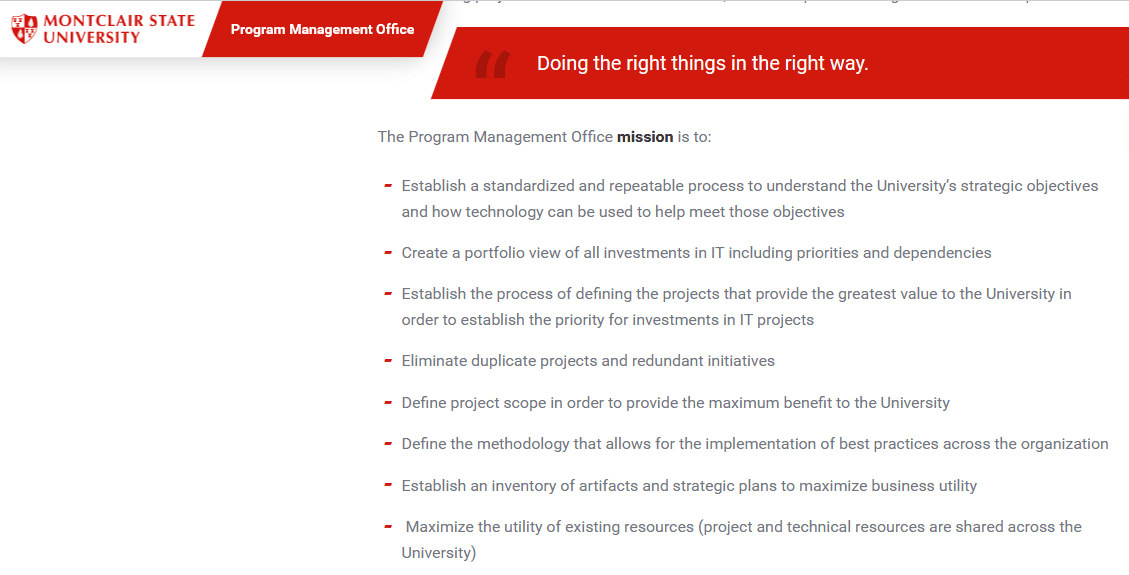
Montclair University (Academic Sector): Their PMO mission, in part, focuses on "providing leadership, guidance, and support for the effective and efficient delivery of strategic projects and programs that advance the University’s mission." This emphasizes the PMO’s role in governance, resource management, and strategic alignment within an educational institution, where projects often support academic programs, research, or infrastructure improvements. The longer version highlights standards, best practices, and collaborative partnerships, reflecting the complex, multi-stakeholder environment of a university.
-
Ministry of Works, Government of Bahrain (Public Sector): This example, while potentially outdated in its online presentation, highlights a public sector focus on "ensuring efficient delivery of infrastructure projects, adherence to national development plans, and implementation of best practices." Public sector PMOs often emphasize accountability, taxpayer value, regulatory compliance, and the successful execution of projects that directly benefit citizens and national infrastructure. Their vision statement outlines a commitment to transparency, quality, and sustainable development.
-
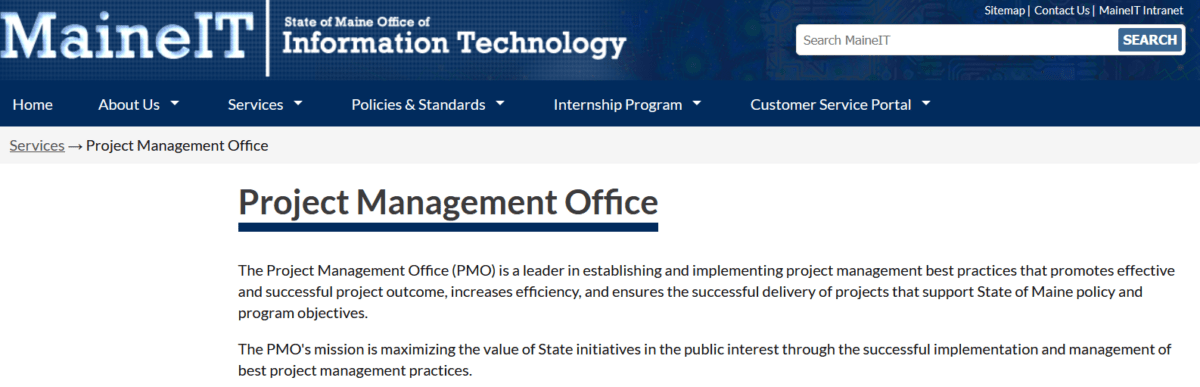
State of Maine Office of Information Technology (Government IT): Their mission centers on "maximizing the value of State initiatives in the public interest through the successful implementation and management of best project management practices." This clearly articulates the dual focus on project excellence and public service. For a government IT PMO, key elements include ensuring secure and efficient technological solutions, supporting state policy, and delivering reliable services to citizens, all within the constraints of public funding and accountability. Their emphasis on guidance throughout the project lifecycle demonstrates a supportive yet directive approach to ensure successful outcomes.
-
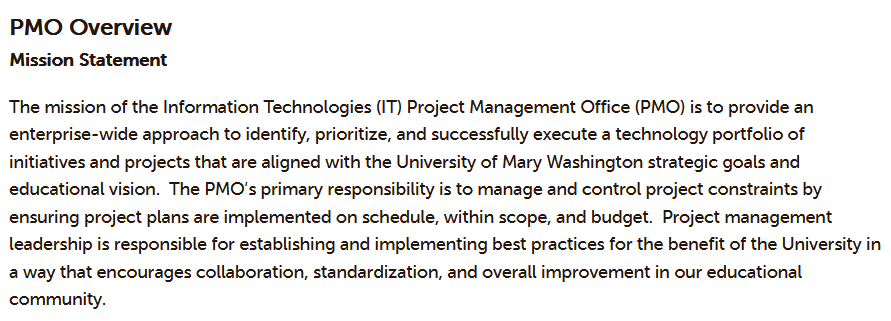
University of Mary Washington (Academic IT): Their vision statement (often closely related to mission) for the IT department’s PMO focuses on "fostering innovation, enhancing technological capabilities, and providing exceptional project leadership to empower the university community." This reflects the strategic role of IT in higher education, supporting learning, research, and administrative functions, with a clear emphasis on enabling the academic mission through technology.
These examples underscore that while the core principles of a PMO mission statement remain consistent, the specific phrasing and emphasis will vary significantly based on the organization’s industry, strategic objectives, and the unique challenges it faces. Government and academic institutions are particularly good sources for examples, as they often publish their strategic documents publicly.
Implications for PMO Effectiveness and Organizational Performance
The establishment and active promotion of a powerful PMO mission statement carry profound implications for both the PMO’s internal effectiveness and its broader impact on organizational performance.
Firstly, a clear mission significantly enhances project success rates. When the PMO’s purpose is well-defined and understood, it can more effectively prioritize projects that align with strategic objectives, implement robust governance frameworks, and provide targeted support to project teams. This leads to better project selection, more efficient execution, and a higher likelihood of delivering desired outcomes on time and within budget.
Secondly, it contributes to improved resource utilization. By focusing the PMO’s efforts on high-value activities dictated by its mission, organizations can avoid wasting resources on misaligned or low-impact projects. This strategic allocation of human and financial capital ensures that investments in project management yield optimal returns.
Thirdly, a strong mission statement helps to cultivate a robust project management culture throughout the organization. It elevates the importance of project management as a discipline and encourages best practices, consistency, and professionalism across all departments. This fosters an environment where projects are seen not just as tasks, but as critical drivers of strategic change.
Finally, it bolsters executive confidence in the PMO. When the PMO can clearly articulate its value proposition and demonstrate how its activities directly contribute to strategic goals, senior leadership is more likely to provide the necessary support, funding, and authority. This increased confidence solidifies the PMO’s position as a strategic partner rather than merely an administrative overhead.
In an era characterized by continuous disruption and the imperative for agile adaptation, a well-defined PMO mission statement provides stability and direction. It allows the PMO to evolve its services and methodologies while remaining anchored to its core purpose, ensuring sustained relevance and impact. By periodically reviewing and, if necessary, revising the mission statement, organizations can ensure it remains a dynamic and accurate reflection of their evolving strategic landscape. Ultimately, a powerful PMO mission statement is not just a document; it is a strategic asset that underpins successful project delivery and drives continuous organizational improvement.
Related posts: