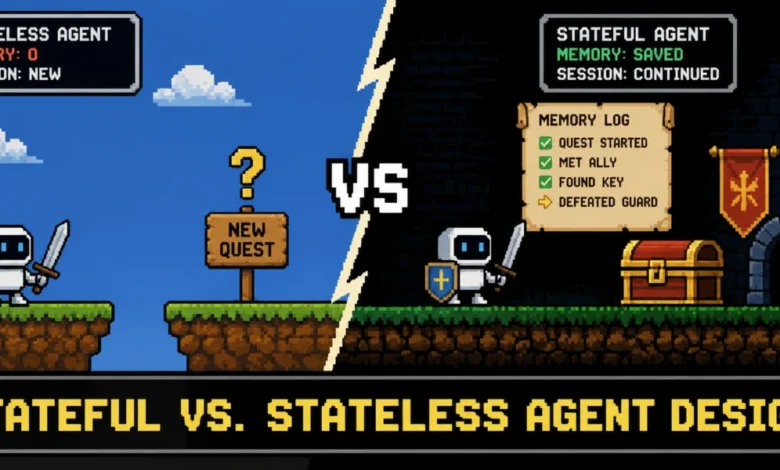
A fundamental decision in the architecture of AI agents, one that precedes even the configuration of load balancers, concerns the locus of the agent’s memory. Whether an agent operates in a stateless or stateful manner profoundly influences its implementation and the entire deployment infrastructure surrounding it. This distinction dictates how an agent manages its internal state – encompassing conversation history and accumulated context – and has significant ramifications for scalability, complexity, and user experience.
The Core Architectural Divide: Stateless vs. Stateful Agents
At its heart, the divergence lies in how agents handle the continuity of interaction. Stateless agents operate on a "fire and forget" principle, treating each user request as an isolated event. They receive a prompt, process it using a language model, and deliver a response. Once the interaction concludes, the agent retains no memory of the exchange. Conversely, stateful agents shoulder the burden of memory themselves. They maintain a persistent record of past interactions, allowing for a more natural, context-aware conversation flow. This fundamental difference impacts everything from the client-side experience to the backend infrastructure required to support these agents.
Stateless Agents: The Simplicity of Isolation
Stateless agents offer a compelling advantage in terms of scalability. Because they do not store any user-specific information on backend servers, incoming requests can be routed to any available agent instance. This horizontal scalability is a significant boon for systems designed to handle a large volume of concurrent users. The implementation is relatively straightforward: the agent receives a prompt, often accompanied by the entirety of the preceding conversation history, invokes the language model, and returns the result.
However, this architectural simplicity comes with a notable drawback, particularly in multi-turn conversations. The responsibility for maintaining and transmitting the conversation history falls upon the client. With each subsequent turn, the client must resend the entire dialogue to the agent. This can lead to a rapid expansion of the context window, driving up token usage and, consequently, operational costs. The "context window" refers to the amount of text an AI model can consider at any given time. As conversations lengthen, the volume of data that needs to be sent with each request grows exponentially, potentially overwhelming the model’s capacity or leading to exorbitant computational expenses.
Illustrative Example: Stateless Agent in Practice
To demonstrate the mechanics of a stateless agent, consider a simplified implementation utilizing the Groq API, known for its high-speed inference capabilities. The Groq platform offers efficient language models, such as llama-3.1-8b-instant, which are well-suited for illustrating these concepts. Initial setup involves installing the groq Python library and configuring an API key.
import os
from groq import Groq

# Obtain an API key from https://console.groq.com/keys and set it here
os.environ["GROQ_API_KEY"] = "PASTE_YOUR_GROQ_API_KEY_HERE"

# Initialize the client
client = Groq()

# Using an efficient model from Groq: Llama 3.1 8B Instant
MODEL_ID = "llama-3.1-8b-instant"
The stateless_agent function exemplifies this paradigm. It accepts a user prompt and an optional list representing the conversation history provided by the client. Crucially, the agent itself does not store any memory of past interactions.
def stateless_agent(prompt: str, provided_history: list = None) -> str:
    """
    The agent relies completely on the client to provide context.
    It retains no information from past interactions in local memory.
    """
    # Initializing with a system prompt
    messages = ["role": "system", "content": "You are a helpful, concise assistant."]

    # Appending whatever history the client provided
    if provided_history:
        messages.extend(provided_history)

    # Appending the new prompt
    messages.append("role": "user", "content": prompt)

    # The LLM processes the entire chain of messages
    response = client.chat.completions.create(
        model=MODEL_ID,
        messages=messages,
        max_tokens=100
    )
    return response.choices[0].message.content.strip()
A simulation of a user-agent conversation highlights the limitations:
# --- Testing the Stateless Agent ---
print("--- Turn 1 ---")
prompt_1 = "Hi, my name is Alice and I am learning about API infrastructure."
response_1 = stateless_agent(prompt_1)
print(f"Agent: response_1")

print("n--- Turn 2 (Without Client Context) ---")
# The agent fails here because it retained no memory of Turn 1
prompt_2 = "What is my name and what am I learning about?"
response_2 = stateless_agent(prompt_2)
print(f"Agent: response_2")

print("n--- Turn 2 (With Client Context) ---")
# The frontend MUST inject the history into the payload for the agent to succeed
frontend_payload = [
    "role": "user", "content": prompt_1,
    "role": "assistant", "content": response_1
]
response_3 = stateless_agent(prompt_2, provided_history=frontend_payload)
print(f"Agent: response_3")
The output clearly demonstrates the agent’s inability to recall previous information when the context is not explicitly provided.
Output:
--- Turn 1 ---
Agent: Hello Alice, nice to meet you. Learning about API infrastructure can be a fascinating and rewarding topic. What specific aspects of API infrastructure would you like to explore or discuss? Are you looking for information on API management, security, deployment, or something else?

--- Turn 2 (Without Client Context) ---
Agent: Unfortunately, I don't have any information about you, including your name. Our conversation just started, so I'm here to help you with any questions or topics you'd like to learn about. Please feel free to share your name and a topic you're interested in learning about.

--- Turn 2 (With Client Context) ---
Agent: Your name is Alice, and you are learning about API infrastructure.
This illustrates that while the implementation is simple, the agent’s utility in maintaining coherent dialogue is entirely dependent on the client’s ability to manage and transmit the conversation history.
Stateful Agents: The Power of Persistent Memory
In contrast, stateful agents take on the responsibility of managing conversational memory. The client’s role is simplified: it only needs to send the latest user prompt along with a unique session identifier. The agent then retrieves the relevant conversation history from a persistent storage layer, such as a database, appends the new message, processes it through the language model, and updates the stored history with the agent’s response.
The Tradeoffs of Statefulness
This approach offers a significantly smoother client-side experience, as the user does not need to worry about managing historical context. Furthermore, stateful agents are better equipped to handle complex, asynchronous workflows. They can pause their execution, await responses from external tools or human approvals, and then resume with full awareness of the ongoing dialogue.
However, this enhanced functionality comes with increased architectural complexity and operational overhead. Scaling stateful systems is inherently more challenging due to the necessity of a robust persistent database layer. In horizontally scaled infrastructures, strategies like centralized memory caching, often implemented with solutions like Redis, become crucial to prevent "localized amnesia." This phenomenon occurs when a session’s history is confined to a single server instance, leading to a loss of context if subsequent requests are routed to a different instance. Managing this distributed state requires careful design and robust synchronization mechanisms.
Illustrative Example: Stateful Agent with SQLite
To illustrate the stateful agent paradigm, we can employ a simple persistent storage mechanism. For demonstration purposes, an in-memory SQLite database is utilized. The core principle is that the agent manages its own memory.
import sqlite3
import json

# Initializing an in-memory SQLite database for notebook testing
conn = sqlite3.connect(':memory:')
cursor = conn.cursor()
cursor.execute('''CREATE TABLE IF NOT EXISTS agent_memory (session_id TEXT PRIMARY KEY, history TEXT)''')
conn.commit()

def stateful_agent(session_id: str, new_prompt: str) -> str:
    """
    The agent manages its own state using a database.
    The client only sends the new prompt and their session ID.
    """
    # 1. Retrieving existing state from the database
    cursor.execute("SELECT history FROM agent_memory WHERE session_id=?", (session_id,))
    row = cursor.fetchone()
    if row:
        conversation_history = json.loads(row[0])
    else:
        # Initializing with system prompt for new sessions
        conversation_history = ["role": "system", "content": "You are a helpful, concise assistant."]

    # 2. Appending the new user prompt
    conversation_history.append("role": "user", "content": new_prompt)

    # 3. Processing the LLM call using the retrieved history
    response = client.chat.completions.create(
        model=MODEL_ID,
        messages=conversation_history,
        max_tokens=100
    ).choices[0].message.content.strip()

    # 4. Updating the state with the assistant's reply
    conversation_history.append("role": "assistant", "content": response)

    # 5. Saving the new state back to the database
    cursor.execute('''
        INSERT INTO agent_memory (session_id, history)
        VALUES (?, ?)
        ON CONFLICT(session_id) DO UPDATE SET history=excluded.history
    ''', (session_id, json.dumps(conversation_history)))
    conn.commit()

    return response
A test conversation highlights the stateful agent’s ability to retain context:
# --- Testing the Stateful Agent ---
print("--- Turn 1 ---")
print(f"Agent: stateful_agent('user_123', 'Hi, I am Bob and I want to scale my AI app.')")

print("n--- Turn 2 ---")
# Notice how the client NO LONGER sends the context payload. Just the session ID.
print(f"Agent: stateful_agent('user_123', 'What was my name again?')")
Output:
--- Turn 1 ---
Agent: Hello Bob, scaling an AI app can be a complex process. May I ask:
1. What type of AI technology is your app built on? (e.g., machine learning, natural language processing, computer vision)
2. Are you using any cloud services like AWS, Google Cloud, or Azure?
3. What are your scalability goals (e.g., increase user count, reduce latency, improve response times)?
This information will help me better understand your requirements and provide more effective assistance.

--- Turn 2 ---
Agent: Your name is Bob.
This demonstrates the fundamental difference: the stateful agent, by managing its own memory, can recall previous information without requiring the client to resend the entire conversation history.
The Balancing Act: Key Considerations for Deployment
The choice between a stateful and stateless architectural design is not merely a technical preference; it is a strategic decision that must align with the specific requirements of the AI agent’s intended application and the projected scale of its usage.
Scalability: Stateless architectures inherently lend themselves to massive horizontal scaling. This is ideal for applications expecting a very high volume of independent interactions, such as broad customer service chatbots or real-time data processing pipelines where each request is self-contained. The ability to distribute load across numerous identical instances without complex state synchronization is a significant advantage.
Complexity and Development Effort: Stateless agents are generally simpler to develop and deploy initially. The logic is contained within each request-response cycle, reducing the need for intricate state management mechanisms. Stateful agents, conversely, require careful consideration of database design, data consistency, and potential caching strategies, adding layers of complexity to the development process.
Cost Implications: While stateless agents might seem cost-effective due to their simplicity, the escalating token costs associated with retransmitting long conversation histories can become a significant factor. Stateful agents, by reducing redundant data transmission, can potentially offer cost savings in scenarios with lengthy dialogues, provided the database and caching infrastructure are managed efficiently.
User Experience: For applications demanding a natural, flowing conversational experience, stateful agents are generally superior. The ability to remember context and engage in more personalized interactions significantly enhances user satisfaction. Stateless agents can provide a disjointed experience if not meticulously managed by the client-side application.
Workflow Complexity: Stateful agents are better suited for complex workflows that involve multi-step processes, tool integration, or asynchronous operations. Their ability to maintain context across these operations is crucial for successful execution. Stateless agents would struggle to manage such intricate sequences without external orchestration.
Data Persistence and Reliability: The persistence of conversation history is a key differentiator. Stateful agents, by design, ensure that historical data is stored reliably, allowing for recovery and auditing. Stateless agents rely on the client to maintain this history, introducing a potential single point of failure if the client-side storage is compromised.
In conclusion, the architectural choice between stateful and stateless AI agents hinges on a careful evaluation of these trade-offs. For applications prioritizing ease of scaling and simplicity, a stateless approach might be optimal. However, for systems requiring rich conversational experiences, complex workflows, and reliable context management, the added complexity of a stateful architecture is often a necessary investment. As AI agent technology continues to mature, understanding these fundamental design principles will be paramount for building robust, scalable, and effective agentic systems.