A Deep Learning-Based Explainable Next-Best-Product Recommendation System Empowers Banking Institutions to Predict Customer Needs

Building a sophisticated deep learning-based explainable next-best-product recommendation system is becoming a critical capability for banking institutions aiming to proactively identify and offer products that best align with individual customer needs. In an era where customer data is abundant—encompassing transaction histories, existing product portfolios, demographic profiles, and intricate behavioral patterns—the challenge lies in transforming this wealth of information into actionable, highly personalized product suggestions. Traditional recommendation engines, often reliant on rule-based logic or collaborative filtering, frequently falter in capturing the nuanced temporal dynamics inherent in a customer’s product adoption journey.
This article delves into the architectural design and strategic decisions behind a cutting-edge Next-Best-Product (NBP) recommendation system, meticulously engineered using Amazon SageMaker AI and the PyTorch deep learning framework. We will explore the rationale underpinning a multi-tower neural network architecture, the innovative use of learned attention for per-customer explainability, and how a suite of AWS services facilitates the seamless transition of this solution from research and development to robust production deployment. While this piece offers an architectural overview rather than a step-by-step deployment guide, the patterns and methodologies discussed hold significant value for anyone involved in designing recommendation systems, whether within the highly regulated financial services sector or any domain characterized by heterogeneous customer data, with the ultimate goal of building more accurate and interpretable predictive models.
Prerequisites for Implementing Advanced Recommendation Systems
To fully grasp the architectural patterns and code examples presented, a foundational understanding of certain technologies and practices is beneficial. This includes familiarity with Python programming, the PyTorch deep learning library, and core AWS services such as Amazon SageMaker, Amazon S3, and AWS Glue. Proficiency in data manipulation libraries like Pandas and Dask is also advantageous, particularly for handling large-scale datasets and complex feature engineering tasks.
For organizations prioritizing security, adherence to the principle of least privilege is paramount. Guidance on crafting effective Identity and Access Management (IAM) policies for Amazon SageMaker can be found in the official AWS documentation, ensuring that access to resources is granted only to those services and users who require it for their specific functions.
It is also strongly recommended to utilize a virtual environment for managing project dependencies. Furthermore, proactively scanning these dependencies for known vulnerabilities using tools like pip-audit before deployment is a crucial step in maintaining a secure and stable system.
It is important to note that the deployment of this comprehensive solution will incur AWS charges. These include costs associated with SageMaker training jobs (specifically, instances like ml.g5.12xlarge equipped with powerful GPUs), SageMaker endpoints for inference, Amazon S3 storage for data assets, and AWS Glue jobs for data processing. To prevent ongoing expenses, it is essential to follow the provided clean-up instructions at the conclusion of this article.
Solution Overview: A Multi-Tower Architecture for Enhanced Accuracy and Explainability
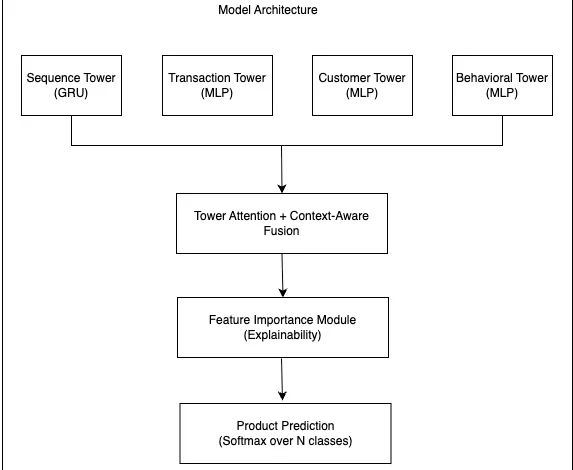
At the heart of this advanced recommendation system lies a sophisticated multi-tower deep learning architecture. This design features four distinct neural network towers, each meticulously engineered to process a specific facet of customer data. These specialized towers are then unified through a learned attention mechanism, a novel approach that simultaneously drives high prediction accuracy and delivers granular, per-customer explainability.
The accompanying diagram illustrates the high-level architectural framework of the solution:
[Insert Diagram: Multi-tower architecture with four specialized neural network towers fused by a learned attention mechanism to produce explainable product recommendations. The diagram should visually depict the four input data types (Sequence, Transaction, Customer, Behavioral), their respective towers, the attention mechanism, and the final output.]
This architecture directly addresses a pervasive challenge within the banking industry: the accurate prediction of a customer’s next likely product acquisition from a diverse range of offerings, including credit cards, savings and checking accounts, insurance policies, personal loans, and mortgages. Crucially, the system is designed to provide transparent, explainable results that can satisfy stringent regulatory requirements, a non-negotiable aspect of financial services.
The Technology Stack: A Synergistic Blend of AWS and Open-Source Tools
The selection of technologies for this solution is deliberate, aiming to leverage the strengths of both cloud-native AWS services and widely adopted open-source libraries. This synergy ensures scalability, flexibility, and efficient processing.
| Component | Technology | Purpose |
|---|---|---|
| ETL & Data Processing | AWS Glue (PySpark) | Serverless Spark-based ETL for data unification, service mapping, feature engineering at scale. |
| Deep Learning Framework | PyTorch | Dynamic computation graphs, research-to-production flexibility, native GPU support. |
| Feature Engineering | Pandas, Dask, PyArrow | ML-specific feature engineering (sequence creation, windowed aggregations). |
| ML Utilities | scikit-learn | Label encoding, standard scaling, train/test split, evaluation metrics. |
| Training Compute | SageMaker (ml.g5.12xlarge) | 192 GB RAM, 4 NVIDIA A10G GPUs, providing substantial computational power. |
| Data Storage | Amazon S3 | Snappy-compressed Parquet files for raw, intermediate, and processed data. |
| Data Catalog | AWS Glue Data Catalog | Schema management, table metadata, crawlers for auto-discovery. |
| Model Registry | SageMaker model registry | Versioned model artifacts, approval workflows. |
| Inference | SageMaker Batch Transform / endpoint | Batch and near-real-time predictions. |
| Orchestration | Amazon SageMaker Pipelines | End-to-end ML pipeline orchestration. |
| Monitoring | CloudWatch | Training metrics, inference latency, model drift detection. |
Why PyTorch? Adaptability for Dynamic Data and Production Readiness
PyTorch was chosen for its dynamic computation graph capabilities, which are particularly well-suited for handling variable-length sequences, a common characteristic of customer interaction data. The pack_padded_sequence function in PyTorch is essential for efficiently processing such sequences without being hampered by padding. Furthermore, PyTorch offers remarkable flexibility, facilitating rapid iteration during the research and development phases and ensuring a smooth transition to production environments due to its native integration with SageMaker training and inference containers.
Why Parquet on Amazon S3? Efficiency and Cost-Effectiveness for Big Data
Storing data in Snappy-compressed Parquet format on Amazon S3 offers significant advantages for large-scale data processing. Parquet’s columnar storage structure enables critical optimizations such as column pruning (reading only necessary columns) and predicate pushdown (filtering data at the storage level). This translates to dramatically faster query times and reduced data transfer costs. Compared to row-based formats like CSV, Parquet provides superior compression ratios (typically 3-5x) and preserves data types, eliminating the need for re-parsing on every read and enhancing data integrity.
Why AWS Glue for ETL? Serverless Scalability and Data Management
AWS Glue, a fully managed ETL service, is instrumental in handling the complex data unification and transformation tasks. By running PySpark jobs on a serverless, auto-scaling infrastructure, AWS Glue eliminates the need for managing underlying compute resources. Its native Spark integration, coupled with the DynamicFrame API for flexible schema handling, automatic registration with the AWS Glue Data Catalog, and job bookmarks for efficient incremental processing, makes it an ideal choice for building robust and cost-effective data pipelines.
Data Pipeline Architecture: From Raw Data to ML-Ready Features
The data pipeline is architected in two distinct stages to ensure both comprehensive data unification and highly specific ML feature engineering.
Data Unification with AWS Glue: Creating a Single Source of Truth
Banking data is notoriously fragmented, often originating from disparate source systems with varying schemas. The AWS Glue ETL job serves as the foundational layer, normalizing these inconsistent schemas. It maps raw transaction types to standardized service categories, consolidating all customer data into a single, chronologically ordered record. This stage also involves the initial engineering of temporal features that capture the timing and sequence of customer interactions. The meticulously processed output is then stored as Parquet files on Amazon S3 and automatically cataloged in the AWS Glue Data Catalog, establishing a reliable single source of truth for subsequent stages.
ML-Specific Feature Engineering with Amazon SageMaker Processing: Tailoring Data for the Model
Following the data unification by AWS Glue, an Amazon SageMaker Processing job takes over to perform ML-specific feature engineering. This stage is crucial for preparing the data in a format directly consumable by the deep learning model. Key tasks include creating product adoption sequences for each customer, computing time-windowed transaction aggregations over various periods (7, 30, 60, 180, and 365 days) utilizing Dask for efficient parallel processing, and padding variable-length sequences to a fixed length to meet the input requirements of the neural network.
Handling Large-Scale Data: Strategies for Memory Efficiency
For datasets that exceed the memory capacity of a single machine, the solution employs a parallel chunked processing strategy. This involves leveraging PyArrow for efficient metadata inspection, utilizing ProcessPoolExecutor for parallel processing of data chunks, implementing explicit garbage collection between batches to free up memory, and employing incremental merging techniques to avoid memory spikes.
import gc
from concurrent.futures import ProcessPoolExecutor

chunksize = 5_000_000
n_workers = 4

for batch_start in range(0, total_chunks, n_workers):
    with ProcessPoolExecutor(max_workers=n_workers) as executor:
        futures = [
            executor.submit(process_chunk_range, input_path, output_path, i, start_row, end_row)
            for i in range(batch_start, min(batch_start + n_workers, total_chunks))
        ]
        for future in futures:
            future.result()
    gc.collect()  # Force garbage collection between batches
When working with sensitive customer data, adherence to security best practices for handling Personally Identifiable Information (PII), regulatory compliance, and robust data governance is paramount, as detailed in the Security Considerations section.
Model Architecture: The Power of Multi-Tower Specialization and Learned Fusion
The core of the recommendation engine is a multi-tower architecture, where each tower is specialized to process a distinct category of customer data, followed by an innovative attention-based fusion mechanism.
Why Multi-Tower Over a Single Network? Catering to Data Diversity
Different types of customer data possess fundamentally different structures and characteristics. Product adoption history, for instance, is an ordered sequence of discrete identifiers. Transaction data comprises numerical aggregations, while demographic information is a blend of categorical and numerical features. Behavioral segments are typically represented by categorical codes. Forcing all these diverse data types through the same generic neural network layers can lead to an inefficient use of model capacity.
The proposed architecture circumvents this limitation by employing four specialized towers, each optimally designed for its specific input type:
| Tower | Input Type | Architecture | Output |
|---|---|---|---|
| Sequence Tower | Product adoption history (padded to fixed length) | nn.Embedding → 2-layer GRU → Fusion with active product count | 64-dim vector |
| Transaction Tower | Time-windowed transaction features | 2-layer MLP (128 → 64) with ReLU and Dropout | 64-dim vector |
| Customer Tower | Demographics, income, family, account features | 2-layer MLP (128 → 64) with ReLU and Dropout | 64-dim vector |
| Behavioral Tower | Segmentation codes, loyalty, usage patterns | 2-layer MLP (128 → 64) with ReLU and Dropout | 64-dim vector |
Sequence Tower: Capturing the Temporal Dynamics of Product Adoption
The Sequence Tower is engineered to process a customer’s historical product adoption journey. It employs a 2-layer Gated Recurrent Unit (GRU), a powerful recurrent neural network architecture specifically designed for sequential data. This is a critical component as it effectively captures the order in which customers adopt products, moving beyond a static view of current product ownership. The GRU’s ability to maintain a hidden state allows it to learn long-term dependencies within the sequence.
import torch
import torch.nn as nn
import torch.nn.utils.rnn as rnn_utils

class SequenceTower(nn.Module):
    def __init__(self, num_products, embedding_dim=32, hidden_dim=64, dropout=0.2):
        super().__init__()
        self.embedding = nn.Embedding(num_products + 1, embedding_dim, padding_idx=0)
        self.gru = nn.GRU(
            input_size=embedding_dim, hidden_size=hidden_dim,
            num_layers=2, batch_first=True, dropout=dropout
        )
        self.active_count_layer = nn.Sequential(
            nn.Linear(1, hidden_dim // 2), nn.ReLU(), nn.Dropout(dropout)
        )
        self.fusion = nn.Sequential(
            nn.Linear(hidden_dim + hidden_dim // 2, hidden_dim),
            nn.ReLU(), nn.Dropout(dropout)
        )

    def forward(self, sequence, seq_length, active_count):
        embedded = self.embedding(sequence)
        packed = rnn_utils.pack_padded_sequence(
            embedded, seq_length.cpu().clamp(min=1),
            batch_first=True, enforce_sorted=False
        )
        _, hidden = self.gru(packed)
        seq_features = hidden[-1] # Use the last hidden state from the last layer
        active_features = self.active_count_layer(active_count.float().unsqueeze(1)) # Ensure active_count is float and has correct shape
        return self.fusion(torch.cat([seq_features, active_features], dim=1))
Why GRU Over LSTM? A Balance of Performance and Efficiency
The choice between GRU and Long Short-Term Memory (LSTM) networks often hinges on complexity and performance. GRUs, with their two gates (reset and update), are computationally less intensive than LSTMs (which have three gates: input, forget, and output). This reduction in parameters (approximately 33% fewer) can lead to faster training times. For sequences of moderate length, such as product adoption histories which might not be excessively long, GRUs often exhibit performance comparable to LSTMs. The GRU’s update gate inherently incorporates a form of residual connection, facilitating smoother gradient flow during training.
Why pack_padded_sequence? Handling Variable Sequence Lengths
Customer product adoption histories are inherently variable in length. Simply padding shorter sequences with zeros can introduce noise and lead the GRU to learn spurious patterns from these padding tokens. The pack_padded_sequence function intelligently masks these padding tokens, ensuring that the GRU only processes the actual data points in each sequence, thereby enhancing model accuracy and efficiency.

Tower Attention Mechanism: Learned Fusion with Built-in Explainability
Instead of a simple concatenation of outputs from the different towers, the architecture employs a learned attention mechanism to fuse them. This is a pivotal innovation that provides per-customer explainability intrinsically, eliminating the need for post-hoc interpretation techniques like SHAP or LIME.
class TowerAttentionMechanism(nn.Module):
    def __init__(self, hidden_dim=64, num_heads=4, dropout=0.1):
        super().__init__()
        self.tower_attention = nn.MultiheadAttention(
            embed_dim=hidden_dim, num_heads=num_heads,
            dropout=dropout, batch_first=True
        )
        self.context_weighting = nn.Sequential(
            nn.Linear(hidden_dim * 4, 4), nn.Softmax(dim=1)
        )

    def forward(self, tower_outputs):
        stacked = torch.stack(tower_outputs, dim=1)  # [batch, 4, 64]
        # Apply multi-head attention to capture inter-tower relationships
        attended, _ = self.tower_attention(stacked, stacked, stacked)
        # Add residual connection for stable training
        stacked = stacked + attended  # Residual connection
        # Concatenate original tower outputs for context weighting
        concat = torch.cat(tower_outputs, dim=1)  # [batch, 256]
        # Compute context-aware weights for each tower
        tower_weights = self.context_weighting(concat)  # [batch, 4]
        # Apply learned weights to each tower's output
        weighted_outputs = [
            tower_outputs[i] * tower_weights[:, i:i+1]
            for i in range(4)
        ]
        return weighted_outputs, tower_weights
The calculated tower_weights are specific to each customer. This means a customer with a rich transaction history will naturally receive a higher weight for the Transaction Tower, while a new customer with clear demographic indicators might be assigned a higher weight for the Customer Tower. This adaptive weighting mechanism not only boosts prediction accuracy but also provides intuitive explainability for relationship managers and regulatory bodies, allowing them to understand the primary drivers behind a particular recommendation for an individual.
Context-Aware Fusion: Residual Blocks for Stable Training
The weighted outputs from the individual towers are then fed into a fusion network. This network incorporates residual connections, a crucial architectural element that significantly aids gradient flow during training. Residual connections enable the network to learn identity mappings when additional depth is not beneficial, preventing the vanishing gradient problem and allowing for the training of deeper, more complex models.
class ContextAwareFusion(nn.Module):
    def __init__(self, hidden_dim=64, dropout=0.2):
        super().__init__()
        # Initial projection to combine weighted tower outputs
        self.initial_projection = nn.Linear(hidden_dim * 4, hidden_dim)
        # First residual block
        self.fusion1 = nn.Sequential(
            nn.Linear(hidden_dim, hidden_dim * 2), nn.LayerNorm(hidden_dim * 2),
            nn.ReLU(), nn.Dropout(dropout), nn.Linear(hidden_dim * 2, hidden_dim)
        )
        self.layer_norm1 = nn.LayerNorm(hidden_dim)
        # Second residual block
        self.fusion2 = nn.Sequential(
            nn.Linear(hidden_dim, hidden_dim), nn.ReLU(), nn.Dropout(dropout)
        )
        self.layer_norm2 = nn.LayerNorm(hidden_dim)

    def forward(self, weighted_outputs):
        # Concatenate weighted outputs from all towers
        concat = torch.cat(weighted_outputs, dim=1)
        # Initial projection
        projected = self.initial_projection(concat)
        # Apply first residual block
        out1 = self.layer_norm1(projected + self.fusion1(projected))
        # Apply second residual block
        out2 = self.layer_norm2(out1 + self.fusion2(out1))
        return out2
Feature Importance Module: Integrated Explainability for Regulatory Compliance
Regulatory compliance in the banking sector mandates a high degree of model explainability. To meet this requirement without resorting to post-hoc methods, the architecture includes a dedicated Feature Importance Module. This module is integrated directly into the forward pass of the model and generates per-customer importance scores that sum to 1.0.
class FeatureImportanceModule(nn.Module):
    def __init__(self, hidden_dim=64):
        super().__init__()
        # Softmax layer to output importance scores for each tower
        self.feature_contribution = nn.Sequential(
            nn.Linear(hidden_dim, 4), nn.Softmax(dim=1)
        )

    def forward(self, fused_features, tower_weights):
        # Calculate feature importance based on fused features
        feature_importance = self.feature_contribution(fused_features)
        # Combine with learned tower weights for final importance scores
        return feature_importance * tower_weights
This module provides outputs such as: "For this customer, 40% of the recommendation was driven by their product sequence, 30% by transaction patterns, 20% by demographics, and 10% by their behavioral segment." This level of detail empowers relationship managers to tailor their client interactions more effectively and provides regulators with the transparency they require.
Training Strategy: Optimizing for Performance and Reproducibility
The training configuration is meticulously designed to achieve optimal model performance and ensure reproducibility.
| Parameter | Value | Rationale |
|---|---|---|
| Optimizer | Adam (lr=0.001, weight_decay=1e-5) | Adaptive per-parameter learning rates, light L2 regularization for preventing overfitting. |
| Loss | CrossEntropyLoss | Standard and numerically stable loss function for multi-class classification. |
| LR Scheduler | ReduceLROnPlateau (factor=0.5, patience=3) | Dynamically adjusts learning rate based on validation loss, preventing premature convergence. |
| Gradient Clipping | max_norm=1.0 | Prevents exploding gradients, especially crucial for RNNs and attention mechanisms. |
| Early Stopping | patience=5 | Halts training when validation performance ceases to improve, saving computational resources. |
| Batch Size | 32 | Balances computational efficiency with memory constraints on GPU instances. |
| Data Split | 80% train / 10% validation / 10% test | Standard practice for robust model evaluation and generalization assessment. |
To ensure complete reproducibility, all random seeds (for PyTorch, NumPy, and CUDA) are fixed. This guarantees that identical training runs will produce identical results, which is critical for debugging and for maintaining model consistency over time.
The training process leverages Amazon SageMaker with ml.g5.12xlarge instances, providing substantial GPU resources. The SageMaker Python SDK simplifies the training workflow by offering a PyTorch Estimator. This Estimator packages the training script, provisions the necessary GPU instances, executes the training job, and automatically stores the resulting model artifacts in Amazon S3.
from sagemaker.pytorch import PyTorch

# Assuming 'role' is pre-defined IAM role ARN
estimator = PyTorch(
    entry_point='train.py',
    source_dir='src/',
    role=role,
    instance_count=1,
    instance_type='ml.g5.12xlarge',
    framework_version='2.5.0',
    py_version='py311',
    hyperparameters=
        'epochs': 50,
        'batch_size': 32,
        'learning_rate': 0.001,
    ,
)
Evaluation Metrics: Measuring Business Impact
The success of the recommendation system is measured using metrics that directly correlate with tangible business value:
| Metric | What It Measures | Business Relevance |
|---|---|---|
| Top-1 Accuracy | Exact prediction accuracy | Did the model predict the precise product the customer needs? |
| Top-3 Accuracy | Correct product in top 3 predictions | Is the ideal product among the top choices presented to a relationship manager? |
| Top-5 Accuracy | Correct product in top 5 predictions | Is the recommended product visible in a customer-facing carousel or suggestion list? |
| MRR (Mean Reciprocal Rank) | Average reciprocal rank of correct product | How high up the list is the correct product on average? |
| Weighted F1 | Per-class precision/recall balance | Does the model perform well across all product categories, avoiding bias? |
In practical evaluations, this model consistently achieved strong performance across these metrics. The correct product was frequently found within the top-3 recommendations, indicating high utility for relationship managers. Furthermore, the Feature Importance Module confirmed that the Sequence Tower, representing product adoption history, provided the most significant predictive signal, followed by transaction patterns, customer demographics, and behavioral segmentation, in that order.
Inference and Deployment: Batch and Real-Time Recommendations
The inference pipeline is designed to support both high-throughput batch scoring and low-latency real-time predictions, leveraging the capabilities of Amazon SageMaker.
For batch scoring, Amazon SageMaker Batch Transform processes the entire customer base on a nightly basis. This generates a comprehensive set of top-k recommendations, along with their associated explainability scores, for each customer. These results are then stored as JSON files on Amazon S3, making them readily accessible for integration with Customer Relationship Management (CRM) systems and dashboards used by relationship managers.
For scenarios requiring immediate recommendations, such as when a customer logs into the mobile banking app or a relationship manager accesses a customer profile, a SageMaker real-time endpoint is deployed. This endpoint serves on-demand predictions with minimal latency.
Each recommendation delivered by the system includes:
- Product Recommendation: The predicted next product.
- Confidence Score: The model’s certainty in the prediction.
- Explainability Score: Per-tower contribution to the recommendation, detailing the influence of product history, transactions, demographics, and behavior.
def generate_batch_recommendations(model, dataloader, top_k=5):
    model.eval() # Set model to evaluation mode
    all_recommendations = []
    with torch.no_grad(): # Disable gradient calculation for inference
        for batch in dataloader:
            # Assuming model takes all tower outputs and returns outputs and feature_importance
            outputs, feature_importance = model(
                batch['sequence'], batch['seq_length'],
                batch['active_count'], batch['transaction'],
                batch['customer'], batch['behavioral']
            )
            # Apply softmax to get probabilities and move to CPU for numpy conversion
            probabilities = torch.softmax(outputs, dim=1).cpu().numpy()

            # Logic to generate top-k recommendations with explainability scores would go here
            # This would involve sorting probabilities and associating them with product IDs and feature importance
            # ... (implementation details for generating recommendations and scores)
            # Example placeholder:
            # recommendations_for_batch = process_probabilities_and_importance(probabilities, feature_importance, batch_metadata, top_k)
            # all_recommendations.extend(recommendations_for_batch)

    return all_recommendations # Or save to S3 directly
To enhance the security of these endpoints, best practices include implementing IAM authentication, rate limiting to prevent abuse, and isolating endpoints within a Virtual Private Cloud (VPC) for network security. Further details can be found in the Security Considerations section.
It is important to reiterate that the code snippets provided are illustrative of architectural patterns and are not production-ready. For production deployments, robust input validation (checking tensor shapes, detecting NaN values, enforcing sequence length constraints), comprehensive error handling, and detailed inference logging are essential. Furthermore, configuring Amazon SageMaker Model Monitor is crucial for detecting and alerting on input distribution drift, which can signal a degradation in model performance over time.
Key Design Decisions: Driving Accuracy and Trust
The success of this recommendation system hinges on several critical design decisions:
- Multi-Tower Architecture: Specialization of neural network towers for different data types maximizes feature learning efficiency.
- Learned Attention Fusion: A novel approach to combining tower outputs that inherently provides per-customer explainability.
- GRU for Sequence Modeling: Effective capture of temporal dependencies in customer product adoption journeys.
- Parquet on S3: Optimized storage for efficient data retrieval and cost savings in large-scale data processing.
- SageMaker for End-to-End ML Lifecycle: Seamless integration of data processing, training, deployment, and monitoring within a managed cloud environment.
Operational Considerations: Ensuring Reliability and Governance
Robust operational practices are essential for maintaining the performance and integrity of the recommendation system in a production environment.
To ensure deterministic outcomes, all random seeds for PyTorch, NumPy, and CUDA are fixed, guaranteeing reproducible training runs. Model artifacts, hyperparameters, and data versions are meticulously tracked using Amazon SageMaker Experiments, providing a clear audit trail and facilitating iterative improvements.
Amazon SageMaker Model Monitor plays a vital role in detecting potential issues. It identifies data drift (changes in the statistical properties of input data), model drift (a decline in prediction accuracy over time), and potential biases (e.g., an over-reliance on demographic features that might lead to unfair outcomes).
The entire ML workflow, from data processing to model deployment, is automated through Amazon SageMaker Pipelines. This orchestrates a monthly retraining cycle using the latest customer data. The pipeline automates data processing, model training, evaluation, and a conditional deployment strategy—meaning the new model is only deployed to production if its performance metrics demonstrate an improvement over the currently active model.
Security Considerations: Protecting Sensitive Financial Data
Given the sensitive nature of financial data, security is a paramount concern:
- Data Encryption: All data at rest (in S3) and in transit (between services) is encrypted using industry-standard protocols.
- Access Control: Fine-grained access control is enforced using IAM roles and policies, adhering to the principle of least privilege.
- PII Masking/Anonymization: Sensitive Personally Identifiable Information (PII) is masked or anonymized during the ETL and feature engineering stages to protect customer privacy.
- Network Security: SageMaker endpoints are deployed within private VPCs, and network access is restricted to authorized sources.
- Auditing and Logging: Comprehensive logging of all API calls and data access events is maintained for security auditing and compliance purposes.
For a detailed understanding of securing ML deployments on AWS, refer to the comprehensive SageMaker security documentation.
Clean Up: Avoiding Unnecessary Costs
To prevent ongoing AWS charges after evaluating this solution, it is imperative to delete the resources that were provisioned. This typically includes:
- SageMaker training jobs and associated model artifacts.
- SageMaker endpoints.
- Amazon S3 buckets used for data storage.
- AWS Glue jobs and Data Catalog entries.
- Any provisioned SageMaker Pipelines or experiments.
These resources can be systematically deleted through the AWS Management Console or by utilizing the AWS Command Line Interface (AWS CLI).
Warning: The deletion of these resources is irreversible. Before proceeding with the clean-up process, ensure that all necessary data has been backed up and that no critical operational processes rely on these resources.
Conclusion: Driving Business Value with Explainable AI
This article has demonstrated the architecture and implementation of a Next-Best-Product recommendation system for the banking sector, leveraging the power of PyTorch and Amazon SageMaker. The innovative multi-tower architecture, coupled with a learned attention fusion mechanism, achieves a compelling balance between high prediction accuracy and the essential explainability required by financial regulators.
The key takeaways from this approach are:
- Enhanced Accuracy: Specialized towers and learned attention lead to more precise product recommendations.
- Built-in Explainability: The architecture provides per-customer insights into recommendation drivers, fostering trust and meeting regulatory demands.
- Scalability and Efficiency: AWS services like SageMaker and Glue ensure the solution can handle vast amounts of data and scale with business needs.
- Production Readiness: The integration of SageMaker facilitates a streamlined path from model development to robust deployment.
The multi-tower architecture presented here is adaptable and can be customized to suit a bank’s unique product catalog and customer data landscape. For those looking to implement similar solutions, the Amazon SageMaker documentation offers extensive resources. Further exploration of PyTorch on AWS can provide additional examples and best practices. For organizations seeking specialized assistance in building advanced recommendation systems, engaging with an AWS representative is recommended.