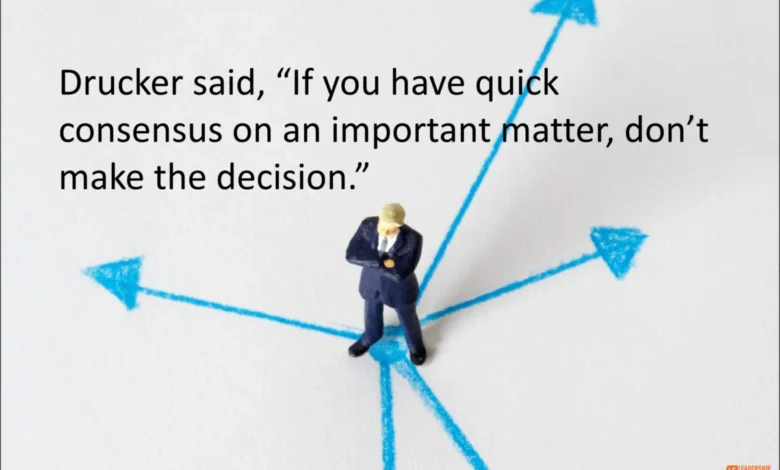
Management theorists and organizational psychologists have long debated the efficacy of rapid consensus in corporate environments. Peter Drucker, the influential management consultant and educator, famously asserted that if a leadership team reaches a quick consensus on an important matter, the decision should not be made. This paradox highlights a critical vulnerability in modern organizational structures: the tendency for groups to prioritize social cohesion over rigorous intellectual inquiry. When decision-makers reach an agreement too quickly, they often bypass the essential stage of "constructive dissent," a process that acts as a vital safeguard against cognitive biases and systemic failure.
The phenomenon of groupthink, first formally defined by social psychologist Irving Janis in the early 1970s, serves as the primary theoretical framework for understanding why rapid consensus can be dangerous. When high-performing teams suppress dissenting opinions to maintain harmony, the resulting decisions often lack the resilience required to withstand market volatility or unforeseen operational challenges. By examining the mechanics of decision-making, it becomes evident that the goal of leadership should not be the elimination of disagreement, but rather the cultivation of a robust environment where differing perspectives are treated as intellectual assets.
The Anatomy of Flawed Decisions
The history of corporate management is replete with examples of high-stakes decisions that failed due to a lack of internal debate. In the late 20th and early 21st centuries, studies by organizations such as McKinsey & Company and the Harvard Business Review have underscored that the most successful strategic initiatives are those that survive a "stress test" of opposing viewpoints. Conversely, failures often stem from the "silent meeting" syndrome, where participants withhold concerns to avoid interpersonal friction or to appear aligned with senior leadership.
Data from organizational research suggests that teams utilizing structured debate protocols report a 25% higher rate of long-term project success compared to teams that rely on intuitive or fast-tracked decision-making. The absence of dissent often masks latent risks, such as technical blind spots, market misalignments, or cultural resistance. When a decision is finalized without being challenged, the organization lacks a contingency plan, making it fragile in the face of inevitable execution hurdles.
Transparency Versus Political Maneuvering
A fundamental challenge in modern corporate culture is distinguishing between legitimate constructive dissent and obstructive political maneuvering. Transparency serves as the primary barrier against the latter. In many hierarchies, individuals may raise objections not to improve a proposal, but to protect personal silos or undermine rivals. This is distinct from constructive dissent, which is centered on the objective improvement of a strategy.

To foster an environment of transparency, leaders must prioritize "public reasoning" over private agendas. When an executive requests further analysis, the motivation should be clearly stated as a need for more data or a deeper understanding of risk. When such requests are veiled attempts to stall a project or marginalize a colleague, the integrity of the entire decision-making process is compromised. Organizations that successfully navigate this divide often implement "devil’s advocate" roles, where specific individuals are tasked with identifying flaws in a proposal, thereby institutionalizing dissent and removing the stigma associated with opposing the majority.
The Role of Leadership in Normalizing Challenge
For constructive dissent to become a core organizational competency, leadership must provide explicit permission for team members to challenge prevailing assumptions. In environments characterized by high power distance, subordinates are unlikely to voice concerns unless they perceive that the leader values accuracy over compliance.
Leadership, in this context, requires the humility to change one’s mind. When a leader consistently doubles down on a failing strategy despite evidence to the contrary, the message to the organization is clear: questioning is futile. Research into organizational culture indicates that employees are significantly more likely to engage in "upward feedback" if they have witnessed their superiors openly acknowledging errors or revising positions based on new evidence. Defensiveness is the primary antagonist of innovation; it shuts down the flow of critical information and creates a culture of silence that can lead to catastrophic strategic drift.
Integrating Diverse Perspectives Early in the Process
The timing of engagement is equally vital. Dissent is most effective when it occurs during the formative stages of a decision, rather than at the implementation phase. By the time a strategy is finalized, the cost of pivoting is prohibitively high. Therefore, leaders should broaden the scope of their consultations to include individuals from various levels of the organization, particularly those on the front lines who possess granular knowledge of operational realities.
The wisdom of the ancient Egyptian sage Ptahhotep, who advised consulting with both the ignorant and the wise, remains relevant today. Frontline employees often hold the "emerald" of critical insight—data points that senior executives, removed from day-to-day operations, may miss. When status-based hierarchies are minimized in favor of meritocratic discourse, the organization gains a more holistic view of the potential impacts of a decision. This practice of cross-functional and cross-hierarchical input acts as an early warning system, highlighting risks that might otherwise remain invisible until they manifest as performance deficits.
The Institutionalization of Wisdom
The objective of fostering dissent is not to prolong meetings or create endless bureaucracy, but to arrive at the most durable solution possible. In high-stakes environments, the goal is to reach "a position of truth" rather than a "position of comfort." This requires a shift in how organizations define success: a meeting that ends in a delay for further analysis should be viewed as a success, while a meeting that results in an unvetted, hasty agreement should be viewed as a professional failure.

Furthermore, technological tools can now facilitate this process by allowing for anonymous feedback loops and structured debate platforms. These tools enable quieter members of a team to contribute their insights without the social pressure of a face-to-face confrontation, thereby democratizing the dissent process. However, these tools are merely supplements to the core leadership requirement: the cultivation of psychological safety.
Broader Implications and Future Outlook
As the global business landscape becomes increasingly complex and interconnected, the capacity for organizations to make sound decisions will be a primary determinant of long-term viability. The reliance on rapid consensus is a legacy of a more stable, predictable era. In the current environment, characterized by rapid technological disruption and geopolitical volatility, the ability to integrate diverse viewpoints and withstand the friction of rigorous debate is a competitive advantage.
Organizations that institutionalize dissent do not just avoid bad decisions; they develop a more resilient workforce. When employees understand that their input is valued and that the process of decision-making is intellectually rigorous, their commitment to the final outcome—even if their original suggestion was rejected—is significantly higher. This creates a culture of ownership and collective accountability.
Ultimately, the process of arriving at a decision is as important as the decision itself. By replacing the desire for quick agreement with a commitment to exhaustive inquiry, leaders can ensure that their organizations are not merely reacting to the present, but are prepared for the uncertainties of the future. The legacy of management thinkers like Drucker and historical figures like Ptahhotep serves as a reminder that the path to wisdom is rarely smooth; it is found in the friction of differing ideas, the courage to be challenged, and the humility to learn from every corner of an organization.
In summary, the pursuit of better decisions requires a fundamental shift in corporate culture. It demands that leaders view themselves not as the ultimate authority whose word is final, but as the architects of a process that draws out the best, most critical thinking from the entire team. By rejecting the lure of quick consensus and embracing the discomfort of constructive dissent, organizations can achieve a level of clarity and strategic foresight that is impossible to reach in a vacuum of agreement.