CEO Confidence Index Records First Pullback in Current Conditions Since March Amid Growing Economic Uncertainty

The landscape for American business leadership has shifted toward a more defensive posture as the latest CEO Confidence Index reveals a marked decline in sentiment regarding current economic conditions. For the first time since the onset of geopolitical instability in the Middle East last March, corporate executives are signaling a retreat in their assessment of the domestic business environment. The data, captured in the latest Chief Executive confidence survey conducted between September 1 and September 3, reflects a broader anxiety stemming from eroding pricing power, persistent operational cost pressures, and a cooling outlook for near-term economic growth.
The survey, which polled over 150 U.S.-based CEOs, recorded a rating of 5.6 out of 10 for current business conditions, representing a 6 percent decline from the 6.0 score reported in August. This drop marks the most significant month-over-month decline since January, a period characterized by intense volatility surrounding shifting federal policy agendas. While the current index remains marginally higher than its January baseline and sits near the 2026 average of 5.7, the rapid deterioration in sentiment during the first week of September suggests that the optimism seen earlier in the summer has reached a plateau.
Chronology of the 2026 Confidence Slide
To understand the current climate, one must look at the trajectory of the 2026 business cycle. The year began with significant trepidation as CEOs navigated legislative uncertainty in Washington, leading to an 8 percent drop in confidence in January. By March, as global tensions escalated, leaders began to adjust their operating models to account for a new reality of geopolitical risk.
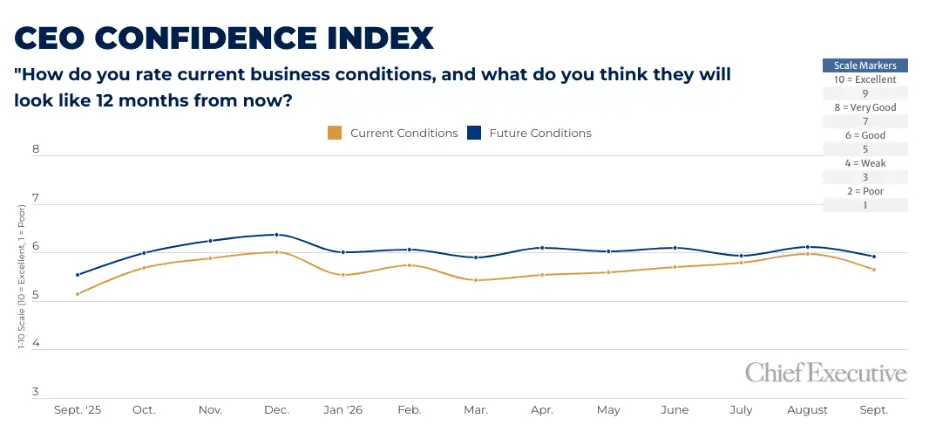
Between April and August, the index showed signs of stabilization as companies absorbed initial supply-chain shocks and adjusted pricing strategies to combat inflationary pressures. However, September’s data acts as a breaking point. The transition from August’s relative stability to September’s contraction underscores the speed at which macroeconomic "noise"—ranging from trade relationship friction to labor cost volatility—is impacting boardroom decision-making.
Economic Outlook and the Growth Divide
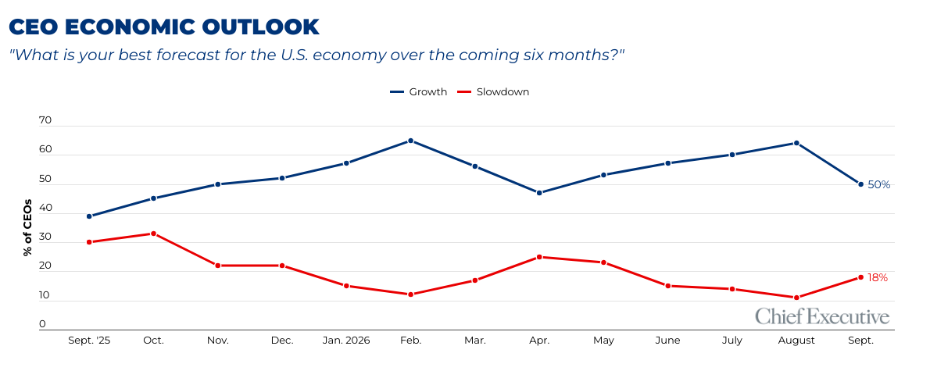
The most critical indicator within the latest findings is the rapid cooling of economic growth expectations. In August, 64 percent of surveyed CEOs anticipated U.S. economic growth over the next six months. By early September, that figure plummeted to 50 percent. Concurrently, the number of executives predicting an economic slowdown rose to 18 percent, up from 11 percent in August—the highest level of negative sentiment recorded since May.
This shift is not uniform across all sectors. The data reveals a "bifurcated reality" in the American market. On one hand, industries tied to essential infrastructure—specifically data centers, electrification, and energy storage—continue to report robust pipelines and high demand. On the other hand, consumer-facing sectors are struggling with a distinct change in behavior among middle-class demographics. Justin Moore, CEO of Florida-based Mile Marker Industries, noted that while premium buyers remain insulated and low-end consumers continue to spend, the "middle-class buyer" is pulling back, prioritizing savings and adjusting their spending habits in response to household economic pressures.
The Pressure of Rising Costs and Eroding Margins
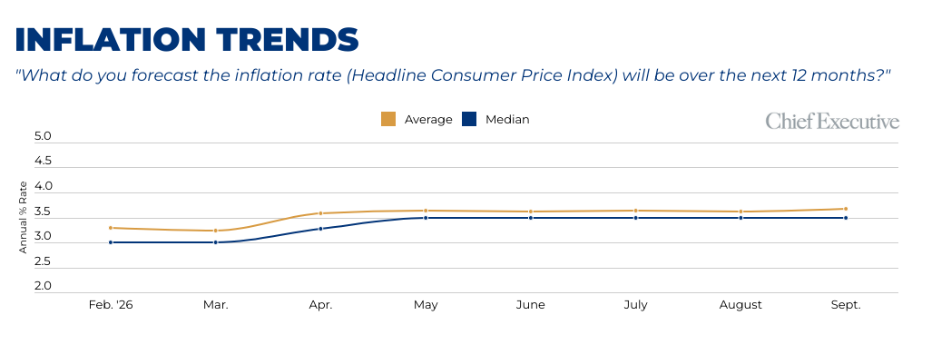
The erosion of pricing power has become a central theme for corporate leaders. While headline inflation expectations remain relatively steady at a median forecast of 3.5 percent for the next 12 months, the reality on the ground for businesses is far more challenging.
Nearly 78 percent of CEOs now expect operating expenses to continue their upward trajectory throughout the remainder of the year. This is a significant escalation from the 73 percent reported in August and a marked increase from the 62 percent recorded at the beginning of 2026. These rising costs are creating a direct squeeze on profitability. Only 61 percent of those polled believe they will close 2026 with higher profits than they realized in 2025, a notable drop from the 69 percent who held that expectation just one month prior.
Innovance CEO Merritt Becker articulated the struggle faced by many manufacturers, noting that while demand remains sufficient to support price adjustments, the "timing lags inflation’s rate of increase." This creates a scenario where companies are constantly playing catch-up, unable to pass costs onto consumers quickly enough to protect their gross margins. Michael McQueeney, owner of KR Johnson, warns that this trend is likely to persist as manufacturers deplete existing inventories and face incoming price increases across the supply chain, a cycle he anticipates will lead to sustained inflationary pressure well into 2027.
Implications for Capital Investment and Labor
Despite the pervasive sense of caution, corporate leaders have not initiated a widespread freeze on capital expenditures (capex). In fact, 50 percent of CEOs plan to increase their investment in the coming months, a figure that exceeds the 45 percent who signaled the same intent at the start of the year.
This counterintuitive investment behavior is driven by a necessity to boost productivity and maintain market position. Faced with labor shortages and rising material costs, companies are doubling down on technology and infrastructure to optimize efficiency. However, the labor market tells a different story. Hiring plans have become significantly more restrained, with only 45 percent of CEOs expecting to expand their headcount, down from 53 percent in January.
This suggests that for many American firms, the strategy is shifting from "growth through scale" to "growth through automation and optimization." A CEO of a private equity-backed firm highlighted the difficulty of this strategy, stating, "We are trying to navigate an environment where investment is clearly necessary to generate growth, but capital to do so is virtually non-existent."
Sector-Specific Vulnerabilities: The Middle Market
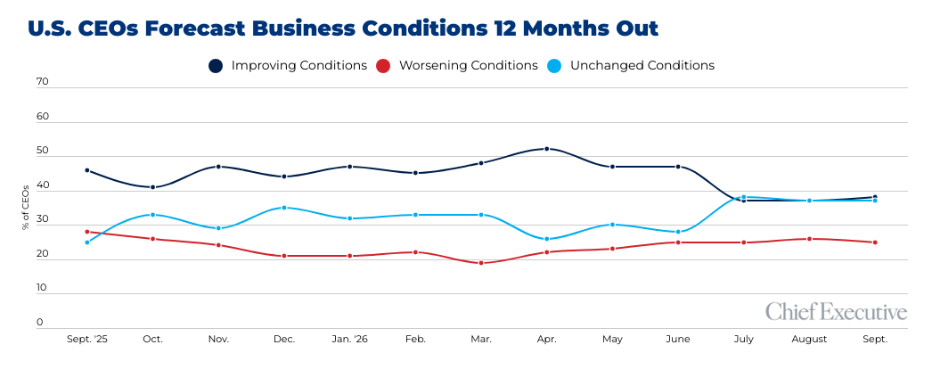
The data also exposes a heightened level of anxiety within the middle market—specifically companies generating between $10 million and $24.9 million in annual revenue. Among these smaller entities, 36 percent of CEOs anticipate that business conditions will deteriorate over the next year, significantly higher than the 25 percent average across the broader survey population.
This disparity highlights a structural vulnerability: smaller firms often lack the diversified revenue streams or the deep cash reserves required to weather extended periods of high input costs and cooling demand. For these companies, the "noise" of global trade disputes and regulatory uncertainty is not merely a background concern; it is a direct threat to operational viability.
Broader Economic Implications
The synthesis of these findings points toward a period of "relentless effort" for corporate leadership. As Allen Krueger Jr. of Krueger Communications summarized, the current environment is defined by unpredictable forecasts and unknown solutions. The consensus among the surveyed leaders is that the underlying fundamentals of the U.S. economy remain strong, but the external environment—characterized by tariff uncertainty, supply-chain constraints, and geopolitical friction—is acting as a significant "wrench in the works."
For policymakers, the message from the C-suite is clear: the volatility in trade relations and the persistent rise in operating costs are beginning to outweigh the benefits of strong fundamental demand. As CEOs adjust their outlook for 2027 to reflect a more challenging reality, the focus for the remainder of the year will likely remain on margin preservation rather than aggressive expansion. The next quarter will be a critical test of whether the American economy can move past these disruptions or if the current cooling trend will manifest as a more sustained period of stagnation.
Ultimately, the September Confidence Index serves as a barometer for a corporate sector that is feeling the cumulative weight of a complex global landscape. While revenue projections remain relatively optimistic—with 73 percent of CEOs still expecting higher revenues for 2026 compared to 2025—the narrowing gap between revenue and profit growth underscores the mounting difficulty of maintaining a bottom line in an era of persistent economic, political, and supply-side instability.