The Thin Blue Line Between Growth and Judgment: Navigating Workplace Learning Data in the Age of Artificial Intelligence

Modern enterprise human resources technology possesses an unprecedented capacity to monitor, dissect, and project professional development. Contemporary corporate learning management systems and AI-driven platforms can track virtually every digital footprint an employee leaves behind: completion rates, points of friction, frequency of attempts, search queries, abandoned course modules, and complex dialogue transcripts with generative AI tutors. While this technological leap has granted learning leaders the granular visibility necessary to tailor professional development like never before, it has simultaneously introduced an urgent ethical dilemma. The core challenge facing modern organizations is determining the exact juncture at which developmental support data transforms into a punitive permanent record utilized for professional evaluation.
The Evolution of Workplace Learning Intelligence
The integration of artificial intelligence into corporate human resources infrastructure represents a significant paradigm shift over the past decade. Historically, corporate training relied on standardized, one-size-fits-all programming, where employees completed annual compliance modules or attended uniform workshops with minimal tracking beyond binary completion metrics.
The widespread adoption of cloud-based learning management systems (LMS) in the late 2010s initiated a shift toward digital tracking. However, the post-2020 acceleration of generative AI and integrated enterprise resource planning ecosystems has exponentially amplified data collection. Today’s platforms do not merely record outcomes; they evaluate behaviors in real-time, mapping out potential skills gaps and forecasting an employee’s future organizational trajectory.
According to recent workplace technology market analyses, global enterprise spending on learning and talent management software has surged, driven largely by corporate demand for predictive analytics. Vendors increasingly market these systems as unified engines that seamlessly connect learning environments with talent marketplaces and performance management structures. Yet, this interconnected architecture has blurred traditional boundaries. Information gathered within a confidential developmental setting can now migrate across systems, frequently without the explicit awareness or continuous consent of the workforce.
The Danger of Automated Inference and the Need for Unfinished Space
At the heart of the modern data governance debate lies a fundamental psychological requirement in professional environments: the space to be unfinished. Learning is, by definition, an iterative process characterized by trial, error, false starts, and remediation.
When an ambitious employee initiates a leadership module but fails to complete it, or requires multiple diagnostic test iterations to achieve proficiency, digital learning logs register these events as raw behavioral data points. Advanced algorithms then parse these signals, frequently translating observable actions into automated inferences. A system tracking three failed assessment attempts may automatically log a competency deficit, while an exploratory search into an alternative career path might flag a flight risk.
HR technology ethicists and organizational psychologists emphasize that these automated inferences frequently misinterpret human behavior. An abandoned course may simply reflect shifting project priorities, and multiple test attempts often demonstrate rigorous persistence and ultimate mastery rather than a lack of capability. When these speculative inferences escape the learning ecosystem and populate permanent HR profiles or talent management dashboards, they risk boxing employees into rigid, algorithmic profiles.
Data Flow and the Silent Migration to Talent Systems
The migration of learning data into high-stakes employment decisions often occurs invisibly. Historically, diagnostic results and formative practice scores remained siloed within educational environments, serving exclusively to guide remediation or advanced coursework.
However, current industry standard configurations among prominent HR software vendors frequently enable cross-platform data synchronization by default. A diagnostic score generated during a practice module can automatically update an employee’s visible skill rating within a connected talent marketplace. Months later, a hiring manager reviewing candidates for a high-visibility stretch assignment may encounter this rating, treating an exploratory learning metric as a definitive performance evaluation.

This silent data drift underscores a critical distinction in data governance: information that is entirely appropriate for educational support is not automatically appropriate for personnel decisions. Industry analysts argue that organizational leaders must abandon the monolithic categorization of "learning data." A clear bifurcation must be established between objective credentials—such as verified certifications and compliance completions—and behavioral telemetry, including search histories, abandoned courses, practice repetitions, and conversational AI interactions.
The AI Tutor Concomitant and Employee Trust
The deployment of generative AI tutors within enterprise training frameworks has exacerbated these privacy and trust concerns. Because conversational AI interfaces mimic interpersonal dialogue, employees naturally interact with them differently than they would with traditional evaluation software. Workers routinely share vulnerabilities, admitting gaps in comprehension, expressing imposter syndrome, or voicing uncertainties regarding their readiness for advancement.
These candid admissions represent vital components of effective pedagogy. However, they also create sensitive transcripts that enterprise systems can potentially capture, retain, and analyze. If employees harbor suspicions that today’s admission of uncertainty to an AI tutor will influence tomorrow’s promotion prospects, their behavior shifts immediately.
Workforce researchers note that surveillance anxiety inevitably suppresses authentic engagement. When workers suspect their learning environments are monitored for evaluative purposes, they default to safe queries, avoid challenging subjects, or abandon the tools entirely. Consequently, organizations risk constructing technologically advanced learning ecosystems that actively undermine the psychological safety required for genuine skill acquisition.
A Five-Stage Governance Framework for Algorithmic HR
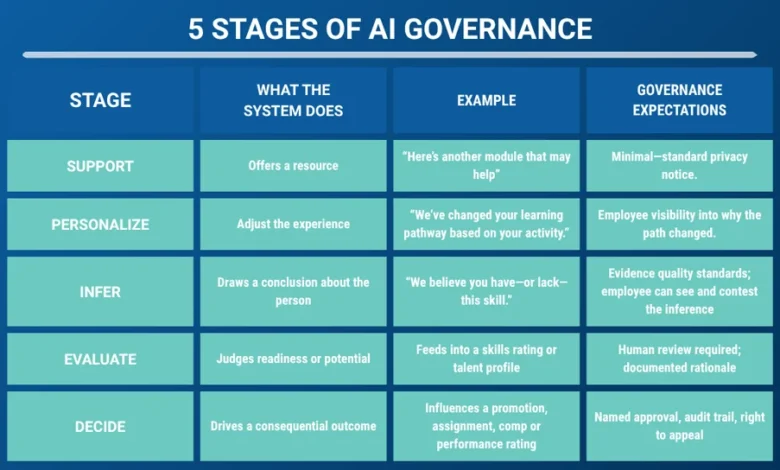
To address the tension between personalization and privacy, learning and development (L&D) executives are increasingly adopting tiered governance frameworks. Rather than enforcing a blanket prohibition on data connectivity—which can inadvertently slow internal mobility and obscure employee achievements—organizations are categorizing AI use cases by their level of consequence.
Industry frameworks typically segment AI learning applications into five distinct stages:
- Support: Recommendations for supplemental reading or elective courses, requiring minimal regulatory scrutiny.
- Assist: AI-driven drafting or formatting assistance for daily tasks.
- Recommend: Curating specific career paths or mentorship opportunities based on demonstrated interests.
- Evaluate: Generating formal skills assessments or performance scores utilized in talent reviews.
- Decide: Directly informing high-stakes operational choices, such as compensation adjustments, promotions, or restructuring.
Under this model, any automated process crossing into the "evaluate" or "decide" thresholds demands rigorous human oversight. Decisions at these high-consequence levels require a named human approver and a verifiable audit trail of the exact evidence considered, moving beyond reliance on unverified system-generated scores. Furthermore, organizations are implementing data-element-level controls, granting employees granular visibility and veto power over what information flows into broader talent pools.
Broader Implications and Strategic Recommendations for L&D Leaders
As artificial intelligence deepens its roots in corporate infrastructure, the responsibilities of chief learning officers and human resources directors are evolving to encompass rigorous data stewardship. The primary mandate moving forward is ensuring that technological efficiency does not infringe upon the fundamental right of employees to experiment, stumble, and learn without permanent penalty.
Experts recommend that L&D leaders apply a straightforward communicative test prior to deploying any advanced learning technology: Would the organization feel fully comfortable explaining the data collection, inference, and sharing policies directly and transparently to the affected employees, independent of legal disclaimers? If executive discomfort arises from that prospect, it serves as an immediate indicator that data practices require adjustment.
Ultimately, while the analytical power of modern learning platforms offers unprecedented strategic value, the long-term health of an organization depends on preserving human trust. Maintaining the room for workers to remain unfinished is not merely an ethical nicety; it is an operational imperative for cultivating a resilient, innovative, and genuinely competent workforce.