Deploying Qwen3.8-2.4T-A95B on Amazon SageMaker HyperPod: A New Frontier for Open-Weights Generative AI

On August 12, 2026, the Alibaba Qwen team fundamentally altered the landscape of open-source artificial intelligence by releasing Qwen3.8-2.4T-A95B, the first "Qwen-Max" class model to be made available with open weights. This milestone represents a significant shift in the accessibility of frontier-level intelligence, providing researchers and enterprises with a model boasting 2.4 trillion parameters—95 billion of which are activated per token—without the constraints typically associated with proprietary, closed-source API ecosystems.
The Technical Evolution of Qwen3.8
The release of Qwen3.8-2.4T-A95B is not merely an increase in parameter count; it is a sophisticated architectural leap. At its core, the model utilizes a hybrid linear-plus-full-attention architecture designed to tackle the most demanding agentic and reasoning workloads, such as multi-step coding, long-horizon planning, and autonomous tool utilization.
A defining feature of this model is its "Gated DeltaNet" layers. In traditional transformer models, the Key-Value (KV) cache grows linearly with the length of the context, eventually leading to massive memory bottlenecks. Qwen3.8 employs a 3:1 ratio of Gated DeltaNet layers to Gated Attention layers. The DeltaNet components use linear attention with a bounded recurrent state, effectively replacing the expanding KV-cache with a fixed-size memory footprint. This allows the model to handle its 262,144-token native context window—which is further extensible to 1,010,000 tokens—without the exponential compute degradation seen in earlier models.
Operationalizing Frontier Models
While the release of open weights grants organizations total data sovereignty and customization freedom, the operational burden remains substantial. Hosting a 2.4-trillion-parameter model is a logistical challenge that demands purpose-built infrastructure. As of late 2026, the industry standard for such deployments centers on high-density GPU clusters, specifically those utilizing NVIDIA’s Blackwell Ultra (B300) architecture.
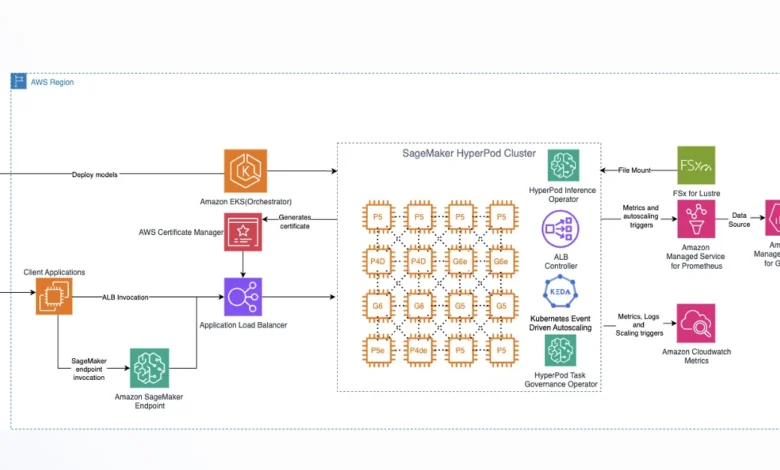
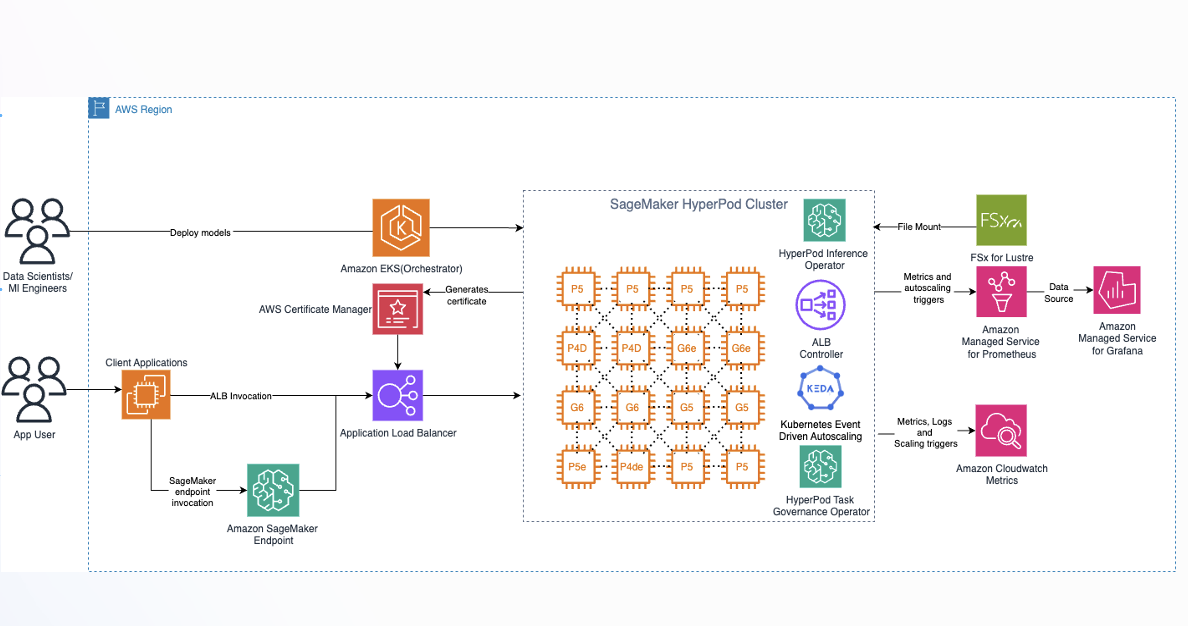
Amazon SageMaker HyperPod has emerged as the primary vehicle for deploying these massive models. By leveraging Amazon Elastic Kubernetes Service (EKS) as a control plane, HyperPod abstracts away the complexities of node health monitoring, container scheduling, and GPU driver management. For organizations that require consistent, high-performance inference, the use of Flexible Training Plans provides reserved capacity that eliminates the risks of on-demand pool contention and cold-start latency.
Chronology of the Deployment Framework
The deployment process for such a model is structured into a precise sequence of technical stages.
- Provisioning: The process begins by securing
ml.p6-b300.48xlargeinstances, which offer 8 NVIDIA B300 GPUs and a total of 2.1 TB of HBM3e memory. - Quantization and Loading: To fit a 2.4T model onto a single 8-GPU node, NVFP4 (W4A4) quantization is employed. This reduces the weight footprint from approximately 4.8 TB to 1.2 TB, leaving necessary headroom for KV-cache and activation buffers.
- Serving Infrastructure: Using the vLLM serving engine, administrators deploy the model with specialized configurations for reasoning parsing and tool calling.
- Validation: The final stage involves running health checks and benchmarking throughput, which typically demonstrates a performance profile exceeding 4,000 tokens per second per GPU in optimized environments.
Data-Driven Performance and Benchmarking
The strategic decision to utilize NVFP4 quantization is backed by compelling performance data. Recent internal benchmarks indicate that the hybrid architecture, when paired with Multi-Token Prediction (MTP) and expert parallelism, yields dramatic improvements in Time-To-First-Token (TTFT) and overall request latency.
In controlled tests, the combination of Tensor Parallelism (TP) and MTP resulted in a 58.7% reduction in TTFT compared to standard configurations. Furthermore, when Expert Parallelism (EP) was added to the mix, the model showed a 12.6% increase in output throughput. These figures suggest that the "frontier-class" performance of Qwen3.8 is not just theoretical—it is highly optimized for production-grade, low-latency applications.
Broader Industry Implications
The availability of Qwen3.8-2.4T-A95B marks a pivotal moment for the AI industry. For the past two years, the gap between proprietary frontier models and open-weights alternatives had been a point of contention. Proprietary models, hosted exclusively behind opaque APIs, forced organizations to sacrifice privacy and control for the sake of reasoning capability. Qwen3.8 effectively closes this gap.
Industry analysts observe that this release positions organizations to build highly customized agentic workflows that were previously impossible. For instance, in the field of quantitative research or large-scale software engineering, the ability to host a model that can perform repository-level coding tasks—without sending sensitive proprietary code to a third-party server—is a competitive differentiator.
Furthermore, the model’s built-in "reasoning_effort" control parameter allows developers to dynamically scale compute resources based on the difficulty of the prompt. This granular level of control is expected to become a standard expectation for future LLM deployments, shifting the focus from raw model size to efficient compute utilization.
The Role of Infrastructure Providers
The collaboration between major cloud providers like AWS and high-performance hardware manufacturers like NVIDIA has become the bedrock of this AI expansion. Without the specific memory bandwidth (8 TB/s per GPU) and interconnect speeds (14.4 TB/s bisection bandwidth) provided by the Blackwell Ultra architecture, deploying a model of this magnitude on a single node would remain a theoretical exercise.
As companies begin to transition from experimentation to full-scale deployment, the focus will likely shift from "can we run the model?" to "how do we maintain long-term reliability?" This is where the integration of automated node replacement and health monitoring within the SageMaker HyperPod environment becomes crucial. The ability of the Inference Operator to handle node failures without manual intervention is a vital safeguard for 24/7 enterprise applications.
Future Outlook and Research Directions
As the industry looks toward the end of 2026, the success of Qwen3.8 provides a roadmap for future development. The next logical steps for researchers include exploring further refinements in MoE (Mixture of Experts) routing, where the model dynamically selects the most efficient experts for a given task, and investigating the limits of MTP speculative decoding.
The widespread adoption of this model is expected to accelerate the development of "self-hosted agents," where independent entities operate autonomous research pipelines that leverage the model’s high performance in PaperBench and instruction-following benchmarks. While challenges remain—specifically regarding the initial capital expenditure of specialized GPU instances and the complexity of managing large-scale Kubernetes clusters—the trajectory is clear: the barrier to accessing frontier-level intelligence is lower than it has ever been.
In conclusion, the release of Qwen3.8-2.4T-A95B is more than just a software update; it is a foundational change in the infrastructure of the digital economy. By democratizing access to trillion-parameter intelligence, Alibaba has provided the building blocks for a new generation of enterprise-grade AI solutions, while platforms like Amazon SageMaker provide the necessary scaffolding to bring these models into the real world with the reliability and scale that modern businesses require.