Large language models (LLMs) are fundamentally designed as next-token predictors. This architectural trait, while enabling fluid and creative text generation, inherently struggles with tasks requiring rigorous, multi-step logical deduction. When tasked with complex planning or intricate mathematics, standard models often attempt to leap directly from a prompt to a conclusion, frequently resulting in "hallucinations" or logical lapses that appear deceptively coherent. To mitigate these shortcomings, the field of artificial intelligence has moved toward reasoning frameworks—specifically Chain of Thought (CoT) and Tree of Thoughts (ToT)—that force models to deliberate before they commit to an output.
The Evolution of Machine Reasoning
The shift toward explicit reasoning in AI began in earnest around 2022. Researchers identified that LLMs, such as GPT-3 and its successors, struggled with arithmetic and symbolic logic because they were trained to minimize prediction error on a sequence rather than to maximize the accuracy of a logical derivation.
Chronologically, the breakthrough began with "Chain of Thought" prompting, introduced in a 2022 paper by Google researchers. This technique demonstrated that by encouraging a model to "show its work," performance on complex benchmarks like GSM8K (a dataset of grade-school math word problems) improved dramatically. Following this, in mid-2023, the academic community introduced "Tree of Thoughts," a more sophisticated framework that treats reasoning as a search problem, drawing on decades-old computer science research into state-space exploration.
Chain of Thought: The Linear Approach
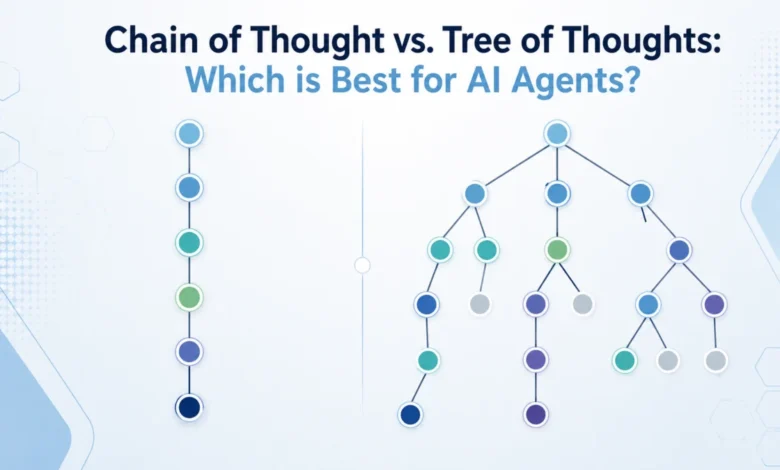
Chain of Thought (CoT) is the foundational methodology for structured reasoning. At its core, CoT functions by generating a sequential, linear narrative of thought. By appending simple triggers—such as the now-famous "Let’s think step by step"—the model is nudged to decompose a complex query into smaller, digestible components.
From a technical standpoint, CoT does not change the model’s weights; rather, it changes the prompt architecture. The model treats each reasoning step as a condition for the next. While effective, the framework is inherently rigid. If a model commits a logical error at step two of a ten-step process, that error cascades through the remainder of the chain. Because the model lacks a "look-ahead" mechanism, it cannot audit its own progress before finalizing the output. Despite this, data shows that CoT is the gold standard for efficiency. It requires minimal computational overhead, as it maintains the same token-to-answer ratio as a standard prompt, making it the preferred choice for latency-sensitive applications.
Tree of Thoughts: Navigating Complexity
Tree of Thoughts (ToT) represents a departure from the linear constraint. In this framework, the model generates multiple potential "branches" of reasoning. Each branch is then evaluated—either by the model itself or by an external verifier—to determine if it remains on the path toward a correct solution.
The analogy to high-level strategic games like chess is precise. In a chess game, a player evaluates several candidate moves, simulating the board state several turns into the future. If a move leads to an unfavorable outcome, the player discards it and returns to the current state to test a different path. ToT applies this "backtracking" capability to language generation.
The implications for system resources are profound. Because ToT requires generating multiple branches and performing iterative evaluations, it can increase the computational cost—measured in tokens and latency—by a factor of ten or more. For complex tasks like strategic resource allocation, architectural design, or high-stakes legal document synthesis, this cost is viewed as a necessary investment to ensure accuracy.
Comparative Performance Metrics
| Feature | Chain of Thought (CoT) | Tree of Thoughts (ToT) |
|---|---|---|
| Reasoning Path | Linear / Single | Branching / Multiple |
| Error Recovery | None (propagation risk) | High (via backtracking) |
| Computational Cost | Low | High |
| Latency | Minimal | Significant |
| Best Use Case | Routine logic, summarization | Strategic planning, complex code |
Implications for AI Agent Architecture
Modern AI agents, which are systems designed to execute multi-step goals using external tools, are increasingly adopting a hybrid approach to these reasoning frameworks. A sophisticated agentic system acts as a coordinator, delegating tasks based on the complexity profile of the request.
For instance, if an agent is tasked with checking a user’s calendar and setting a reminder, the overhead of a "Tree of Thoughts" approach is unnecessary and wasteful. The agent will utilize a simple Chain of Thought to ensure the logic of the time zone conversion and scheduling is sound. However, if the agent is tasked with "Automate the deployment of this microservice to AWS, ensuring all security compliance checks are met," the agent may initiate a ToT process. It will generate multiple deployment strategies, simulate potential failures for each, and select the path with the highest probability of success.
Expert Perspectives on Future Implementation
Industry practitioners argue that the choice between CoT and ToT is effectively a question of "compute budget versus confidence." As models continue to scale, some argue that the distinction may blur. If a model’s internal reasoning capability improves, the need for explicit, resource-heavy search (ToT) may decrease. However, for current-generation models, the industry consensus remains: ToT is the premier tool for tasks where the "cost of failure" outweighs the "cost of computation."
Broader Economic and Operational Impact
The integration of these frameworks has shifted the focus of AI development from merely increasing the parameter count of models to optimizing the "inference-time compute." By shifting resources toward the reasoning phase rather than the training phase, developers are finding that they can achieve higher reliability without needing to retrain massive foundational models.
This evolution is already impacting corporate AI budgets. Organizations are increasingly moving away from "one-size-fits-all" prompting and toward modular agentic systems. In this new paradigm, the software infrastructure determines the reasoning method dynamically. This reduces the frequency of catastrophic errors in automated workflows, which is a vital requirement for the adoption of AI in sectors such as healthcare, finance, and critical infrastructure, where a "hallucination" can have real-world consequences.
Conclusion: The Strategic Choice
The decision to utilize Chain of Thought versus Tree of Thoughts is a critical architectural choice that defines the reliability of an AI agent. Chain of Thought provides a transparent, efficient mechanism for routine tasks, ensuring that the model remains grounded in a sequential logic flow. Tree of Thoughts serves as a powerful, albeit costly, mechanism for navigating ambiguity, permitting the system to test hypotheses and correct its trajectory in real-time.
As these technologies mature, we can expect the industry to move toward automated "reasoning managers"—systems that analyze the complexity of a task in real-time and decide which framework is appropriate. Until then, the burden remains on developers to select the framework that aligns with their specific tolerance for cost and their absolute requirement for accuracy. The future of reliable AI does not rest solely on the intelligence of the model, but on the sophistication of the framework that guides its thoughts.