Automating Retail Catalog Enrichment with Serverless Model Customization and Reinforcement Learning

Retail catalogs are the backbone of e-commerce, yet they rarely arrive in a clean, structured, or standardized format. Product names, descriptive text, and category paths often originate from a fragmented array of internal and external data sources, leading to a "dirty data" problem that plagues search functionality, recommendation engines, and user navigation. For years, retailers have relied on the manual labor of thousands of employees to categorize stock keeping units (SKUs), a process that is not only slow and expensive but also prone to human inconsistency. As the scale of digital marketplaces continues to balloon into the millions of SKUs, the necessity for a scalable, automated solution has shifted from a competitive advantage to a fundamental operational requirement.
Recent advancements in generative artificial intelligence have provided a potential path forward. While general-purpose frontier models can generate tags through sophisticated prompt engineering, these models are often cost-prohibitive for high-volume, repetitive tasks. Furthermore, a generalist model may not adhere strictly to the specific, nuanced taxonomy required by a retailer’s unique backend system. When a taxonomy is stable and the output can be scored programmatically, the industry is increasingly moving toward the customization of smaller, open-weight models. By teaching a model a specific schema directly, retailers can optimize the trade-off between missing tags—which hurt discoverability—and unnecessary tags—which clutter the user experience.
The Evolution of Model Customization
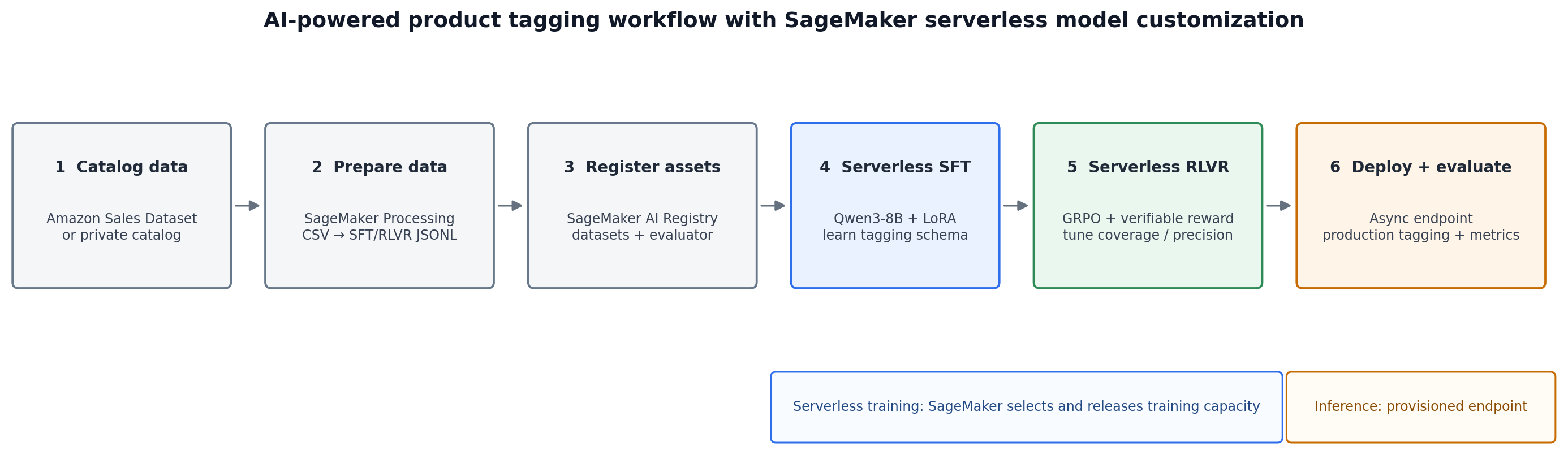
The current approach to this challenge involves a two-stage training pipeline. First, the model undergoes supervised fine-tuning (SFT) to learn the structural requirements of the catalog. Second, the model is refined using reinforcement learning with verifiable rewards (RLVR) via Group Relative Policy Optimization (GRPO). Amazon SageMaker has recently streamlined this workflow by introducing serverless model customization. This managed service allows developers to offload the complexities of infrastructure management—such as selecting specific GPU instances or maintaining custom training containers—to the cloud provider, which automatically manages training capacity.
This shift represents a significant evolution in how machine learning operations (MLOps) teams handle enterprise-grade AI. Historically, teams had to provision Amazon SageMaker Training Jobs (SMTJ) with specific hardware configurations, which required extensive oversight. The integration of the Amazon SageMaker Python SDK v3 now allows for "serverless trainers," where the system resolves the necessary resources for a given model, such as the Qwen3-8B architecture, and releases them upon completion.
Chronology and Workflow Architecture
The implementation of this workflow follows a deliberate three-part architecture: data preparation, model customization, and asynchronous inference.
In the first phase, raw catalog data—often sourced from datasets such as the Amazon Sales Dataset on Kaggle—is processed to normalize product information. This is done through an Amazon SageMaker Processing job, ensuring that the preparation phase is repeatable and auditable. Data is mapped into a predefined nine-category tagging target before being registered in the Amazon SageMaker AI Registry as versioned assets.
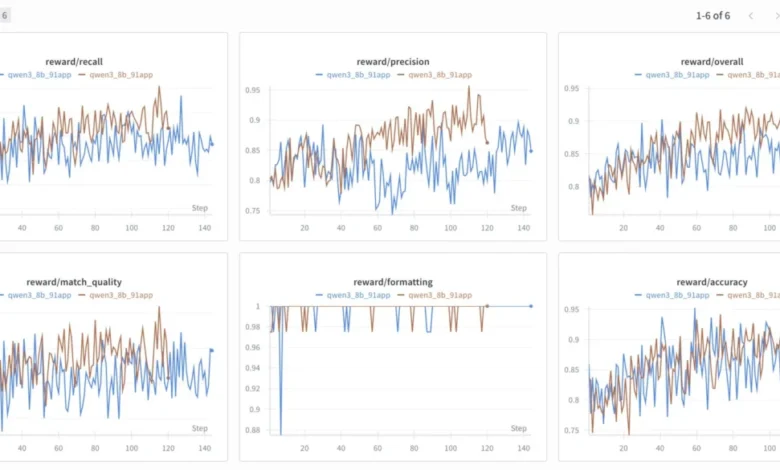
In the second phase, the Qwen3-8B model is subjected to SFT. By using Low-Rank Adaptation (LoRA), the system teaches the model the instruction-to-tag pattern. SFT provides the most significant jump in performance because it directly demonstrates the desired input/output behavior. Following this, the RLVR stage uses a deterministic reward function to fine-tune the model’s behavior. Unlike human-in-the-loop systems, which are difficult to scale, RLVR relies on a "rule-based" reward system that compares the generated output against a ground truth reference.
Finally, in the deployment phase, the optimized model is hosted on an Amazon SageMaker Asynchronous Inference endpoint. This choice is critical for batch-oriented retail environments. Unlike real-time inference, which requires immediate response times and high availability, asynchronous inference allows for requests to be queued and processed in the background, significantly reducing costs while maintaining the ability to process millions of items during off-peak hours.
Supporting Data and Performance Metrics
The effectiveness of this approach is evidenced by the performance shift observed when transitioning from a baseline model to an SFT-trained model, and finally to an RLVR-optimized model. In empirical testing, the "Overall" performance score—a weighted metric accounting for recall, precision, and accuracy—saw a marked improvement.
The baseline model typically struggles with catalog complexity, showing an overall score of approximately 0.354. Upon applying SFT, this score surges to 0.6827. The jump is driven largely by a massive increase in recall (from 0.327 to 0.6689), which is the result of the model "learning" the schema. However, the subsequent application of GRPO and RLVR is where the subtle, business-critical trade-offs occur. After RLVR, the recall increases further to 0.703, though precision sees a slight decrease from 0.652 to 0.638.
This nuance is vital for catalog managers. If a retailer values completeness above all else—meaning they would rather have an extra, potentially redundant tag than miss a vital attribute—the RLVR process can be weighted to favor recall. Conversely, if the downstream impact of "noisy" or incorrect tags is high, the reward function can be adjusted to prioritize precision. This ability to encode business strategy directly into the reward function represents a fundamental shift in how AI is governed in retail.
Broader Implications for the Retail Sector
The implications of this technology extend beyond simple cost savings. By automating the classification of inventory, retailers can significantly reduce the "time-to-shelf" for new products. In a traditional workflow, a new product might sit in a "pending categorization" queue for days; with automated enrichment, that same product can be live and searchable in minutes.
Furthermore, this approach addresses the "cold start" problem for new product lines. When a retailer enters a new category, they often lack the historical data to train traditional machine learning models. Because the Qwen3-8B model is pre-trained on a vast corpus of human language, it already understands the relationship between concepts. The fine-tuning process simply provides the "top-layer" of domain-specific logic required to align the model with the retailer’s specific schema.
Industry experts observe that this represents the maturation of Large Language Models (LLMs) in the enterprise. "We are moving away from the era of ‘magical’ chatbot assistants and into an era of ‘specialized’ functional models," says one industry analyst. "The goal is no longer to build a model that can answer any question in the world, but rather a model that can answer one question—’What are the correct tags for this product?’—with 99.9% reliability."
Challenges and Future Considerations
Despite the benefits, challenges remain. The primary constraint is the quality of the "ground truth" data. If the initial catalog data used for training is inherently flawed or inconsistently labeled, the model will learn those biases. Therefore, rigorous data cleaning and the maintenance of a "golden dataset" remain essential.
Moreover, the regulatory and compliance landscape regarding AI-generated catalog content is still emerging. Retailers must ensure that automated tagging does not violate consumer protection laws regarding product descriptions. For example, if an AI model misclassifies a product in a way that suggests a material is hypoallergenic when it is not, the liability rests with the retailer. Consequently, while the training process can be automated, the validation process must remain robust, with human oversight integrated into the model-selection and deployment stages.
Conclusion
The convergence of serverless cloud infrastructure and reinforcement learning with verifiable rewards provides a scalable, efficient, and highly accurate solution for the persistent problem of retail catalog management. By utilizing models like Qwen3-8B and the latest Amazon SageMaker tooling, organizations can transform their data pipelines from a bottleneck into a competitive asset.
The transition from general-purpose prompting to specialized, RL-optimized model customization marks a turning point in enterprise AI. As the technology continues to stabilize, it is expected that more retailers will abandon the "prompt engineering" approach in favor of these fine-tuned, specialized models. The result is a more organized digital marketplace, a more efficient backend operation, and ultimately, a more seamless shopping experience for the end consumer. For retailers, the path forward is clear: success in the modern digital economy will be defined by the ability to turn unstructured, messy catalog data into precise, actionable, and machine-readable insights.