Beyond the Dashboard: Why Corporate AI Rollouts Fail Without Knowledge Circulation

The modern corporate landscape is currently witnessing an unprecedented surge in capital allocation toward artificial intelligence technologies. Across global enterprises, chief learning officers and executive leadership teams are tasked with executing seamless technological integrations, developing robust enablement curricula, and certifying managers to track completion metrics on interactive learning and development dashboards. On paper, these initiatives frequently meet every designated key performance indicator. However, an 18-month post-implementation review across multiple business units often reveals a starkly different operational reality: profound polarization in actual tool utilization.
While a select handful of agile teams manage to deeply integrate artificial intelligence copilots into their daily workflows—fundamentally rewriting how they draft, review, and execute core responsibilities—other divisions remain entirely stagnant. In these lagging units, employees leave the technology open yet unclicked, treating the corporate mandate merely as another administrative hurdle to be waited out. This widespread discrepancy highlights a critical systemic flaw in contemporary organizational strategy. The primary obstacle to technological assimilation is no longer software acquisition or initial training, but rather the internal stagnation of operational knowledge. Without active systems designed to circulate peer-to-peer insights at the speed of technological evolution, standard corporate learning models inevitably fail.
The Chronology of Implementation and the Illusion of Completion
The typical trajectory of enterprise-wide software rollouts follows a predictable, highly structured timeline that often works against organic adoption. In the initial phase, organizations commit substantial financial resources—frequently doubling their AI budgets as a share of overall revenue—with 72 percent of chief executive officers personally directing strategic deployment. During months one through six, human resources and learning and development departments focus heavily on top-down distribution. They build comprehensive enablement curricula, mandate completion rates, and deploy interactive dashboards designed to verify that every manager has received standard certification.
By months six through twelve, the institutional expectation is that usage metrics on the dashboard will correlate directly with productivity gains. However, this period typically exposes the fragility of the traditional cascade model. As the technology undergoes rapid, iterative updates pushed by software developers, pre-set corporate training modules quickly become obsolete. Employees who successfully develop informal workarounds or discover high-value use cases keep these breakthroughs to themselves. Conversely, teams struggling to integrate the copilot into their daily routines maintain strict silence out of professional self-preservation. Admitting an inability to navigate the new tools carries the implicit risk of professional exposure, while unauthorized workarounds risk being labeled as rogue behavior. By the time formal refresher courses or leadership reviews are finally scheduled, the underlying software has already advanced, rendering the scheduled curriculum fundamentally irrelevant.
Quantitative Realities and Market Data
Recent empirical data from leading global advisory firms underscores the systemic risks associated with purely mechanistic, technology-focused implementation strategies. According to comprehensive findings from Deloitte’s Global Human Capital Trends report, seven out of ten business leaders identify organizational speed and operational nimbleness as their paramount competitive strategy through the remainder of the decade. Yet, despite this stated priority, 59 percent of organizations continue to approach artificial intelligence deployment through a strictly technical lens, ignoring the necessary human-centric framework.
The financial implications of this oversight are substantial. Organizations that treat AI adoption merely as an IT deployment rather than a human-centered design challenge are 1.6 times more likely to fall short of their projected return on investment. Furthermore, supplementary research from the Boston Consulting Group highlights that corporate learning is increasingly moving out of the traditional classroom environment, forcing enterprises to rethink how capability requirements are structured. This shift is further illuminated by Udemy’s Global Learning and Skills Trends Report, which reveals a profound disconnect within the managerial chain: while 88 percent of surveyed employees view effective leadership as critical to the success of AI initiatives, only 48 percent believe their immediate supervisors possess the readiness required to guide them.
The Structural Shift from Cascade to Circulation
Addressing this pervasive readiness gap requires a fundamental architectural redesign of enterprise learning systems. Historically, corporate education has relied upon a unidirectional cascade model, wherein knowledge is designed at the executive level, pushed downward through hierarchical channels, and reinforced at rigid chronological intervals. Feedback mechanisms within this traditional structure typically manifest as post-implementation surveys that arrive far too late to influence active operational strategies.
From an organizational theory perspective, the cascade model functions as a single-loop learning system. It is structurally capable of adjusting minor outputs or enforcing compliance, but it remains fundamentally blind to the underlying assumptions that govern employee behavior. In contrast, modern adaptive leadership frameworks advocate for a transition toward multi-directional knowledge circulation, effectively mirroring double-loop learning at scale. In a circulatory system, the frontline workforce is not treated as the terminal endpoint of a top-down directive, but rather as the primary source of operational intelligence.
Establishing effective multi-directional feedback loops, however, depends entirely upon two core organizational prerequisites: employees must firmly believe that their contributions will actively influence decision-making, and they must feel absolute psychological safety knowing that transparency regarding their struggles will not be used against them. When these conditions are absent, institutional silences take over, stifling innovation and paralyzing productivity.
Cultivating Trust and Psychological Safety
The emotional labor required to admit confusion or to quietly master a tool ahead of institutional timelines is rarely acknowledged within standard corporate policies. When organizations frame artificial intelligence adoption exclusively through compliance metrics and utilization dashboards, they inadvertently drive employee struggles deeper into the shadows. Workers worry about perceived competence, fear dispensability, and internalize the stigma of falling behind.

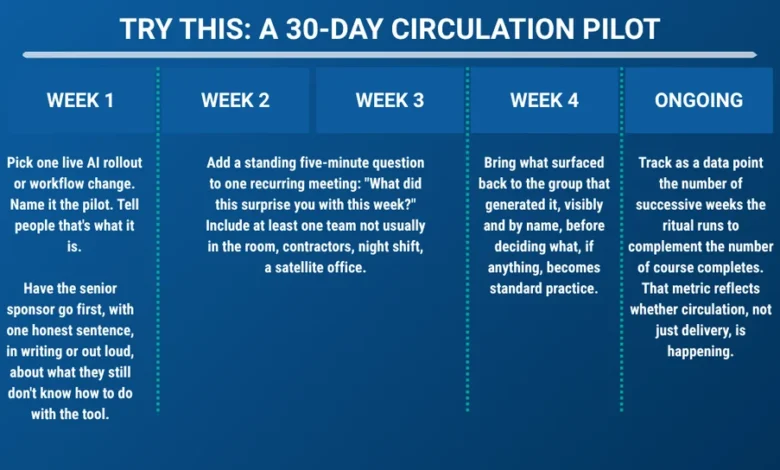
Forward-thinking enterprises are beginning to combat this dynamic through rapid-cycle inquiry—short, structured bursts of authentic listening such as brief workflow walk-throughs and focused feedback sessions that feed directly into real-time decision-making. By way of illustration, several forward-looking corporations have integrated a single, highly effective qualitative inquiry into their regular leadership meetings: "What are we currently assuming about this tool that we have not yet tested?"
When senior leaders model intellectual humility by answering this question regarding their own operational uncertainties first, they effectively normalize vulnerability across the enterprise. This practice builds organization-level adaptive intelligence, defined as the collective capacity to sense live operational signals, question underlying assumptions, and execute immediate operational adjustments without waiting for formal, bureaucratic review cycles.
Equity in Knowledge Distribution
A critical vulnerability within any circulatory learning model is the risk of reinforcing existing power asymmetries. If left unmonitored, knowledge circulation systems frequently re-concentrate influence among individuals who are already closest to institutional power—those who possess high visibility, advanced credentials, and established fluency in corporate communication.
Conversely, frontline workers, night-shift employees, and contract staff often operate far from formal decision-making bodies. Without deliberate intervention, their grassroots experimentation with artificial intelligence risks fading into obscurity simply because formal communication channels do not exist to capture it. Building a truly humanizing learning system requires intentionally extending psychological safety and structural support across all organizational tiers and employee identities, ensuring that valuable operational insights can emerge from any level of the enterprise.
Artificial Intelligence as a Listening Partner
Ironically, the very technology driving operational disruption can also be leveraged to transform how an enterprise learns from itself. Modern agentic artificial intelligence systems possess advanced pattern-recognition capabilities that can accurately detect operational divergence, predict emerging workflow trends, and identify innovative grassroots workarounds at a scale that traditional learning and development teams could never manually staff.
A select group of innovative organizations has begun deploying AI as an early-warning sensing mechanism during rapid-cycle inquiries. In these models, machine learning algorithms flag unconnected teams utilizing unique, independent use cases, while human leaders retain absolute decision-making authority over how those insights are scaled. Crucially, this approach only succeeds when the sensing mechanism is deployed transparently, explicitly opted into rather than secretly imposed, and strictly insulated from individual surveillance. If employees suspect that AI-driven data collection is being utilized to monitor personal performance metrics or identify who is falling behind, the candor required for genuine organizational learning evaporates instantly.
The Evolution of Judgment as the Core Curriculum
The proliferation of generative artificial intelligence creates an unprecedented paradox for corporate education: the software itself increasingly teaches the procedural "how." When an employee can prompt an AI model to draft a complex financial model, write software code, or outline a strategic communications plan within seconds, the traditional role of corporate training shifts dramatically.
As noted by industry analysts, this technological capability presents a unique gift to learning and development professionals, liberating them from the burden of teaching routine procedures. Consequently, human judgment becomes the definitive new curriculum. Employees must be educated in critical reflexivity—knowing precisely when to trust an algorithmic output, when to rigorously interrogate its underlying logic, and how to intervene when a confident machine-generated response contains subtle errors or unexamined biases. Skills such as critical thinking, emotional intelligence, and the capacity to navigate ambiguity, long categorized as secondary soft skills, are now universally recognized as mission-critical, load-bearing competencies.
Strategic Implications for the Next Two Quarters
For chief learning officers and enterprise executives navigating this volatile landscape, the path forward demands immediate, deliberate structural choices rather than passive observation. Over the next two quarters, organizations seeking to optimize their technological investments must transition their focus from compliance-driven adoption dashboards to trust-based circulation networks.
Practically, this involves embedding standing listening mechanisms into the pre-launch phases of all major technological initiatives, utilizing short, structured inquiry slots with the exact frontline teams designated to use the tools. Executive leadership must model vulnerability and transparency by publicly acknowledging their own learning curves, thereby dismantling the stigma associated with technological hesitation. Furthermore, enterprises must decouple talent assessment from rigid organizational charts, deploying trait-mapping methodologies that evaluate employees based on their practical capacity for problem-solving, collaboration, and adaptive execution.
Ultimately, the competitive advantage in an AI-driven economy will not belong to the enterprise that acquires the most advanced software licenses or achieves the highest completion rates on mandatory training modules. It will belong to the organization that successfully fosters an environment of radical trust, where operational knowledge circulates freely across all levels, transforming continuous learning from a corporate mandate into a living, organizational habit.