Scaling Reinforcement Learning for Mixture-of-Experts Models via Amazon EKS and Elastic Fabric Adapter

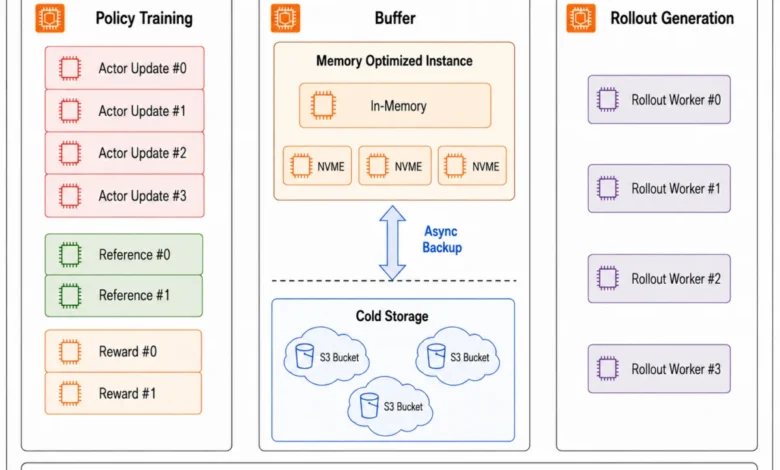
The rapid proliferation of Mixture-of-Experts (MoE) architectures in large language model (LLM) development has necessitated a fundamental shift in how engineers approach infrastructure. As models grow toward trillions of parameters, developers increasingly rely on post-training techniques like Reinforcement Learning from Human Feedback (RLHF) and the newer Group Relative Policy Optimization (GRPO) to refine model behavior. However, the infrastructure requirements for these stages—specifically the need to synchronize elastic inference for rollout generation with tightly coupled policy training—have introduced significant performance bottlenecks. To mitigate these, organizations are now deploying sophisticated, heterogeneous clusters on AWS, utilizing Amazon Elastic Kubernetes Service (Amazon EKS) and Elastic Fabric Adapter (EFA) to achieve high-throughput, low-latency communication.
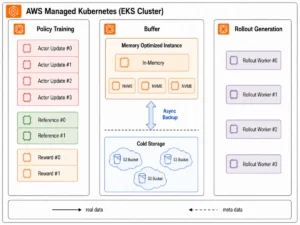
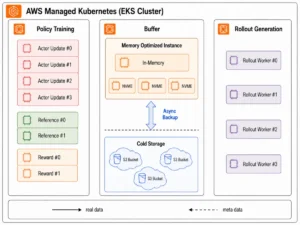
The shift toward MoE models is driven by the need for computational efficiency. By activating only a subset of parameters for any given token, MoE architectures allow for massive model capacity without the prohibitive inference costs associated with dense models. Yet, this sparsity comes at a cost during the training lifecycle. The transition from pre-training to post-training requires a complex interplay of hardware resources. Specifically, RL workloads demand an asynchronous loop where "rollout" workers generate vast amounts of experience data through inference, which are then consumed by "policy-training" workers to refine model weights. When this loop spans hundreds of accelerators, the communication overhead—specifically Expert Parallelism (EP)—often becomes the primary constraint, eclipsing raw compute power.
The Anatomy of the Infrastructure Challenge
To understand the scale of the challenge, one must examine the specific mechanics of large-scale reinforcement learning. Traditionally, Proximal Policy Optimization (PPO) requires a critic model to estimate value, adding a layer of memory and compute overhead. Newer methods like GRPO attempt to streamline this by using group-based relative rewards, yet the underlying infrastructure demands remain largely identical: they require massive rollout generation and a perfectly synchronized training feedback loop.
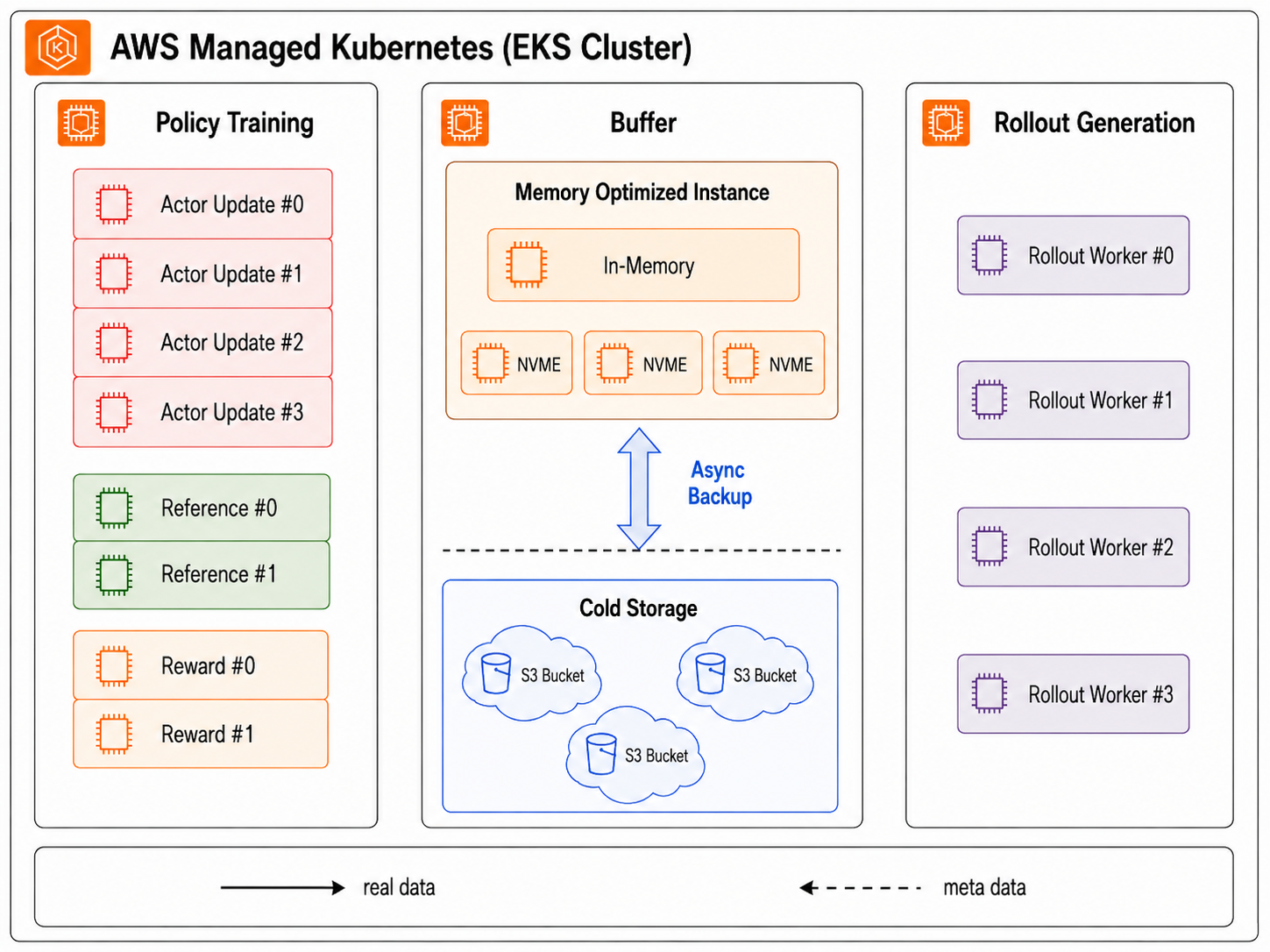
In a distributed environment, the system faces three primary hurdles. First, the coordination of heterogeneous compute resources is paramount. Rollout generation is an inference-heavy task that prioritizes throughput, while policy training is a training-heavy task that requires low-latency, lock-step synchronization. If the training workers wait too long for the rollout workers, hardware sits idle; if the rollout workers outpace the training workers, memory buffers overflow and system stability declines.
Second, communication protocols are under immense pressure. Intra-node traffic is typically handled by high-bandwidth fabrics like NVLink. However, as jobs scale across multiple physical nodes, traffic shifts to inter-node networking. In MoE models, Expert Parallelism introduces dynamic, all-to-all token routing that is far less structured than the predictable patterns seen in Tensor or Pipeline Parallelism. This creates "bursty" and fine-grained traffic that can easily overwhelm standard network interfaces, leading to performance degradation.
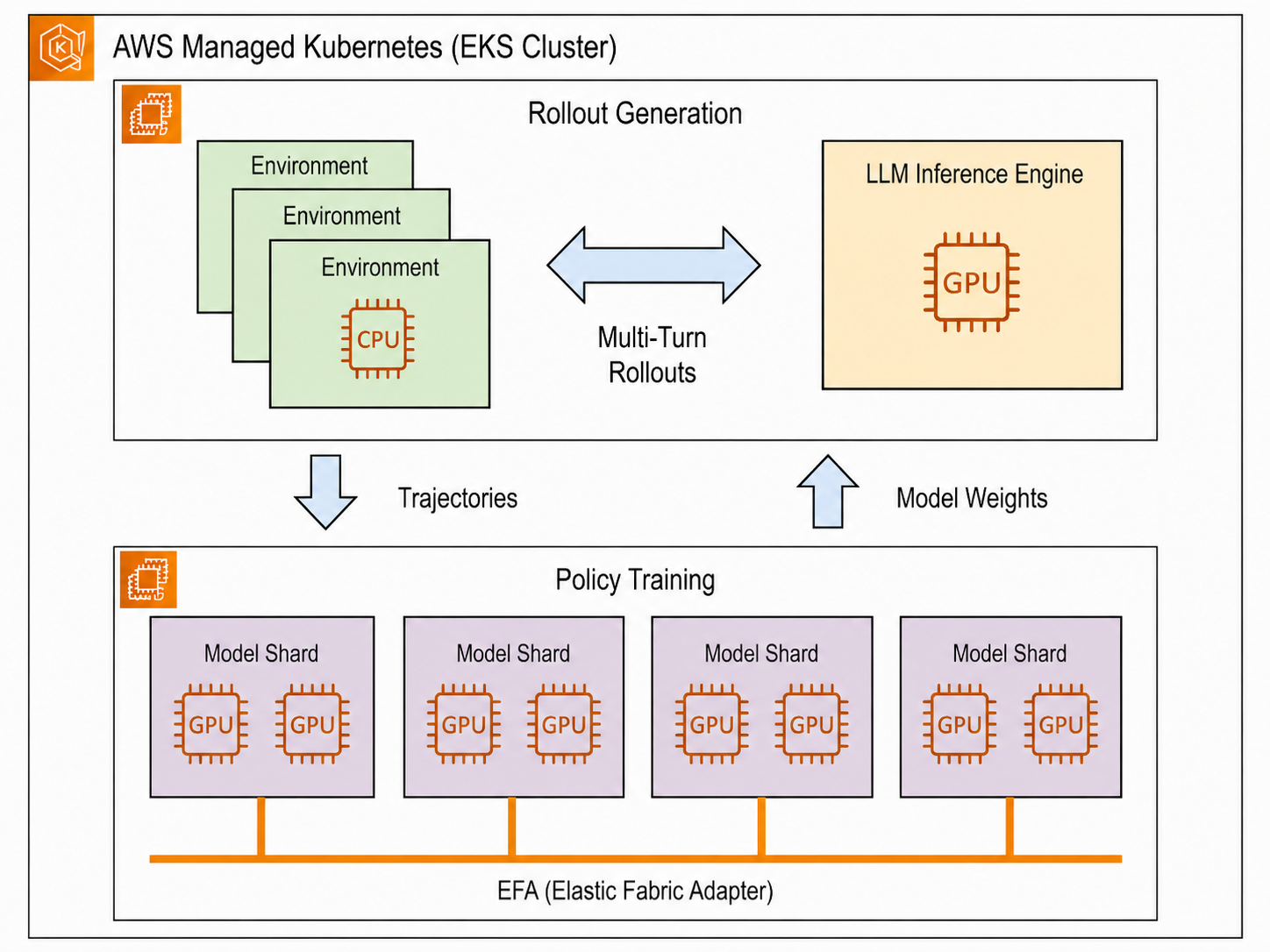
Third, dynamic orchestration is required to keep these subsystems in balance. Because training, inference, and evaluation often share the same underlying hardware, the system must be agile enough to shift capacity between these roles without triggering NCCL timeouts or causing cascading failures.
The Role of EFA and DeepEP in Optimization
The integration of EFA—an AWS-specific networking interface—has proven to be a watershed moment for these workloads. EFA provides OS-bypass capabilities and integrates with NVIDIA GPUDirect RDMA, allowing data to be transferred directly between GPU memory buffers across instances. This effectively minimizes the involvement of the CPU and the operating system, which is critical when dealing with the high-frequency communication required by MoE token routing.
To further refine this, developers have turned to DeepEP, a specialized communication library for MoE models. DeepEP replaces generic, inefficient collective communication operations with specialized dispatch and combining kernels. By contributing to the migration of DeepEP’s primitives to libfabric, AWS has enabled these specialized kernels to run over EFA, creating a portable, high-performance transport layer.
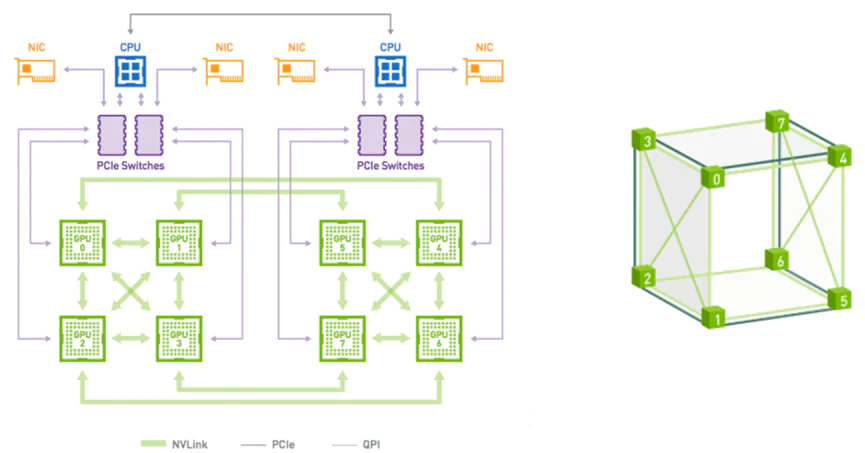
Recent performance benchmarks conducted on 48 P5en instances underscore the effectiveness of this architecture. In trials comparing standard communication stacks against the optimized DeepEP-over-EFA stack, engineers observed a 40 percent increase in aggregate RL rollout throughput. This improvement is not merely incremental; it represents a significant reduction in the total cost of ownership for large-scale training pipelines by ensuring that expensive H100 and B200 GPU accelerators remain utilized at peak efficiency.
Chronology and Operational Implementation
The deployment of this architecture generally follows a rigorous, multi-stage process designed to isolate workloads while maintaining connectivity.
- Infrastructure Provisioning: Using
eksctl, organizations define distinct node groups. A general-purpose node group handles orchestration tasks, while an accelerator-optimized node group is reserved for heavy-duty GPU workloads. Taints and tolerations are used to ensure that only the correct pods land on the high-performance accelerator hardware. - EFA Integration: The EFA Kubernetes device plugin is deployed as a DaemonSet across the accelerator node groups. This ensures that every GPU instance is correctly configured to utilize the high-speed RDMA network fabric.
- Containerization and Optimization: The software stack is built using specialized AWS Deep Learning Containers (DLCs). This involves pinning specific versions of PyTorch, NCCL, and DeepEP to ensure binary compatibility and optimal performance. The use of a standardized Dockerfile—incorporating the latest EFA-optimized NCCL libraries—is standard practice to maintain reproducibility across training runs.
- Execution and Monitoring: With the cluster configured, TorchX is employed to submit jobs. TorchX acts as an abstraction layer, separating the job’s application-level configuration (such as model hyperparameters and parallelism strategies) from the underlying Kubernetes infrastructure. This allows researchers to iterate on model design without needing to modify the underlying cluster topology.
Broader Implications for AI Infrastructure
The move toward this highly optimized, Kubernetes-based approach signals a maturation in the AI industry. Early LLM training efforts were often monolithic, requiring bespoke, rigid infrastructure that was difficult to scale and maintain. The current transition to modular, EKS-driven architectures allows teams to treat their training clusters as dynamic, programmable resources rather than static silos.
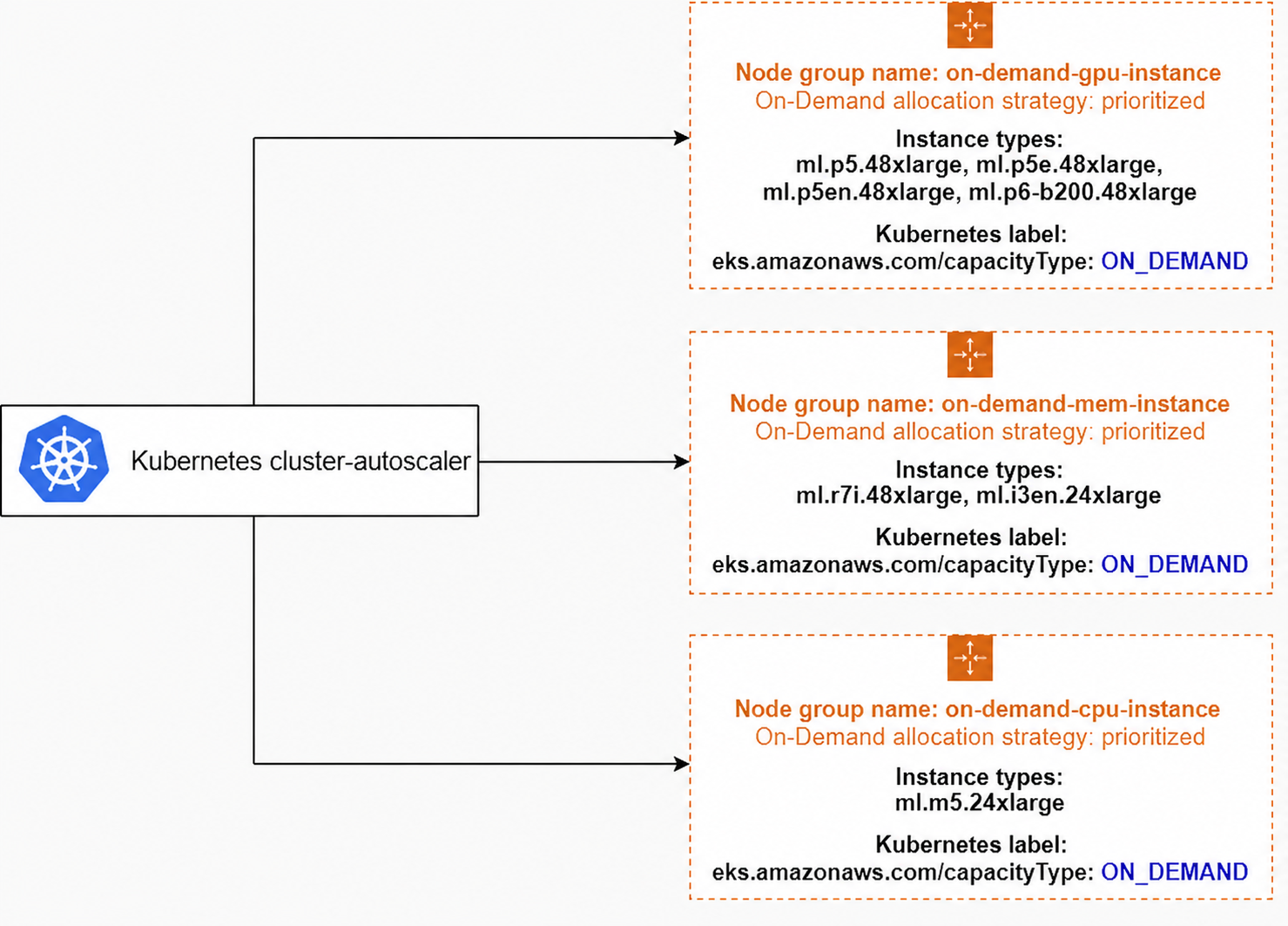
Furthermore, the ability to utilize Amazon EC2 Spot Instances for rollout generation—a task that is inherently more fault-tolerant than policy training—represents a significant economic benefit. By separating the rollout workers (which can be interrupted and reassigned) from the policy-training workers (which require long-running, stable connections), companies can reduce the overall cost of their RLHF pipelines by a significant margin.
Expert Perspectives and Industry Outlook
Industry observers note that as models continue to scale toward the multi-trillion parameter threshold, the bottleneck will increasingly shift from "how many FLOPS can we provide" to "how efficiently can we move data across the rack." The success of the DeepEP-over-EFA model suggests that the future of large-scale AI training lies in the tight coupling of software-defined communication libraries with high-performance, low-latency hardware fabrics.
For organizations currently struggling with the "straggler" problem—where a single slow worker stalls an entire training job—the lessons learned from these EKS-based deployments provide a clear roadmap. By prioritizing inter-node communication efficiency and utilizing topology-aware dispatch kernels, teams can maintain the stability of their RL loops even as they scale to thousands of accelerators.
Conclusion
As the development of LLMs evolves from pure pre-training to more sophisticated, iterative post-training processes, the infrastructure supporting these efforts must evolve accordingly. The combination of Amazon EKS, EFA, and DeepEP offers a robust framework for managing the competing demands of rollout generation and policy training. By enabling higher throughput and more stable communication, this architecture not only accelerates the time-to-market for advanced AI models but also ensures that the massive capital investment in GPU hardware is translated into tangible model improvements rather than lost to network wait-times and system bottlenecks. As these patterns become industry standard, they will likely serve as the foundational blueprint for the next generation of AI research infrastructure.