The True Cost of Professional Leadership: Navigating Executive Compensation in Growing Private Enterprises

For CEOs looking to take their companies to the next level, bringing in professional management can mean confronting a difficult question about what top talent costs. As entrepreneurs transition from the "founder-led" phase to a structured, scalable corporate model, they often find that their internal financial benchmarks are no longer aligned with the realities of the competitive executive labor market. This psychological and financial adjustment is a pivotal moment in the lifecycle of a private business, marking the divide between an owner-operated venture and an institution capable of long-term, independent growth.
The Evolution of the Founder’s Mindset
The journey of an entrepreneur is typically defined by frugality and reinvestment. In the early stages, founders often keep their own salaries at the absolute minimum to preserve cash flow and fuel expansion. When the time comes to hire a seasoned president, chief financial officer (CFO), or chief operating officer (COO), this habit of low compensation can create a significant barrier to entry.
When a founder realizes that a professional executive’s market value is substantially higher than their own take-home pay, the resulting "sticker shock" can stall critical hiring decisions. This dynamic is exacerbated by the fact that many founders view their compensation through the lens of equity growth—they are building wealth through the appreciation of the company’s value, not necessarily through annual salary. Conversely, a professional executive hired from a larger corporation expects a compensation package that reflects their opportunity cost, risk profile, and specialized experience.
Quantitative Benchmarking: The 2026–2027 Compensation Landscape
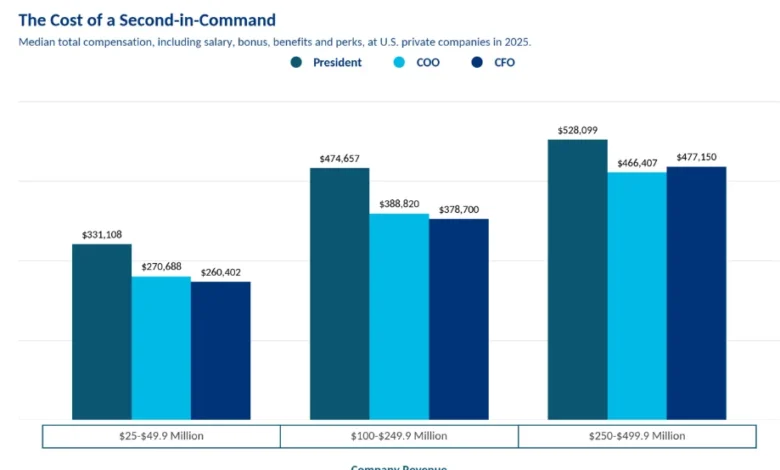
Data from the 2026–2027 CEO & Senior Executive Compensation Report by Chief Executive Group provides a clear picture of these market requirements. As of 2025, the median total compensation—encompassing base salary, bonuses, equity, and perks—for a president in a U.S. private company reached $354,608. Meanwhile, COOs secured a median of $282,940, and CFOs reached $272,434.
These national medians, however, obscure the exponential relationship between corporate scale and executive pay. The cost of leadership is not a static figure but a variable that shifts according to the complexity of the organization.
- Mid-Market Tier ($25M–$49.9M Revenue): Companies in this growth stage pay their presidents a median of $331,108. The CFO role is valued at $260,402, while COOs command $270,688.
- Expansion Tier ($100M–$249.9M Revenue): As firms cross the $100 million threshold, the pressure to professionalize increases. Median compensation for presidents climbs to $474,657, while CFOs and COOs see their compensation rise to $378,700 and $388,820, respectively.
- Scale-Up Tier ($250M–$499.9M Revenue): At this level of complexity, the market for top-tier talent is fierce. Presidents earn a median of $528,099, with COOs and CFOs nearing the half-million-dollar mark at $466,407 and $477,150, respectively.
The Danger of the Median: Understanding Quartile Ranges
One of the most frequent mistakes made by boards and founders is using median figures as a budget target. By definition, 50% of the market pays more than the median. When a business requires specific, high-demand capabilities—such as a CFO with experience in navigating a complex IPO process or a COO capable of streamlining a multinational supply chain—the cost is rarely the median.
For instance, looking at the CFO role within companies generating $100 million to $249.9 million in revenue, the top-quartile compensation reaches $596,198. This is more than $200,000 higher than the median. For a company seeking to disrupt its industry or execute a high-stakes exit strategy, paying for the top quartile is often an investment in risk mitigation rather than a simple overhead expense.
The Strategic Value of "Imported" Talent
The decision to hire externally is often driven by the need for institutional knowledge that does not exist within the current organization. As businesses evolve, the capabilities required to manage them change:
- The Growth President: A firm expanding into international markets or new product lines requires a president with a track record of managing large, complex, and geographically dispersed organizations. These individuals command a premium because their experience is directly tied to the mitigation of "growing pains" that could otherwise sink a smaller firm.
- The Transactional CFO: For founders preparing for a liquidity event, sale, or significant outside investment, the CFO becomes the most important hire. The market for CFOs with deep expertise in SEC reporting, capital structure, and transaction advisory is exceptionally competitive.
- The Operations Specialist: Rapidly growing manufacturers often face a ceiling where "gut-feeling" management is no longer sufficient. An operations leader who can implement rigorous, data-driven production discipline is often the difference between profit and loss as volume scales.
Industry-Specific Dynamics and Private Equity Influence
The compensation landscape is further complicated by industry sector and ownership structure. Private equity-backed firms, which prioritize rapid enterprise value creation, frequently structure compensation packages that rely more heavily on performance-based bonuses and long-term incentive plans (LTIPs). This contrasts with family-owned or legacy private businesses, which may favor higher base salaries to attract talent that values stability.
Industry demand also plays a role. In sectors like technology or specialized manufacturing, the scarcity of executive talent with niche technical knowledge can push compensation well above the figures reported in broader surveys. Founders must therefore analyze their specific peer group rather than relying on general market averages.
Bridging the Expectation Gap
When an entrepreneur struggles to reconcile the cost of a new executive with their own historical compensation, they must shift their frame of reference. The CEO’s salary is often a secondary concern because their true financial gain is derived from the equity appreciation of the firm. A hired senior executive does not have that same cushion. Without a significant equity stake, an executive will, and should, demand a higher salary and cash-based incentive structure to compensate for the lack of ownership-related wealth accumulation.
Furthermore, paying a premium is not a guarantee of success, but failing to pay market rate is a guarantee of mediocrity. The "cost" of the wrong hire—in terms of lost time, missed market opportunities, and cultural misalignment—often dwarfs the incremental difference between a median salary and a top-quartile compensation package.
Strategic Recommendations for Founders
As boards and owners plan for the next phase of growth, the approach to compensation should be strategic rather than reactive:
- Benchmark for the Future: Don’t just pay for the role as it exists today. Pay for the role as it will need to function in three to five years.
- Structure for Performance: Use incentives to align the interests of the new executive with the goals of the company. If the company’s objective is an exit within five years, ensure that equity incentives reflect that timeline.
- Look Beyond the Base: In a tight labor market, the total rewards package—including benefits, performance bonuses, and long-term incentives—is often more persuasive to a high-level candidate than a simple base salary figure.
- Consult Professional Data: Utilize resources like the 2026–2027 CEO & Senior Executive Compensation Report to understand the nuances of the market. This provides an objective baseline that removes the personal emotion often associated with setting compensation for senior roles.
Ultimately, the transition from a founder-led business to a professionally managed enterprise requires a departure from the "bootstrapper" mentality. Recognizing that human capital is the primary engine of scale is the first step toward building a sustainable, high-growth organization. The question for the modern CEO is not simply "Can I afford this executive?" but rather "Can the business afford the cost of not having this capability?" By aligning compensation with the strategic value the executive brings, founders can effectively bridge the gap between their current reality and their long-term vision.