Beyond Prohibition and Blind Adoption: The Bot Check Method and the Corporate-Academic Crisis of Cognitive Debt


The corporate boardroom and the university lecture hall rarely share an operational vocabulary, yet chief learning officers, executive education faculty, and talent development executives currently find themselves paralyzed by the exact same systemic dilemma. Faced with the generative artificial intelligence boom, academia chose prohibition, implementing strict AI detection tools, punitive honor codes, and structural workarounds designed to make artificial intelligence assistance impossible or detectable. Simultaneously, corporate America pursued the diametrical opposite: unbridled adoption, deploying metrics dashboards, rapid-fire AI fluency programs, and internal pressures to integrate large language models into workflows as quickly as possible. Both institutions made the identical foundational error. Neither policy asks the definitive question regarding human development: What is the human being supposed to be doing while artificial intelligence is actively in the room?
This shared pedagogical and operational oversight is no longer merely theoretical. Emerging neuroscientific research indicates that improper AI integration carries biological, measurable costs that threaten to erode the core cognitive foundations of both the modern workforce and higher education. As organizations across sectors grapple with the fallout of both reactionary bans and reckless rollouts, a structural third way known as the Bot Check Method has emerged. Developed by educator and researcher Christyl L. Murray, this four-phase sequence attempts to reconcile human agency with artificial intelligence capabilities, offering a governed framework that bridges the gap between total abstinence and unregulated exposure.
The Neuroscience of Cognitive Debt: Evidence from the MIT Media Lab
The catalyst for a fundamental reevaluation of AI integration policies arrived via a landmark study conducted by researchers at the MIT Media Lab. Titled Your Brain on ChatGPT: Accumulation of Cognitive Debt when Using an AI Assistant for Essay Writing Task and led by researcher Nataliya Kosmyna, the study provided hard physiological data regarding what happens to the human brain when generative AI is introduced prematurely into complex cognitive workflows.
For the investigation, researchers outfitted 54 university students with high-density electroencephalography (EEG) caps. These caps measured real-time electrical brain activity as the participants drafted essays under three distinct operational conditions: utilizing ChatGPT, relying on a standard search engine, or working entirely unaided with no external tools. The results were stark and unambiguous. Students who relied on ChatGPT demonstrated the weakest overall brain connectivity across neurological regions associated with active critical thinking, working memory integration, and complex synthesis. Conversely, students working without any technological assistance exhibited the strongest, most densely distributed neural networks.
To test the lingering effects of reliance, the researchers introduced a fourth session where students who had previously used ChatGPT were required to write essays completely unassisted. Their neural engagement remained severely depressed—a state researchers categorized as underengagement. The habit of intellectual outsourcing appeared to have temporarily altered baseline patterns of cognitive activation, mirroring a financial model where debt limits future mobility. Consequently, researchers coined the term cognitive debt to describe the cumulative neurological toll of delegating critical thought to large language models over extended periods.
Beyond the neurological readings, behavioral metrics revealed a corresponding decline in intellectual ownership. Self-reported ownership of the written essays was lowest among the LLM user group and highest among the unassisted control group. Furthermore, AI-reliant participants struggled significantly to accurately recall, attribute, or quote their own submitted work. The tool had not merely optimized the writing process; it had systematically diminished the user’s cognitive engagement and psychological investment in the output. Commenting on the findings, Kosmyna noted that while the exact equilibrium of human-AI collaboration remains undefined, the data serves as an undeniable warning signal demanding disciplined oversight regarding when and how these tools are introduced.
The Two Broken Frames: The Abstinence Error Versus Ungoverned Adoption
The institutional response to these unfolding realities has been hampered by two opposing, yet equally flawed, behavioral frameworks. The academic sector’s reliance on prohibition mirrors historical abstinence-only public health strategies. Just as abstinence education fails to prevent targeted behaviors and instead forces them into unmonitored environments, academic bans on generative AI do not stop students from using large language models. Instead, detection software drives the usage underground, stripping away the pedagogical scaffolding that could otherwise render the encounter educationally generative. Students continue to use AI as a silent replacement for their own intellectual labor rather than as a critical dialogue partner.
In corporate environments, the abstinence error manifests differently, breeding a phenomenon known as shadow AI. When enterprises implement heavy-handed restrictions or outright bans without providing sanctioned, well-governed alternatives, employees do not abandon the technology. Instead, they migrate to personal devices, consumer-grade applications, and unsecured external networks on their personal smartphones. Consequently, sensitive corporate assets—including proprietary client data, internal strategic roadmaps, compensation tiers, human resources files, financial projections, and competitive intelligence—flow directly into third-party AI models operating entirely outside enterprise security perimeters and governance frameworks. Organizations operating under the assumption that strict prohibition policies protect their data are frequently blind to where that information is actually migrating.

Conversely, enterprises that pursue wide-open adoption without structural boundaries encounter an inverted set of challenges. By measuring success strictly through adoption dashboards and utilization frequency metrics, companies incentivize sheer volume over cognitive rigor. These organizations track how often tools are accessed, but they fail to measure whether that usage enhances human capability or quietly degrades it. Both institutional extremes share a foundational failure: they omit the developmental inquiry into what kind of critical thinker an individual is becoming through their ongoing relationship with automated systems.
The Framework for Agency: Theoretical Foundations of the Bot Check Method
To resolve these systemic failures, educational and corporate learning leaders must transition from a binary choice of restriction versus adoption to a tertiary framework centered entirely on human agency. In this context, agency represents the capacity to formulate independent cognitive positions prior to consulting automated tools, to bring that independent reasoning into critical discourse with machine-generated output, to evaluate AI responses skeptically rather than authoritatively, and to synthesize human and machine perspectives into a unified product that retains genuine intellectual ownership.
This developmental trajectory relies heavily on established learning theories, notably the Community of Inquiry (CoI) framework established by D. Randy Garrison, Terry Anderson, and Walter Archer. Garrison defines cognitive presence as the extent to which learners construct and confirm meaning through sustained reflection and discourse. According to the CoI model, meaningful cognitive construction requires four sequential phases: a triggering event that establishes intellectual stakes, exploration where learners examine the problem space, integration where they build conceptual meaning, and resolution where they apply and confirm those insights.
The MIT Media Lab data confirms that introducing artificial intelligence too early in this sequence short-circuits both the triggering and exploration phases. When a large language model supplies the structural frame before the human participant has formulated an independent perspective, the necessary neurological pathways fail to activate. The Bot Check Method was specifically engineered to force compliance with this natural cognitive sequence across every operational deployment.
The Four Phases of the Bot Check Method
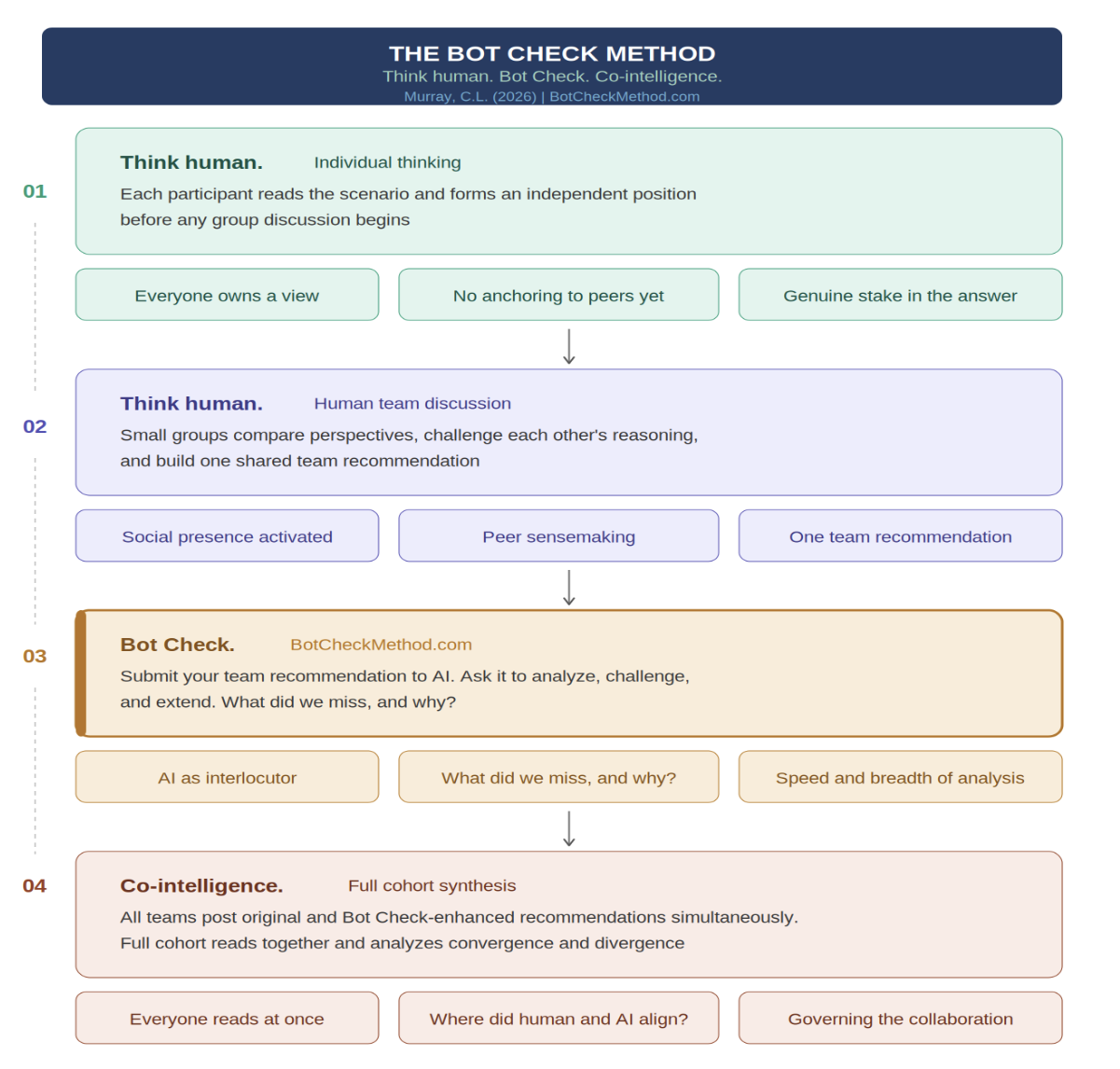
Structured as a repeatable, four-phase operational sequence, the Bot Check Method maps directly onto the Community of Inquiry model, systematically neutralizing the failure modes inherent in both prohibition and ungoverned deployment:
Phase 1: Think Human
Before any group collaboration or interaction with artificial intelligence, participants must independently confront the core problem and develop an autonomous position. This stage acts as the essential triggering event within the CoI framework, establishing personal intellectual stakes. Bypassing this step, as cautioned by the MIT EEG data, invites the rapid accumulation of cognitive debt.
Phase 2: Think Human Together
Participants assemble into small peer cohorts to share their individual diagnoses, challenge disparate reasoning, and forge a cohesive team recommendation. This operationalizes the exploration phase of the CoI framework. Rooted in established social constructivist learning models, this social presence enables learners to establish emotional and collaborative connections, paving the way for advanced cognitive depth before any artificial intelligence is introduced.
Phase 3: Bot Check
Only after the human team has successfully formulated and defended an original recommendation do they introduce the large language model. The team submits their finalized analysis to the AI with specific prompts: What underlying gaps exist in this reasoning? What alternative perspectives were omitted? Where does the model diverge from the human analysis, and what do those divergences reveal about the quality of the team’s logic? Teams may even prompt the AI to help formulate rigorous stress-tests against their own assumptions before evaluation. Crucially, the AI functions strictly as an adversarial interlocutor rather than an authoritative source of final answers, preserving human intellectual ownership.
Phase 4: Co-Intelligence
All participating teams simultaneously publish their original human-derived recommendations alongside their Bot Check-enhanced iterations to a centralized, shared channel. The broader learning community analyzes convergence and divergence patterns collectively. By examining where human logic aligned with or outperformed machine outputs, the collective group extracts nuanced insights that neither isolated human actors nor autonomous systems could generate independently.
Scaling Enterprise Capability Through the SHINE Framework
While the Bot Check Method functions as an immediate session-level design, scaling it into a permanent enterprise capability requires comprehensive organizational governance. This scaling architecture is provided by the SHINE framework, which aligns structural pillars directly with institutional readiness:
Sponsorship and Sensemaking: Enterprise AI Ambassadors model the Bot Check sequence publicly before formal training rolls out across broader business units, demonstrating authentic human-first, AI-informed engagement.
Habits and Upskilling: Organizations shift performance metrics away from raw tool proficiency toward disciplined behavioral sequences, treating independent human reflection as a mandatory prerequisite for automated consultation.
Integration and Incentives: Workflows are structurally redesigned so that individual critical reflection is embedded as an immutable system requirement prior to running automated diagnostic prompts.
Norms and Governance: Enterprises replace blunt prohibition policies and fragmented usage guidelines with a unified governance architecture that dictates how human minds and artificial intelligence systems collaborate safely and productively.
Evidence and Expansion: Continuous loop monitoring tracks convergence and divergence data from bot-checking sessions, surfacing team reasoning quality, tool limitations, and evolving governance needs in real-time.
Strategic Imperative for Learning Leaders
The convergence of neuroscientific data, educational theory, and enterprise operational realities points toward a singular conclusion: the ongoing debate between AI prohibition and unmitigated adoption is a false dichotomy. The accumulation of cognitive debt documented by the MIT Media Lab demonstrates that failing to structure human-AI interaction systematically results in the gradual erosion of critical workforce capabilities.
The resolution does not lie in locking technology out of the classroom or the corporate office, nor does it involve accelerating adoption speeds without pedagogical guardrails. The path forward requires a deliberate commitment to structured human agency. By prioritizing independent human thought, leveraging collaborative peer discourse, applying targeted artificial intelligence scrutiny, and enforcing rigorous governance frameworks, organizations can successfully harness computational power without compromising human intellect. The decision facing chief learning officers and academic administrators is straightforward: whether to implement structured cognitive design today or manage the mounting costs of unmanaged cognitive debt tomorrow.