Connecting Talent Development to the Bottom Line: Why CEOs Demand Measurable Business Impact from L&D Programs

Corporate governance and executive leadership standards have shifted dramatically over the last decade, transitioning away from subjective performance indicators toward uncompromising metrics of financial accountability. Recent empirical research sponsored by the Association for Talent Development (ATD) highlights a decisive consensus among top-tier leadership: an overwhelming 96 percent of Fortune 500 chief executive officers identify measurable business impact as the single most critical performance indicator for talent development initiatives. Return on investment (ROI) closely follows as the second most vital metric. This data underscores a fundamental reorientation in organizational strategy. Executives no longer view learning and development (L&D) as a peripheral corporate perk or a compliance-driven HR exercise. Instead, they demand that educational initiatives serve as direct drivers of operational efficiency, revenue growth, and strategic alignment.
This mandate is not exclusive to for-profit corporate giants. Nonprofits, public sector entities, and philanthropic organizations increasingly evaluate their internal capacity-building programs through the same rigorous lens. Every operational structure relies on fundamental performance indicators—commonly referred to as business measures—such as output volume, product or service quality, cost containment, and cycle time. When modern chief executive officers or executive directors evaluate the efficacy of a talent development program, their inquiry invariably centers on a singular, pragmatic question: Does this program tangibly advance the core objectives of the enterprise? Aligning learning outcomes directly with organizational strategy bridges the historical divide between human resources and executive financial planning, transforming educational programming from an expense line item into an investment portfolio.
Historical Evolution of the Value Chain
To understand how contemporary organizations measure and maximize this alignment, it is necessary to examine the historical evolution of evaluation frameworks. The architectural foundation of modern learning evaluation rests on a classic logic model. While foundational concepts date back to the late nineteenth century, industrial psychologist Raymond Katzell formally published a structured version of this value chain in 1952. Subsequently, educational theorist Don Kirkpatrick popularized these sequential tiers, establishing the baseline taxonomy that decades of corporate trainers utilized to assess educational outcomes. However, modern operational frameworks have expanded upon these foundational steps to address the rigorous demands of contemporary Chief Financial Officers.

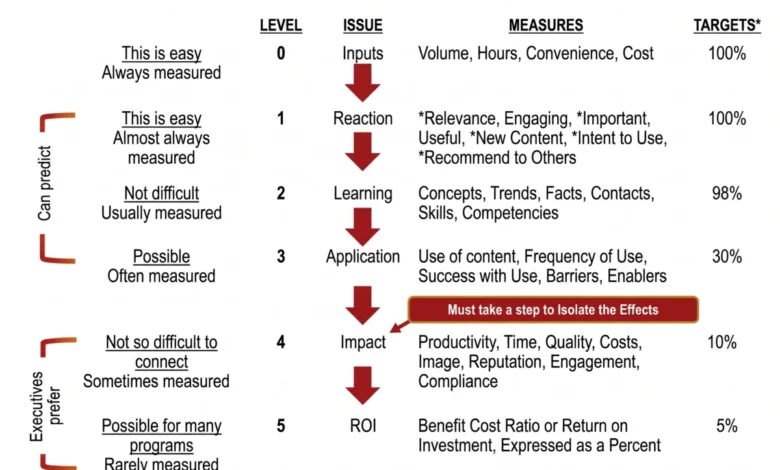
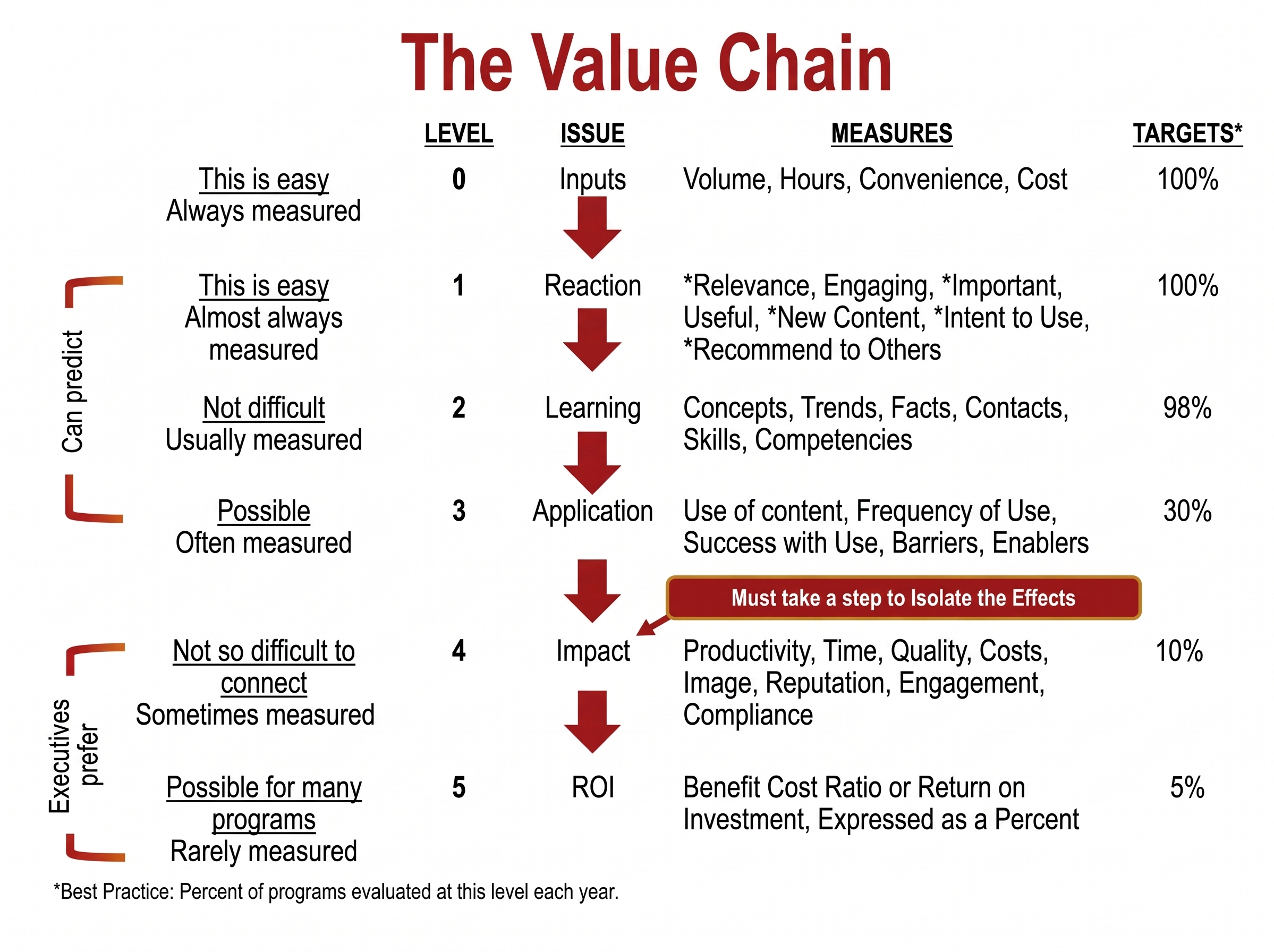
The contemporary value chain operates as a progressive logic model where each phase builds cumulatively upon its predecessor. The framework initiates at Level 0, designated as Input. This phase captures the fundamental resource expenditures of any given initiative, tracking participant volume, time commitment, and total financial outlay. From this baseline, the model advances through five distinct tiers of progressive outcomes.
Level 1 evaluates Reaction, measuring how participants perceive the immediate value, relevance, and importance of a project or program. While reaction data is often dismissed as mere satisfaction scoring, practitioners recognize that a severely adverse participant reaction can actively derail a new initiative before implementation even begins. Level 2 measures Learning, quantifying the specific acquisition or enhancement of knowledge, technical proficiencies, and behavioral competencies.
Level 3 shifts the focus to Application, tracking real-world implementation by participants in their daily work environments. This tier captures the frequency and extent of skill utilization, operational success rates, and the specific barriers or organizational enablers that influence performance change. Level 4 measures Impact, identifying the direct operational consequences of that application. Because impact measures manifest as concrete improvements in output, quality, cost, and time, isolating the specific effects of the program from external market variables is essential for maintaining analytical credibility. Finally, Level 5 calculates Return on Investment (ROI). This advanced metric converts realized business impacts into monetary values and compares them directly against the total direct and indirect costs of the program, yielding a precise benefit-cost ratio.
The 12-Step ROI Methodology Framework
Recognizing the limitations of superficial evaluation models, organizational development experts developed a comprehensive, twelve-step framework known globally as the ROI Methodology. Presently utilized by over 11,000 organizations worldwide, this system functions simultaneously as an evaluation protocol and a strategic design architecture. By embedding accountability into the initial planning stages, the methodology ensures that programs are engineered from inception to deliver verifiable financial and operational outcomes.
The architecture of the ROI Methodology is divided into deliberate phases: designing for results, planning the evaluation, collecting data, analyzing data, and optimizing outcomes. Each phase incorporates strict empirical standards designed to satisfy the rigorous scrutiny of corporate financial leadership.
Phase one initiates with meticulous evaluation planning, anchored by three critical steps. Step 1 requires practitioners to "start with why" by explicitly aligning the proposed talent development program with a specific, quantifiable business measure. Organizations must determine whether they are addressing a pressing operational problem or pursuing a strategic opportunity, identifying the exact metrics that reflect success. Step 2 mandates validation of the chosen solution. If leadership presents a pre-formulated problem, practitioners must conduct a thorough root-cause analysis to ensure the proposed intervention directly addresses the underlying structural issue. Step 3 involves embedding expectations of success directly into the program architecture through strategic design thinking, culminating in the formal drafting of comprehensive data collection and ROI analysis plans.
Data Collection and the Credibility Challenge
Following the planning phase, the methodology transitions into data collection. While collecting reaction and learning data (Step 4) remains standard operational procedure for most enterprises, capturing application and impact data (Step 5) requires targeted field instruments, including structured action plans and operational performance tracking.
The most formidable hurdle in executive evaluation is establishing absolute analytical credibility—a challenge addressed during the data analysis phase. Step 6 mandates the isolation of the program’s effects from external organizational influences. Credible isolation techniques range from experimental and control group methodologies to trend line analysis and expert estimation. When estimation is necessary, data must be gathered through non-threatening, unbiased channels from the most credible organizational sources and systematically adjusted for statistical error.
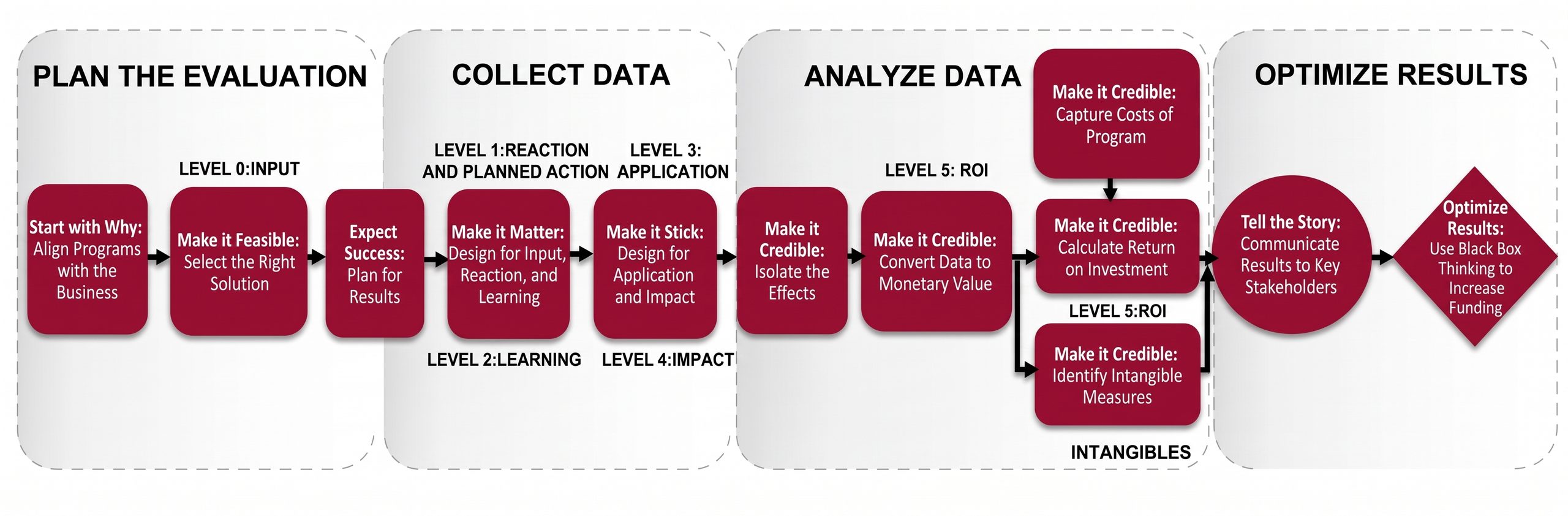
Step 7 converts verified impact data into monetary values. Utilizing standard organizational values approved by corporate financial leadership, practitioners translate operational improvements—such as reduced error rates or accelerated project delivery—into financial returns. When direct conversion is not feasible, organizations rely on conservative external research or conservative estimates, adhering strictly to the guiding philosophy: "When in doubt, leave it out." Metrics that resist credible monetary conversion are categorized in Step 8 as intangible measures, which, while unquantified financially, retain significant qualitative value.
Step 9 ensures comprehensive fiscal accountability by capturing all direct and indirect program costs, including administrative overhead, material expenses, and the lost opportunity cost of participant time. Guided by the principle "When in doubt, leave it in," this conservative accounting practice enhances the ultimate credibility of the evaluation. Step 10 calculates the final financial return utilizing established formulas for the benefit-cost ratio (BCR) and percentage ROI, providing executive leadership with a definitive answer to the core operational inquiry: Was the financial investment worthwhile?
Optimizing Results and Strategic Implications
The final phase of the methodology focuses on translating empirical findings into long-term organizational value. In Step 11, quantitative datasets from all five outcome levels are synthesized into compelling, evidence-backed narratives that engage stakeholders and secure ongoing executive buy-in. Step 12 leverages these optimized results to influence future capital allocation, secure expanded funding for human capital initiatives, and recognize the specific teams responsible for driving operational excellence.
The broader implications of this rigorous measurement paradigm signal a permanent maturation of the talent development sector. As corporate boards and executive committees increasingly demand absolute transparency regarding human capital expenditures, L&D professionals must transition from creative facilitators to strategic financial stewards. By anchoring educational design to concrete business measures, isolating program effects with unwavering analytical rigor, and maintaining conservative financial accounting standards, talent development departments can secure their positions as indispensable drivers of enterprise-wide success.