In contemporary corporate culture, leadership is frequently discussed in terms of strategic foresight, emotional intelligence, and crisis management. Yet, a fundamental misconception continues to distort how professionals view one of the most critical traits required to navigate modern uncertainty: courage. Conventional wisdom suggests that bravery is an innate emotional state, a sudden surge of fearlessness that arrives spontaneously during moments of high-stakes pressure. For decades, executives and managers have operated under the assumption that if they do not instinctively feel confident, they are unequipped to lead through disruption.
However, a fundamental reexamination of this premise is reshaping executive education. According to leadership expert, educator, and author Kimberly Davis, society has misidentified the very nature of bravery. Rather than treating courage as an emotion that precedes action, Davis argues that bravery is an action itself—a deliberate physical and behavioral choice that manifests through what leaders actually do when faced with adversity. This perspective forms the cornerstone of her newly revised and updated award-winning book, Brave Leadership – Unleash Your Most Confident, Powerful, and Authentic Self to Get the Results You Need.
The implications of this reframing extend far beyond individual self-improvement; they strike at the heart of modern organizational dynamics, employee retention, and transformational change management.
The Evolution of Executive Bravery in an Era of Uncertainty
To understand the urgency behind redefining leadership courage, one must examine the turbulent landscape of the modern workplace. Over the past decade, corporate leaders have confronted an unprecedented succession of systemic shocks, ranging from global supply chain fractures and rapid technological disruptions—including the ascent of artificial intelligence—to macroeconomic volatility and shifting workforce expectations surrounding remote and hybrid models.
Historically, corporate leadership models relied heavily on positional authority. Leaders issued directives, and subordinates complied out of organizational hierarchy and contractual obligation. In the twentieth-century industrial economy, this transactional framework largely sufficed. However, the twenty-first-century knowledge economy operates under fundamentally different rules. Today’s workforce, particularly younger generations entering the professional sphere, demands purpose, psychological safety, and authentic engagement. Compliance driven by fear or obligation no longer yields optimal productivity or innovation.
It is within this crucible of complexity that Davis’s pedagogical approach gains critical relevance. Having spent years shaping executive minds at Southern Methodist University’s Cox School of Business Executive Education, Davis has observed a recurring pattern among aspiring and seasoned leaders alike: the paralyzing fear of vulnerability. Many executives believe that showing uncertainty is a sign of weakness, leading them to project a facade of infallible confidence.
Davis’s work challenges this deeply ingrained corporate conditioning. By reframing bravery as a verb rather than a feeling, she posits that authentic leadership does not require the absence of fear. Instead, it requires individuals to act in alignment with their core values and organizational objectives despite the presence of fear. This distinction is vital for cultivating sustainable resilience within institutions.
Background and Pedagogy: The Roots of Brave Leadership
The genesis of Davis’s leadership philosophy did not emerge in a sterile academic vacuum; it was forged through rigorous, hands-on application across diverse cultural and geopolitical landscapes. In addition to her tenure at SMU’s Cox School of Business, Davis dedicated four years to working with the Bush Institute’s WE Lead program. This initiative focuses on identifying, training, and empowering female leaders across the Middle East and North Africa—regions characterized by complex socioeconomic dynamics, traditional gender hierarchies, and volatile political climates.
Working within the WE Lead framework provided Davis with empirical proof of her core thesis. In environments where systemic barriers present daily, tangible risks to professional advancement and personal security, waiting to "feel" brave is a luxury no effective leader can afford. Women participating in the program had to exercise courage preemptively. They demonstrated bravery not because they were devoid of apprehension, but because their commitment to their communities and professional visions compelled them to take decisive, visible actions.
This cross-cultural application underscored a universal truth of human behavior: action precedes emotion. In psychological literature, this aligns closely with behavioral activation theories, which suggest that altering one’s behavior can systematically influence internal emotional states. When applied to executive leadership, waiting to feel confident before making a difficult decision often results in paralysis by analysis. Conversely, stepping forward, communicating transparently, and making tough choices initiates a feedback loop that builds genuine confidence over time.
Shifting from Positional Authority to Influence-Driven Leadership
A central tenet of Davis’s expanded framework involves the transformation of how leaders motivate their teams. Traditional management models emphasize control and compliance. Modern leadership, however, necessitates inspiration and voluntary alignment.
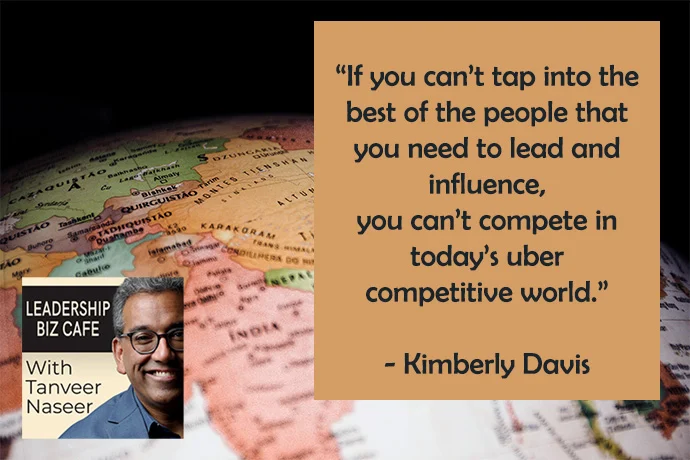
During discussions featured on professional forums such as the Leadership Biz Cafe podcast hosted by Tanveer Naseer, Davis emphasizes that true leadership bravery involves deeply understanding what matters to employees. In an era defined by the "Great Attrition" and shifting employee priorities—where mental health, workplace flexibility, and organizational values carry unprecedented weight—leaders can no longer assume that financial compensation alone will secure loyalty.
To lead bravely today means engaging in difficult, empathetic conversations with staff members to uncover their core motivations, professional aspirations, and personal pain points. It requires leaders to champion their teams’ interests, sometimes at the expense of short-term bureaucratic convenience or upper-management consensus. When employees recognize that their leadership is actively listening to their needs and courageously advocating for their well-being, a profound shift occurs: they choose to follow the leader out of trust and shared purpose, rather than complying merely because they are obligated to by an organizational chart.
Broader Economic and Organizational Implications
As organizations worldwide grapple with the imperatives of digital transformation, environmental, social, and governance (ESG) standards, and shifting labor markets, the demand for actionable leadership frameworks has never been higher. Business analysts note that corporate failures are rarely products of poor technical strategy; rather, they are almost universally failures of leadership courage.
When leadership teams fail to address cultural toxicity, ignore emerging market disruptions, or shy away from transparent communication during crises, organizations stagnate or collapse. Conversely, companies that embed a culture of behavioral bravery foster environments where calculated risk-taking is encouraged, failures are treated as developmental milestones rather than punishable offenses, and innovation thrives.
Davis’s updated insights offer a practical roadmap for executive boards, human resources directors, and organizational development specialists. By decoupling courage from emotion, enterprises can demystify leadership development. Training programs can shift away from abstract concepts of charisma and innate talent, focusing instead on observable, measurable behaviors: How does a leader communicate during a layoff? How swiftly do they address unethical behavior? To what extent do they protect psychological safety within their teams?
Conclusion: Redefining the Future of Work
The conversation surrounding Kimberly Davis’s revised work highlights a paradigm shift in how modern institutions view human potential. Bravery is not a rare genetic trait bestowed upon a fortunate few; it is a daily practice, an intentional choice available to any professional willing to align their actions with their deepest convictions.
As the global business community continues to navigate an unpredictable economic and technological landscape, the challenge for leaders is clear. They must abandon the passive wait for confidence and instead embrace the active discipline of courage. By doing so, they not only transform their own executive trajectories but also build resilient, deeply committed organizations capable of thriving amidst uncertainty.