Bridging the Gap: Why Fortune 500 CEOs Are Demanding Measurable Business Impact From Talent Development

In the modern corporate landscape, executive leadership teams are increasingly turning away from traditional, activity-based metrics in favor of tangible financial results. Recent research sponsored by the Association for Talent Development (ATD) highlights a profound shift in corporate expectations: 96 percent of chief executive officers at Fortune 500 companies identify "business impact" as the single most important measure of talent development programs. Return on investment (ROI) closely follows as the second highest priority.
This data underscores a long-standing tension between human resources departments and executive suites. For decades, learning and development (L&D) divisions evaluated their success based on completion rates, hours spent in training, and post-session participant feedback surveys. However, modern C-suites demand a definitive connection between corporate education investments and bottom-line outcomes.
Whether in a for-profit corporation or a non-profit entity, every organization relies on core operational metrics such as output, quality, cost management, and time efficiency. When top executives are asked if they want learning initiatives to directly influence these organizational goals, the unanimous answer is affirmative. Consequently, impact has become the essential "why" driving contemporary workforce education.
The Evolution of the Value Chain

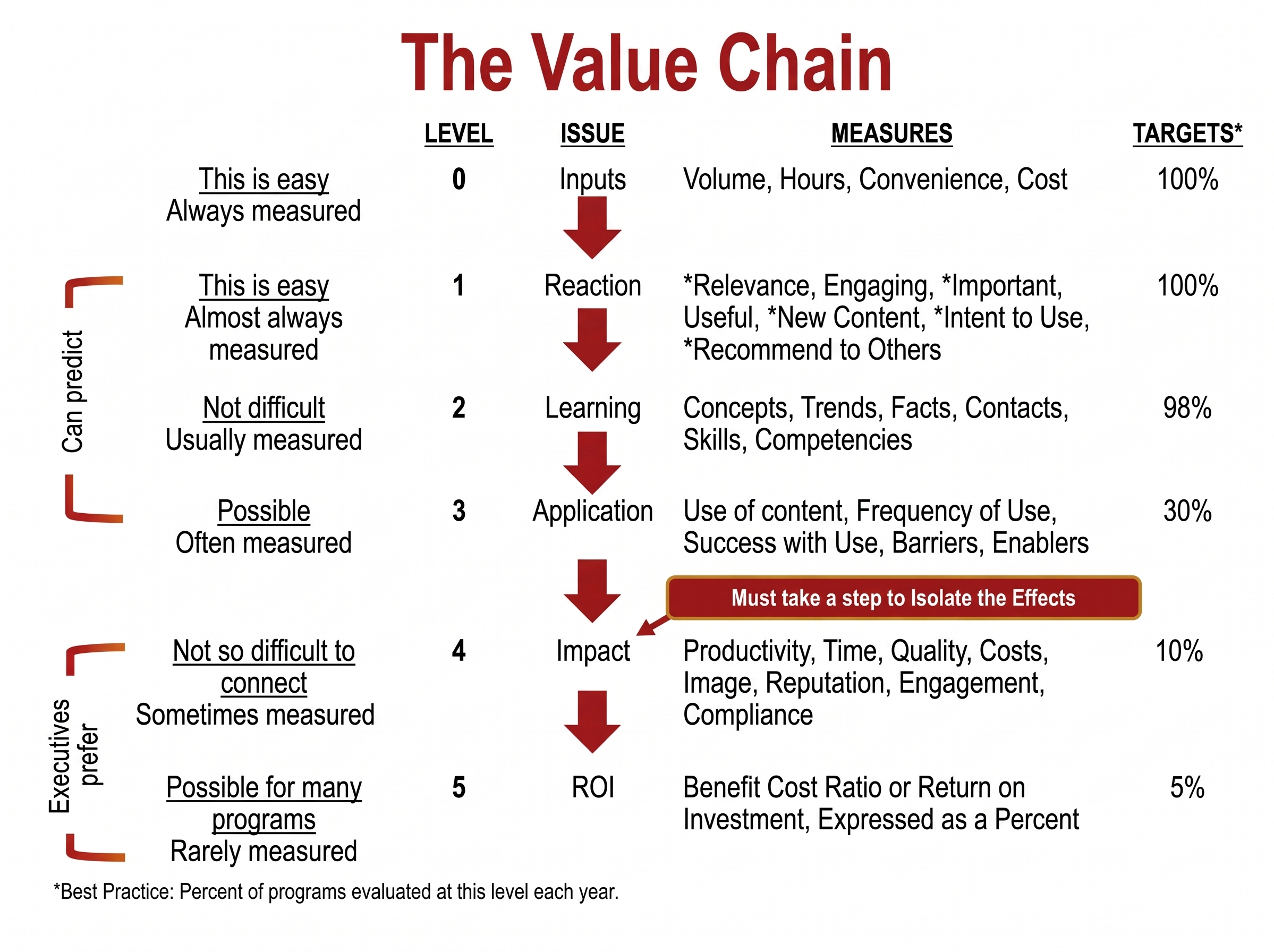
To understand how modern organizations align learning initiatives with financial goals, industry experts point to a foundational framework known as the value chain. Dating back to logic models established in the 19th century and expanded by organizational researchers like Raymond Katzell in 1952—and later popularized by educator Don Kirkpatrick—this structured sequence of data types demonstrates how outcomes build upon one another.
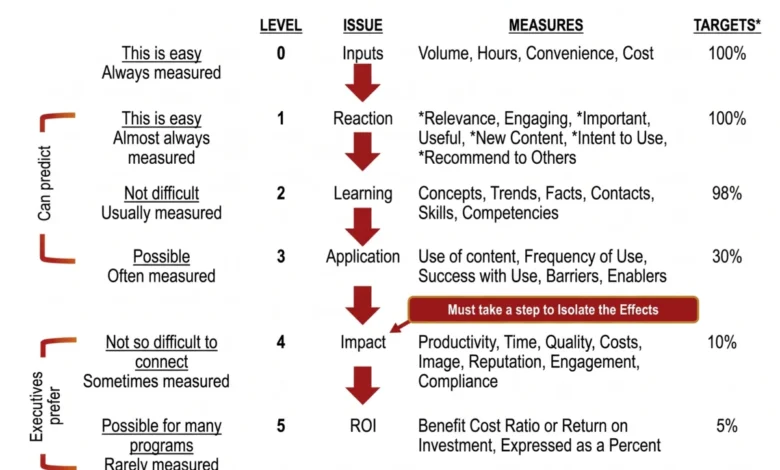
In this cumulative progression, Level 0 examines inputs, tracking the number of participants, time invested, and overall financial costs. The subsequent five levels outline a hierarchy of outcomes:
Level 1 evaluates participant reaction, measuring whether learners perceive the content as relevant, valuable, and worthy of recommendation. A poor initial reaction can undermine the adoption of any new corporate initiative.
Level 2 tracks learning, focusing on the specific acquisition or enhancement of knowledge and hard or soft skills.
Level 3 measures application, monitoring whether participants actually implement what they have learned in their day-to-day work environments. This level captures frequency of use, success rates, and external barriers or enablers.

Level 4 examines business impact, evaluating the ultimate consequences of application. These metrics map directly to standard organizational Key Performance Indicators (KPIs) such as productivity, error rates, operational expenditures, and cycle times. Establishing credibility at this stage requires isolating the program’s effects from outside economic or operational variables.
Level 5 calculates return on investment. At this pinnacle stage, verified business impacts are converted into monetary benefits and weighed against the total direct and indirect costs of the program to determine the benefit-cost ratio and overall ROI percentage.
The 12-Step ROI Methodology
To systematically achieve these levels of accountability, a growing number of enterprises utilize a comprehensive 12-step framework known globally as the ROI Methodology. Adopted by more than 10,000 organizations worldwide, the framework serves not merely as a retrospective evaluation tool, but as a strategic design system that shapes how programs are planned, implemented, and optimized from their inception.
Designing for Results and Planning the Evaluation

The methodology begins well before a training session takes place, focusing heavily on front-end planning.
Step 1 requires program designers to "start with why" by aligning every educational initiative with a specific business metric. Stakeholders must determine whether the program addresses an existing performance problem or prepares the organization to capture a new strategic opportunity.
Step 2 ensures that learning is the correct prescription for the identified issue. While many requested programs stem from genuine organizational needs, rigorous pre-analysis prevents the deployment of training solutions to problems rooted in faulty equipment, misaligned incentives, or broken workflows.
Step 3 focuses on engineering success by establishing clear operational expectations and incorporating design-thinking actions that prime the initiative for measurable adoption. These planning phases culminate in two critical operational documents: a data collection plan and an ROI analysis plan.
Data Collection and Credibility Challenges
Once the educational intervention is underway, data collection moves beyond simple end-of-course happiness sheets. Steps 4 and 5 gather baseline metrics on reactions, learning milestones, operational application, and resulting business impact.
To satisfy skeptical Chief Financial Officers and corporate boards, Steps 6 through 10 address the rigorous credibility challenges inherent in financial analysis. Step 6 mandates the isolation of the program’s effects, employing control groups, trend-line analysis, or conservative management estimates to ensure that outside market factors are not falsely credited for internal performance improvements.
Step 7 converts verified impact metrics into monetary values using standard corporate values or conservative external benchmarks. The guiding philosophy at this stage is "when in doubt, leave it out," ensuring that financial claims remain defensible under strict auditing scrutiny.
Step 8 acknowledges intangible measures—valuable outcomes like enhanced teamwork, improved customer satisfaction, or boosted morale that cannot be easily or credibly translated into monetary figures within a reasonable timeframe.
Step 9 incorporates all direct and indirect program costs, including the compensation value of participant time away from core duties, adhering to the principle of "when in doubt, leave it in" to prevent underestimating expenses.
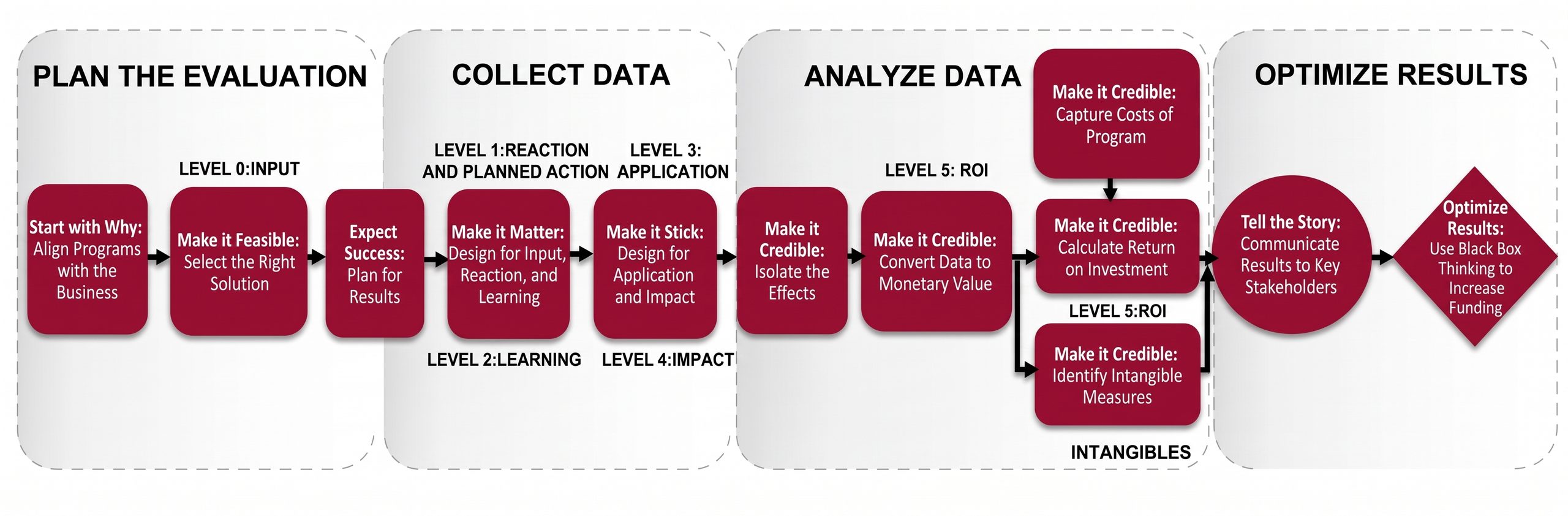
Step 10 finalizes the mathematical computation of the benefit-cost ratio and ROI percentage, answering the ultimate executive question: Was the expenditure worthwhile?
Optimizing Results and Strategic Implications
The final phases of the methodology transform raw analytics into strategic organizational assets. Step 11 leverages the multi-level data sets to construct compelling, evidence-backed narratives that engage stakeholders, investors, and frontline managers.
Step 12 focuses on long-term optimization. By feeding evaluation data back into the organizational budgeting cycle, human resources leaders can justify continued funding, secure executive sponsorship, and continuously refine the quality of future talent development initiatives. Furthermore, this data-driven transparency elevates the professional standing of L&D teams within the corporate hierarchy, transforming learning from a traditional cost center into an indispensable driver of strategic enterprise value.