As the adoption of generative AI moves from experimental prototypes to mission-critical production environments, the limitations of static, public benchmarks have become increasingly apparent. While standardized evaluations like the Massive Multitask Language Understanding (MMLU) or the GSM8K math benchmark provide a baseline for general reasoning capabilities, they are largely blind to the nuances of enterprise deployment. They cannot determine if a customer support chatbot adheres to strict data privacy policies, nor can they verify whether a Retrieval-Augmented Generation (RAG) pipeline is accurately surfacing proprietary documentation. To bridge this gap, organizations are increasingly turning to custom evaluation harnesses—bespoke, repeatable testing frameworks that treat AI performance with the same rigor as traditional software testing.
The Evolution of Model Testing
The methodology for evaluating language models has undergone a significant shift over the past 24 months. In the early stages of the LLM boom, developers relied on manual "vibe checks," where a human would ask a few questions and judge the quality based on intuition. However, as organizations scaled their AI operations, this manual approach proved unsustainable and prone to confirmation bias.
By mid-2023, the industry began adopting automated evaluation frameworks, mirroring the continuous integration and continuous deployment (CI/CD) pipelines used in traditional DevOps. A test harness acts as the necessary scaffolding, systematically feeding inputs into an AI system, capturing the outputs, and scoring them against a predefined baseline. This transition marks a shift toward scientific, data-driven model management, where pass rates, latency, and operational costs are tracked across every iteration.
The Anatomy of a Custom Evaluation Framework
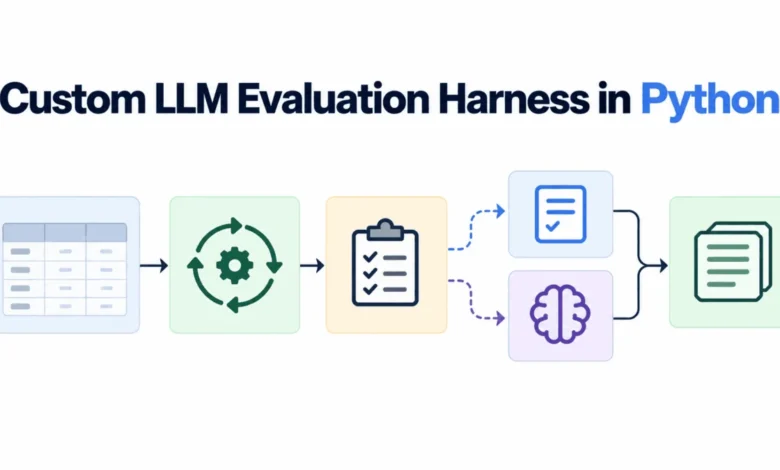
A robust evaluation harness is built upon four distinct, modular components: the golden dataset, the inference runner, the judge layer, and the persistent logging system. By isolating these functions, developers gain the ability to iterate on their grading criteria without the financial and temporal burden of re-running expensive model inference.
1. Curating the Golden Dataset
The foundation of any evaluation is the "golden dataset"—a collection of curated inputs and expected outcomes. Unlike synthetic datasets generated by other LLMs, which often suffer from "happy path" bias, an effective golden dataset must be rooted in historical user logs or documented failure modes.
Industry standards suggest a minimum set of 20 to 50 high-fidelity test cases for a proof-of-concept, scaling into the hundreds for production environments. Each case should include a unique identifier for tracking performance over time, the raw input prompt, and a concise "expected concept" or outcome. This structure allows teams to categorize tests by difficulty, domain (e.g., technical troubleshooting vs. policy compliance), or origin, creating a roadmap for identifying where the model consistently falters.
2. The Inference Runner: Managing Concurrency
The inference runner acts as the bridge between the dataset and the model. Utilizing tools like LiteLLM, developers can abstract the underlying API calls, allowing them to switch between providers like OpenAI, Anthropic, or locally hosted models without modifying the core logic.
In a production-grade environment, the runner must handle asynchronous requests to ensure efficiency. By leveraging Python’s asyncio library, developers can fire dozens of requests in parallel, significantly reducing the "wall-clock time" of evaluation runs. Setting strict parameters—such as retry limits and timeout thresholds—is critical to maintaining the stability of the evaluation. Implementing a num_retries=3 and a timeout=30 strategy serves as the minimum viable configuration for preventing network-related latency from skewing performance metrics.
3. The Judge Layer: Automated Scoring
The most critical component of the harness is the judge layer, which determines whether the model’s output constitutes a "pass" or a "fail." Two distinct strategies are typically employed:
- Deterministic Judging: This involves checking for specific strings, substrings, or formatting requirements. It is computationally inexpensive and highly consistent. For example, if an application requires the model to return a JSON object, the deterministic judge checks the syntax rather than the intent.
- LLM-as-a-Judge: This involves deploying a secondary, often more capable model (such as GPT-4o) to evaluate the output of the model under test. By using Pydantic to enforce a specific schema, developers ensure the judge returns a structured response containing both a boolean pass/fail status and a textual justification. This approach is essential for semantic evaluations, such as assessing whether a model’s refusal to answer a prompt was polite, accurate, and compliant with safety guardrails.
4. Logging and Long-Term Analysis
The final component is the logging system, which saves results in a line-delimited JSON (.jsonl) format. This format is inherently crash-safe and allows for incremental updates. By logging both the model’s raw output and the judge’s rationale, organizations create a permanent, auditable trail.
The decoupling of inference and scoring is a strategic architectural choice. If a team decides that their initial grading rubric was too lenient, they can update their judge layer and re-evaluate the historical raw outputs stored in the logs. This eliminates the need for redundant API calls, saving thousands of dollars in token costs when working with large-scale datasets.
Fact-Based Analysis and Implications
The shift toward custom harnesses reflects a broader trend in AI governance. As companies integrate LLMs into customer-facing products, the risk of "hallucinations" or policy violations represents a significant liability. Data from recent industry reports indicates that organizations with automated evaluation pipelines report a 40% higher rate of successful model deployment compared to those relying on manual testing.
Furthermore, the integration of these harnesses into CI/CD pipelines has enabled "regression testing" for AI. When a model provider releases a new version (e.g., moving from GPT-4 to GPT-4o), developers can instantly run their golden dataset through the harness to see if the new model performs better or worse on their specific domain-specific tasks. This transparency is vital for maintaining uptime and quality of service.
Technical Implementation Considerations
For developers building these systems, the dependency list remains intentionally minimal to avoid "dependency hell." The core stack—Python 3.10+, litellm, pydantic, and the standard json and asyncio libraries—provides a lean, highly extensible framework.
However, as the scale of testing grows, developers must consider the "cost of evaluation." While running a small dataset is negligible, evaluating thousands of prompts against a paid API can become a line item on the infrastructure budget. Consequently, many teams are now adopting a tiered approach: using smaller, faster models for quick, iterative testing, and reserving high-end models for final, comprehensive regression suites.
Conclusion and Future Outlook
Building a custom LLM evaluation harness is not merely a technical task; it is a fundamental requirement for any organization that intends to treat AI as a reliable software component. By focusing on modularity, developers create a framework that can evolve alongside the rapidly changing landscape of Large Language Models.
Future developments in this space will likely focus on "Auto-Evals," where the harness itself evolves to generate new test cases based on previous failures, and the integration of these systems into observability platforms that provide real-time dashboards for model health. As the industry matures, the focus will continue to shift away from broad, theoretical capability toward the granular, business-specific performance that ultimately determines the success or failure of AI implementation. With a solid foundation in place, engineers are empowered to test, tune, and iterate with confidence, ensuring that their AI systems are not just capable, but consistently aligned with user needs and organizational standards.