Airbnb Revolutionizes Real-Time Guest Recommendations by Extending Chronon Feature Platform with Sub-Minute Latency

In an aggressive push to modernize its machine learning infrastructure and capture immediate user intent, travel and hospitality giant Airbnb has significantly upgraded its open-source Chronon feature platform. By integrating Push Mode and Near Real Time (NRT) Model Transform, the company has successfully reduced the staleness of its sequence-based recommendation embeddings from nearly two days down to less than a minute. Typically, updates to a guest’s preference profile now propagate through the system in a lightning-fast 10 to 30 seconds. This technological leap has yielded concrete business and algorithmic dividends, translating to a 1.67% improvement in offline Normalized Discounted Cumulative Gain (NDCG)—a standard metric for evaluating ranking quality—and an approximately 0.33% lift in uncancelled bookings during live online A/B testing.
The Evolution of Airbnb’s JourneyFormer Recommendation Engine
To understand the magnitude of this architectural shift, one must examine the foundation upon which it is built. Airbnb’s recommendation engine relies heavily on JourneyFormer, an advanced sequence recommender powered by a Transformer encoder. The JourneyFormer architecture is designed to capture, interpret, and represent a guest’s multifaceted journey through the platform, taking into account their historical bookings, property reviews, and granular browsing behavior.
Prior to the recent integration of Push Mode and NRT Model Transform, this Transformer-based encoder operated strictly as a heavy daily batch processing job. Every twenty-four hours, the system processed massive volumes of historical interaction data to generate high-dimensional embeddings. These embeddings were then pushed to a low-latency key-value store optimized for rapid retrieval.
When a guest initiated a search on the platform, the online ranking system would fetch the precomputed embedding corresponding to that user, combine it with the live search query parameters, and generate personalized listing recommendations. This decoupled design intentionally kept the computationally expensive Transformer encoder entirely outside of the latency-sensitive serving path, ensuring that search results loaded swiftly for millions of concurrent users.
However, this daily batch architecture suffered from a glaring operational limitation: temporal staleness. Any browsing activity, wishlist additions, or search queries performed by a guest after the daily batch job had concluded remained entirely invisible to the recommendation system until the next scheduled run. When accounting for data pipeline processing delays, queuing times, and batch execution windows, the effective staleness of a guest’s profile could stretch close to forty-eight hours.
During this extensive window, a user might complete a weekend getaway search in San Francisco, book a hotel, and immediately begin searching for family vacations in Tokyo. Under the old architecture, the system would continue serving recommendations tailored to San Francisco long after the user’s intent had completely shifted, resulting in missed conversion opportunities and a suboptimal user experience.

Bridging the Gap: The Mechanics of Chronon’s Push Mode and NRT Model Transform
To eliminate this multi-day lag without sacrificing online serving performance, Airbnb’s infrastructure engineering team turned to Chronon, the company’s proprietary, open-source feature platform designed to unify batch and streaming feature computation. The newly introduced solution centers around two core capabilities: Push Mode and Near Real Time (NRT) Model Transform.
In traditional streaming architectures, downstream services often rely on continuous polling or scheduled triggers to check for updated feature values, introducing unnecessary latency and computational overhead. Push Mode fundamentally alters this paradigm by enabling a streaming job to actively publish an immediate notification the exact moment a feature value is committed and written to the pipeline. This event-driven mechanism empowers downstream systems to react instantaneously to fresh guest activities, such as a sudden listing click or map interaction.
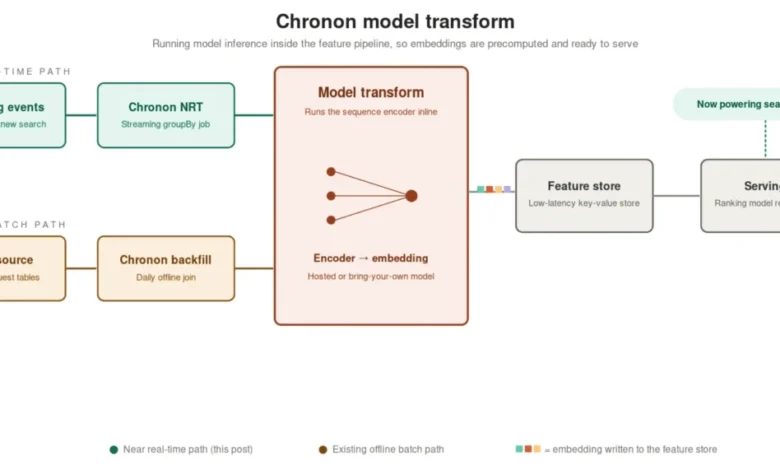
Complementing Push Mode is the NRT Model Transform capability. Historically, deploying a complex machine learning model—such as a Transformer encoder—into a real-time streaming pipeline required engineers to rewrite the inference logic in a stream-processing framework like Apache Flink or Apache Beam. This duplication of effort often led to training-serving skew and architectural bloat. With NRT Model Transform, Chronon allows an already deployed, production-vetted model to execute natively from within the streaming pipeline itself. Consequently, Airbnb utilizes the exact same Transformer sequence encoder for both its historical batch processing and its new near-real-time streaming workflows.
The resulting end-to-end pipeline operates with remarkable efficiency. As a guest navigates the platform, granular events—including property views, filter adjustments, and search queries—are captured in real time. These live events are seamlessly merged with the guest’s existing short-term and long-term historical sequence data stored in Chronon. Once the updated feature state clears the pipeline, the embedded NRT Model Transform triggers model inference on the fly.
The newly generated embedding is subsequently written to the very same low-latency online store utilized by the legacy batch system. Because the downstream online ranking path remains structurally unaltered, the integration required minimal disruption to existing production services while drastically improving the freshness of the underlying data representations.
Engineering Perspectives and Industry Implications
Pengyu Hou, a Senior Software Engineer on Airbnb’s Infrastructure team, highlighted the core engineering challenge solved by the upgrade, noting in technical documentation that the NRT Model Transform bridges a historically difficult gap between event-driven data processing and model inference by allowing Chronon to call an already deployed model directly from within the streaming flow.
/filters:no_upscale()/news/2026/10/airbnb-chronon-recommendation/en/resources/1Screenshot%202026-10-03%20at%206.49.35 PM-1791079284330.png)
This architectural pattern aligns with a broader, highly discussed trend in modern machine learning engineering: predictive caching and feature-triggered inference. In traditional architectures, predictions are computed synchronously upon every user request, which can introduce prohibitive latency when utilizing heavy deep learning models. Alternatively, some systems pre-compute predictions during batch jobs, sacrificing freshness.
Other open-source feature platforms, such as Feast, have documented cached prediction architectures where inference tasks are triggered asynchronously by underlying feature updates. While this pattern trades increased write volume and pipeline complexity for exceptionally low serving latency, Chronon distinguishes itself by tightly integrating streaming computation, model transformation, and rigorous feature consistency directly into a unified platform. By enforcing architectural parity between offline training pipelines and online serving environments, Chronon helps mitigate the risk of data drift and training-serving skew.
Broader Impact on the Travel Tech Sector and Open-Source Ecosystem
The successful deployment and subsequent open-source contribution of these features to the public Chronon repository on GitHub mark a significant milestone for the broader data engineering and machine learning communities. As consumer expectations for hyper-personalized, context-aware digital experiences continue to escalate, traditional batch-based recommendation systems are increasingly proving inadequate. Platforms like Airbnb must evolve from remembering what a user did yesterday to instantaneously adapting to what a user is doing right now.
The quantifiable gains achieved by Airbnb—specifically the 1.67% boost in offline NDCG and the 0.33% increase in uncancelled, finalized bookings—demonstrate that closing the feature freshness gap is not merely an academic exercise in infrastructure optimization, but a direct driver of top-line business value. In the highly competitive online travel agency and marketplace sectors, a fraction of a percentage point in conversion lift translates to millions of dollars in gross booking value annually.
Furthermore, by open-sourcing Push Mode and NRT Model Transform, Airbnb is providing enterprises across various industries—from e-commerce and fintech to digital media—with robust architectural blueprints for tackling real-time machine learning challenges. As organizations increasingly adopt unified feature platforms to streamline their artificial intelligence operations, Chronon’s latest enhancements set a new benchmark for how complex, deep learning-based recommendation engines can achieve sub-minute data freshness without compromising system stability or query latency.