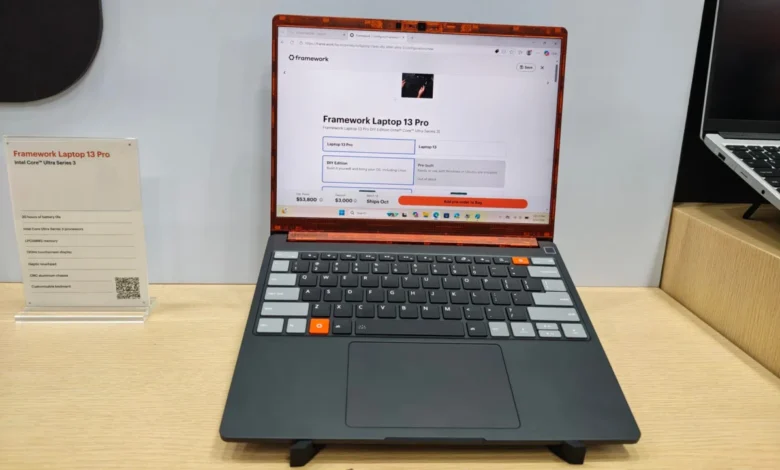
The situation marks a sharp reversal from the "rare good news" shared by the company just last month, when it successfully sourced more affordable and higher-performing SSDs for the same model. However, the volatility of the global semiconductor market has now swung in the opposite direction. According to official communications from Framework, prices from their primary memory suppliers have more than doubled compared to previous inventory costs. This increase significantly exceeds the low-to-mid double-digit percentage rise the company had initially forecasted and budgeted for during the preorder phase.
While Framework maintains that it has enough total physical modules to cover the volume of existing orders, the specific "mix" of capacities—specifically 16GB, 32GB, and 64GB modules—does not align with the current preorder queue. As a result, the company has been forced to implement a tiered downgrade system to ensure that shipments can continue without indefinite delays or massive surcharges passed directly to the consumer.
The Logistics of the Downgrade: Affected Batches and Tiers
The memory shortage specifically impacts the higher-capacity configurations of the Laptop 13 Pro. Framework has provided a detailed breakdown of which customers will be affected based on their "batch" number, a system the company uses to manage production runs and delivery windows.

For customers who ordered the 64GB configuration, Framework has confirmed it possesses enough inventory to fulfill Laptop 13 Pro orders through Batch 4 and standalone Mainboard orders through Batch 7. Customers whose orders fall into batches later than these milestones will see their configuration automatically adjusted from 64GB down to 32GB. To compensate for this reduction, Framework will charge these customers the original, lower price associated with the 32GB tier at the time of their initial preorder.
A similar logic applies to the 32GB configurations. DIY Edition and standalone Mainboard orders beyond the currently covered batches will be transitioned to 16GB of memory. Again, these customers will be billed at the original 16GB price point. Interestingly, one specific segment remains untouched: prebuilt Core Ultra 7 orders configured with 32GB will not be downgraded. Framework explained that this is due to the fact that they do not currently offer a 16GB configuration for that specific prebuilt SKU, making a downgrade technically unfeasible within their current product stack.
For many professional users, particularly those in software development, data science, and creative fields, the drop from 64GB to 32GB may represent a significant hurdle. However, Framework’s modular design provides a unique silver lining: unlike traditional ultrabooks where RAM is soldered to the motherboard, Laptop 13 Pro owners will be able to upgrade their memory manually in the future once market prices stabilize and supply increases.
Understanding LPCAMM2: The Technology Behind the Price Spike
To understand why Framework is facing this specific crisis, one must look at the technology involved. The Laptop 13 Pro utilizes LPCAMM2, a relatively new memory standard designed to bridge the gap between the power efficiency of LPDDR5X (typically soldered and non-upgradeable) and the modularity of traditional SODIMM modules.

LPCAMM2 is a breakthrough for the "Right to Repair" movement because it allows laptops to remain thin and energy-efficient while still featuring replaceable memory. However, because the standard is in its infancy, the supply chain is highly consolidated. Only a handful of major manufacturers, such as Micron and Samsung, are currently producing these modules in volume. When demand for high-performance memory surges in other sectors—most notably in the AI server and data center markets—small-to-medium-sized manufacturers like Framework often find themselves at the mercy of massive price fluctuations.
Market analysts suggest that the doubling of LPCAMM2 costs is a symptom of a broader "memory crisis" in 2026. As artificial intelligence applications move from the cloud to "on-device" processing, the demand for high-bandwidth, low-power memory has skyrocketed. This has led to a bidding war for the underlying silicon wafers, leaving consumer hardware brands to navigate a minefield of rising BOM (Bill of Materials) costs.
A Chronology of Pricing Volatility at Framework
This is not the first time in recent months that Framework has had to adjust its pricing or configurations in response to market shifts. The company has maintained an unusually open dialogue with its community regarding the costs of doing business in a post-pandemic, AI-driven economy.
In May 2026, Framework issued a warning to its customer base that its stockpile of SSD inventory, purchased at lower 2025 rates, was nearly exhausted. This led to an inevitable price hike for storage modules as newer, more expensive stock arrived at their assembly facilities. At that time, DDR5 pricing appeared relatively stable, though Framework did note a slight increase in 8GB module costs after selling through their initial low-cost batch.

By June 2026, the company found a moment of respite when it secured a deal for newer, faster SSDs at a lower cost than their previous generation. This allowed them to pass savings onto customers—a move that bolstered consumer confidence. However, the current LPCAMM2 spike has effectively wiped out the goodwill generated by the SSD price drop, highlighting the "whack-a-mole" nature of supply chain management in the current era.
The company’s policy remains consistent: existing preorders are protected from price increases. If a component cost rises after a customer has placed a deposit, Framework honors the original price. Conversely, if a price falls, the customer receives an automatic reduction. The current "downgrade" strategy is a middle-path solution designed to honor the original pricing tiers even if the physical hardware must be scaled back to meet inventory realities.
Broader Market Implications and Rising System Costs
The memory spike is not happening in a vacuum. Framework has indicated that new orders—those placed after the current adjustments—will reflect a much higher price floor. It is not just the LPCAMM2 modules that are getting more expensive; the company is also adjusting prices for entire systems and Mainboards to account for higher costs across the board. These include increased fees for Intel Core Ultra processors, Windows licenses, and various other silicon components.
However, the pricing landscape is not universally negative. In a detailed update, Framework noted that while 16GB DDR5 modules and certain high-end SSDs like the SN850X 1TB and SN7100 4TB are seeing price increases, other components are actually becoming cheaper. The company has successfully reduced prices on 48GB DDR5 modules, the massive SN850X 8TB SSD, and the SN7100 1TB drive.

This divergence suggests a bifurcated market where "mid-range" high-demand components (like 16GB and 32GB modules) are being squeezed by volume demands, while "niche" high-capacity components (like 8TB drives) are seeing economies of scale as they move toward more mainstream adoption.
The Impact on Framework’s Mission and Reputation
For a company that built its brand on the idea of the "consumer-first" laptop, forcing a hardware downgrade on preorders is a risky move. However, industry experts point out that Framework’s transparency is their greatest asset in this situation. Most traditional OEMs (Original Equipment Manufacturers) would likely cancel orders entirely, delay them by months without explanation, or quietly swap components for lower-quality alternatives without informing the buyer.
By explicitly stating the batch numbers affected and the exact reason for the change, Framework is leaning into its community-centric model. The company is essentially betting that its customers—who often prioritize repairability and ethical corporate behavior—will be more understanding of a supply chain crisis than the average "big box" retail consumer.
Furthermore, the modular nature of the Framework 13 Pro acts as a pressure valve. If a user receives a 32GB machine but truly needs 64GB, they are not stuck with a suboptimal device for its entire lifespan. They can simply purchase a 64GB LPCAMM2 module a year or two down the line when the "memory crisis" of 2026 has hopefully abated.

Looking Ahead: The Future of Modular Computing
As Framework navigates these turbulent waters, the tech industry is watching closely. The success or failure of the Laptop 13 Pro—and how the company handles these fulfillment hurdles—will likely serve as a case study for the viability of modular consumer electronics.
The move to LPCAMM2 was a bold step toward making thin-and-light laptops more sustainable, but it has also exposed Framework to the vulnerabilities of being an early adopter of new standards. As production of LPCAMM2 ramps up at Samsung and Micron, prices are expected to eventually stabilize. Until then, Framework buyers are finding that the price of pioneering a more repairable future sometimes involves a bit of compromise in the present.
For now, the company is focused on clearing the Batch 4 and Batch 7 hurdles and ensuring that new customers have a clear understanding of the volatile pricing landscape. While the news of receiving less memory than ordered is undoubtedly a disappointment for many, it serves as a stark reminder of the complexities of modern hardware manufacturing and the fragile nature of the global silicon supply chain.