Autonomous Data Products for the Autonomous Era: Rethinking Data Architecture for GenAI

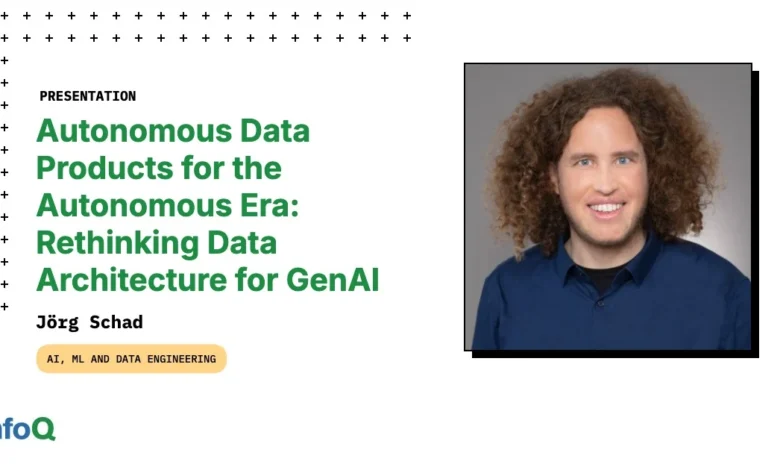
The rapid acceleration of generative AI (GenAI) technologies is exposing critical vulnerabilities in conventional enterprise data architectures, according to Jorg Schad, VP of Engineering at Nextdata. Speaking at a recent InfoQ presentation, Schad underscored that the primary impediment to successful GenAI and deep learning initiatives is not often model inaccuracy but rather the profound underestimation of operational complexities, particularly data accessibility and management at scale. This challenge is exacerbated by the sheer speed and volume of data consumption required by autonomous agents, a hallmark of the emerging "autonomous era."
The Protracted Journey from Prototype to Production
Enterprises frequently encounter a "bumpy road" when attempting to transition promising GenAI prototypes into production environments. Initial demonstrations, often conducted with meticulously curated sample datasets by internal teams or external consultants, garner significant excitement from upper management. However, the true test of scalability and integration begins when these prototypes must connect to real-world, often messy, and diverse enterprise data sources. This transition frequently leads to project failures, as the intricate web of disparate systems, protocols, and data formats proves too complex for seamless integration.
The landscape of machine learning (ML) models, applications, and connectivity frameworks is evolving at an unprecedented pace. Organizations grapple with a proliferation of tools, from LangChain to custom-built solutions, each potentially employing different interfaces and data access methods. This lack of standardization leads to fragmented data stacks where each team builds its own infrastructure, creating silos and hindering enterprise-wide scalability. The challenge is not merely connecting a single data source but making a growing volume of varied data assets available across numerous applications, often in multi-cloud environments.
Furthermore, the sheer volume of data, once connected, introduces a phenomenon known as "context rot." As more undifferentiated or unspecific context is fed into large language models (LLMs) or GenAI systems, performance can paradoxically decrease. Research, including benchmarks often cited by frameworks like LangChain, indicates a sweet spot for the amount of information an LLM can effectively process. Beyond this threshold, models struggle to discern relevance, leading to increased hallucinations and diminished accuracy. This highlights the critical need for specificity in data provision to autonomous agents.
Perhaps the most critical concern in this autonomous landscape is safety. The prospect of autonomous agents accessing and manipulating sensitive enterprise data raises significant governance and security questions. Unchecked access could lead to catastrophic data breaches, exposure of private or sensitive information, or even unintended database alterations by an errant coding agent. The inherent risk is significantly amplified compared to scenarios where human data scientists act as a supervisory layer.
Schad distilled these challenges into four pillars:
- Standardization: The imperative to unify data access and ML system interfaces across diverse enterprise environments.
- Speed of Access: The need for rapid data connectivity and delivery to keep pace with autonomous consumption.
- Specificity: Ensuring that only the right amount of relevant information is exposed to GenAI models to optimize performance.
- Safety: Implementing robust mechanisms to protect data privacy, enforce quality rules, and prevent misuse by autonomous systems.
Drawing Parallels with Computing’s Evolution: From Mesos to Kubernetes
Schad’s background in building large-scale distributed systems, including early work on Apache Mesos and Kubernetes, informs his perspective on tackling data complexity. He posits that the current state of data architecture mirrors the early days of microservices, prior to the widespread adoption of containerization. Docker and Kubernetes revolutionized computing by standardizing container images, runtimes, networking, and storage layers, enabling diverse implementations and frontends to operate on a unified foundation. This established an "hourglass of standardization," where various programming languages and applications could target different hardware platforms through a standardized intermediate representation.
Schad suggests that the data world now requires a similar paradigm shift: a "containerization" for data assets and a standardized specification for their scalable management. This vision encompasses both the encapsulation of data and metadata into manageable units and an orchestration layer to manage these "data containers" at a global scale.
The "Data 2.0 Hairball" and Organizational Fragmentation
Current data architectures, termed "Data 2.0," are failing due to their inherent fragmentation at both organizational and architectural levels. Implementing new ML or GenAI initiatives typically involves a complex cast of characters: platform engineers, data product owners, ingestion teams, data architects, data stewards, data engineers, data governance, and ultimately, data consumers (human and agent). Each persona navigates a distinct slice of the data problem, often working with different tools and incomplete metadata, leading to extensive coordination overhead and significantly slowing down the entire process.
From an architectural standpoint, this fragmentation manifests as a "data management hairball." Enterprises typically deploy a multitude of specialized tools for cataloging, governance, quality (e.g., Monte Carlo, Soda, Great Expectations), and ETL/data pipelines. Weaving these disparate solutions into a cohesive architecture is a Herculean task, often resulting in brittle, difficult-to-maintain systems. While foundational elements like multi-cloud infrastructure, storage, compute, and security are relatively mature, the challenge lies in unifying them and making them accessible to a growing array of applications.
The complexity stems from various dimensions:
- Location: Data spread across multiple cloud regions, on-premise data centers, with varying residency requirements.
- Formats and Access Modes: Data consumed via RAG (Retrieval Augmented Generation), vector embeddings, SQL notebooks, Power BI, or other proprietary protocols.
- Processing: Diverse compute engines like Spark, Polars, Snowflake, or Iceberg Lakehouses.
- Applications: A rapidly expanding ecosystem of applications built on top of this data.
- Human Skills: The varied expertise and personas involved in interacting with the data platform.
This intricate web of complexity, previously a challenge for human engineers, becomes an insurmountable obstacle for autonomous agents without a fundamental architectural rethinking.
Autonomous Data Products: The Path to Data 3.0
The proposed solution, "Autonomous Data Products," draws heavily from the "data mesh" paradigm popularized by Zhamak Dehghani, but with a critical distinction: each data product is a running process with its own runtime controller or "kernel." This elevates the concept beyond mere dashboards or tables to a self-managing, executable entity.
An autonomous data product is envisioned as:
- Encapsulation: It combines data, metadata, and access paths into a single, manageable unit, akin to a microservice container. This provides an abstraction layer, allowing consumers to interact with a semantic data asset without needing to know its underlying physical storage or access mechanisms (e.g., Snowflake, ADLS).
- Lifecycle Management: Each data product manages its own lifecycle:
- Sensing Inputs: It monitors upstream data products or external sources for changes, enabling intelligent updates. This avoids the inefficiency of fixed-schedule Spark jobs that might run hourly even if the data only changes monthly.
- Transformation: It encapsulates the actual compute job (e.g., Spark, Databricks SQL) that processes the data.
- Quality Checks & Promotion: Crucially, data quality rules are enforced before the transformed data is made accessible to downstream consumers. This prevents the "post-fact" alerts common with traditional quality tools, where faulty data might have already been consumed by agents or chatbots, leading to incorrect actions or responses.
- Standardized APIs: It exposes standard APIs for observability and discovery, allowing users to easily understand its contents, metadata, and underlying code without navigating multiple systems.
- Multimodal Access: Different consumers often require data in different formats (e.g., SQL for analysts, file-based for ML model training, vector embeddings for GenAI agents, MCP for autonomous querying). A data product, being centered on the semantic representation, can provide the same underlying data in multiple physical output formats, ensuring consistency and preventing "out-of-sync" issues between parallel pipelines.
- API-Driven: Each data product offers its own API, making it a discoverable and shareable asset. Access control is managed at this API level.
This "Data 3.0" vision aims to abstract away the "hairball" by providing a standardized, encapsulated, and domain-oriented approach to data. It shifts responsibility "left," empowering domain teams, who possess the deepest understanding of their data’s semantics, to build and manage their own data products. This decentralized approach removes the bottleneck of central data teams, allowing them to focus on providing self-serve infrastructure rather than debugging individual data pipelines.
Ensuring Safe Autonomous Data Consumption: Policy-Driven Governance
A core tenet of autonomous data products is the integration of policy-driven governance. Data product developers can rapidly build solutions, but the governance team (e.g., CISO) must ensure compliance with regulations like PII protection. Traditional review processes are often slow and bottleneck development.
Autonomous data products address this through:
- Centralized Policy Repository: Policies (e.g., "no PII to LLMs") are defined centrally as contracts.
- Automated Enforcement: Every data product deployed on the mesh must adhere to these contracts. The orchestration system automatically checks for compliance during deployment and runtime, similar to Kubernetes Admission Controllers. For instance, if a data product exposes an MCP or embedding output, it might be mandated to implement a predefined PII check.
- Scalable Safety: This automated enforcement ensures safety at scale without human governance teams becoming a bottleneck, allowing rapid iteration while maintaining enterprise-wide compliance.
Agent Lifecycle with Progressive Tool Discovery
The standardization fostered by autonomous data products significantly enhances the agent lifecycle, particularly through "progressive tool discovery." By standardizing how MCP (Machine-to-Cognitive Protocol) tools and output ports are defined as part of data products, enterprises can create a unified ecosystem.
The progressive tool discovery pattern works as follows:
- Single Gateway: An MCP gateway acts as a single endpoint for all data products and tools in the mesh.
- Initial Discovery: An agent’s first query to the
list_toolsendpoint returns only a single, generic tool, e.g.,discover_tools_give_me_context. - Contextual Tooling: When the agent calls this tool with a specific task (e.g., "get customer feedback"), the system dynamically provides a refined list of tools highly relevant to that task (e.g.,
get_customer_feedback). This avoids overwhelming the LLM with an excessive number of irrelevant tools. - Controlled Access: All access is mediated through the single gateway, which enforces authorization and authentication policies, ensuring that agents only access data and tools for which they have permissions.
- Iterative Refinement: After completing a task, the list of available tools can be reset or re-filtered, maintaining specificity and preventing context overload.
This approach ensures that autonomous consumers are provided with only the specific, relevant tools and resources they need for a given task, optimizing performance and security.
Broader Implications and Industry Outlook
The shift to autonomous data products represents a fundamental reorientation from a centralized, storage-oriented data stack to a semantic, domain-oriented model. Instead of prioritizing the choice of storage technology (e.g., Snowflake vs. Databricks), the focus moves to what data needs to be made available, with the physical implementation becoming a secondary, encapsulated detail.
Key shifts enabled by Data 3.0 include:
- Context-Aware Ground Truths: Exposing small, specific slices of data rather than entire data warehouses provides precise context for autonomous consumers, preventing context rot.
- Modality Shift and Reuse: A semantic-first data product can generate multiple output modalities (SQL table, vector embedding, document file) from a single source, eliminating the need for parallel pipelines and ensuring all representations remain in sync. This dramatically improves data consistency and reduces maintenance overhead.
- Self-Orchestration: Each data product independently senses inputs and decides when to run, decentralizing orchestration power from a central team to the domain data product owners, fostering agility and business alignment.
- Inbuilt Lineage and Reasoning: Lineage is inherent to the data product abstraction, providing a clear audit trail for data versions, models, and decisions, which is crucial for compliance and explainability.
- Proactive Governance: Data quality and compliance checks are integrated within the data product’s lifecycle, preventing faulty data from ever reaching consumers, a significant improvement over post-fact detection.
This paradigm shift holds profound implications for enterprise IT strategies. It promises faster time-to-market for GenAI applications, reduced operational costs due to optimized compute resource utilization, and a robust framework for data governance in an increasingly autonomous world. While specific implementations, such as Nextdata’s platform demoed by Schad, showcase how these principles can be brought to life, the underlying architectural patterns are believed to be broadly applicable across industries.
The ultimate takeaway from this evolving landscape is the critical importance of domain-centric GenAI and a disciplined approach to exposing only the necessary information. By encapsulating data, standardizing access, enabling multimodal consumption, and enforcing policy-driven security, enterprises can build scalable, safe, and effective data architectures ready for the autonomous era. The lessons learned from the standardization of computing are now being applied to data, paving the way for a more intelligent and resilient future.