DHTMLX Gantt Review: Powering Custom Web-Based Project Management and Scheduling Interfaces

The modern enterprise software landscape increasingly demands specialized tools tailored to exact operational workflows rather than rigid, out-of-the-box software packages. For product owners, chief technology officers, and engineering teams building proprietary project management solutions or internal productivity applications, incorporating robust timeline visualization remains a persistent development challenge. Addressing this technical requirement, software vendor DHTMLX offers DHTMLX Gantt, a specialized JavaScript library engineered specifically for embedding interactive project planning, scheduling, and resource management capabilities directly into existing web applications.
Unlike standalone SaaS project management platforms designed for end-users, DHTMLX Gantt functions purely as a developer component. Operating on a self-hosted architecture, the library provides the underlying mechanics for custom software builds, mirroring the architectural foundation utilized by prominent third-party tools such as GanttPro. Alongside its flagship Gantt component, the vendor maintains a broader ecosystem of modular JavaScript user interface components, including schedulers, Kanban boards, and interactive to-do list widgets, allowing development teams to construct cohesive, custom-tailored productivity suites.
Core Functional Capabilities and Architecture
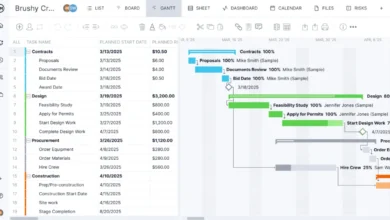
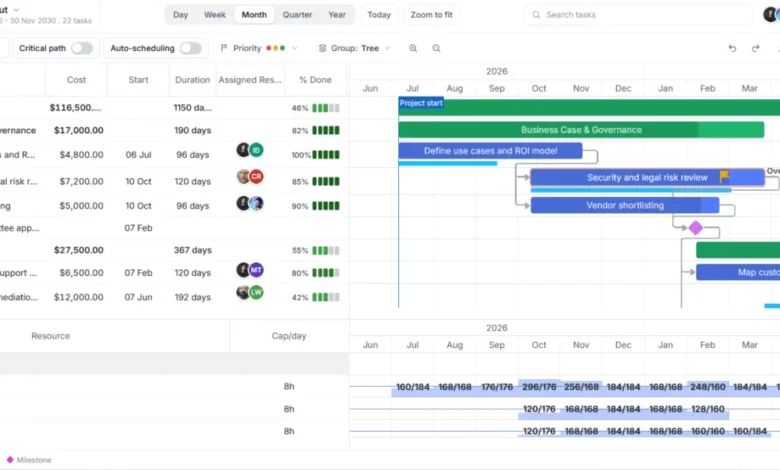
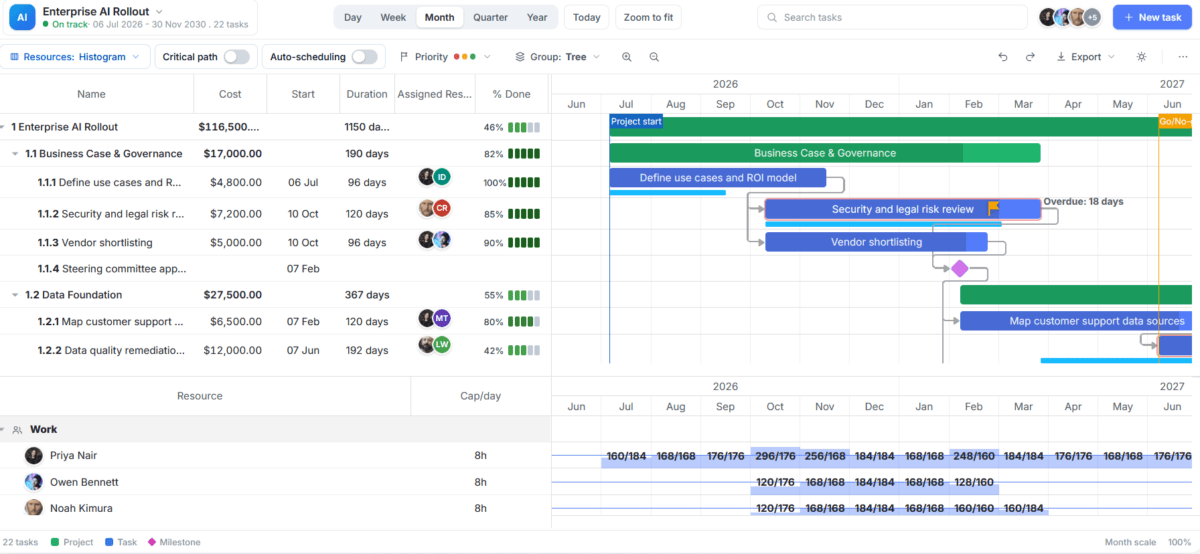
At its technical core, DHTMLX Gantt merges a highly configurable task grid with an interactive timeline, yielding a unified interface for visualizing complex project structures, schedules, and task dependencies. Developers can programmatically organize tasks and milestones, establish and modify dependencies directly upon the interactive chart interface, and instantly visualize how schedule modifications to a single task cascade across the broader project timeline.
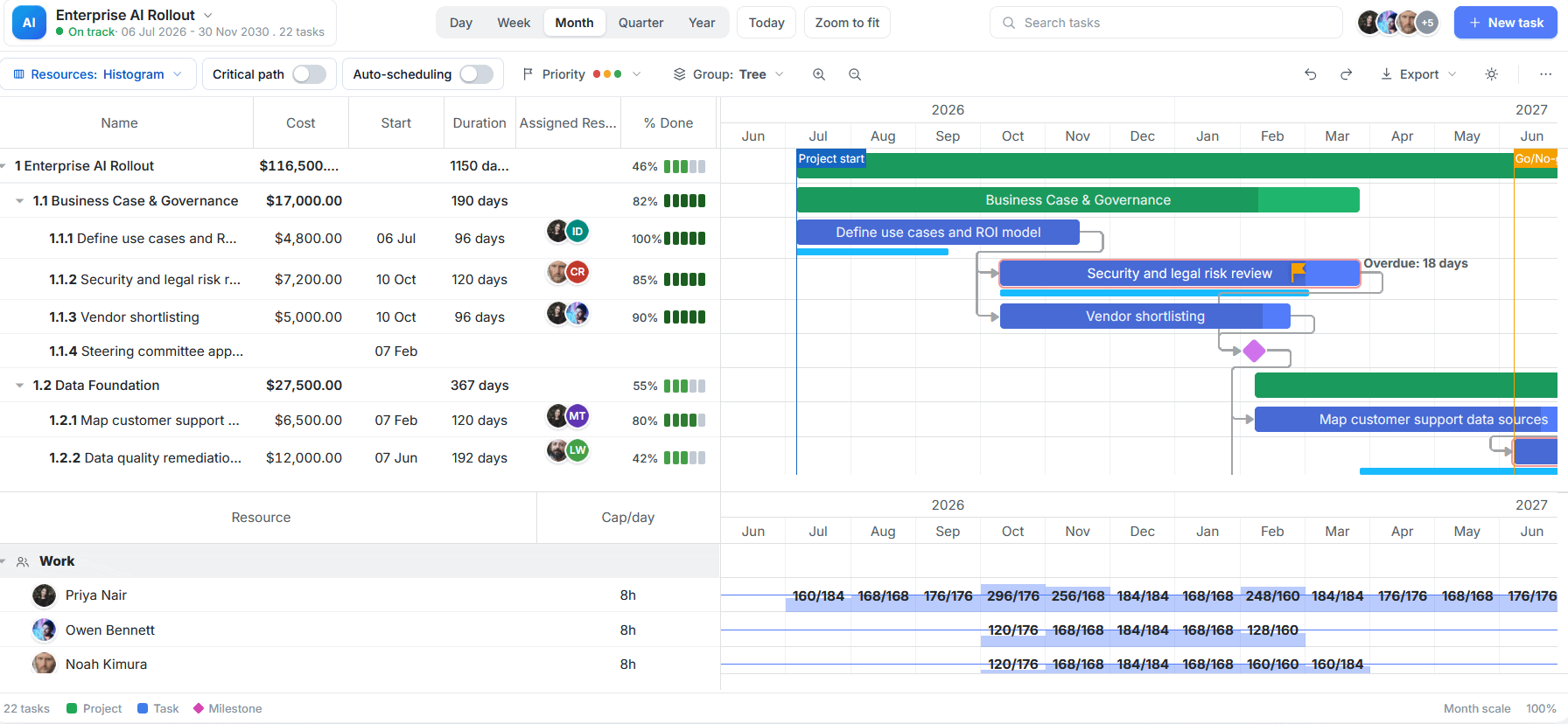
Beyond standard timeline tracking, the library supports advanced project planning paradigms. These include automated critical path calculations, comprehensive resource management, working calendars, schedule constraints, and customizable scheduling rules. Such capabilities elevate the component from a basic graphical renderer into a robust calculation engine capable of supporting intricate planning workflows in data-intensive sectors such as construction, manufacturing, and enterprise software engineering.
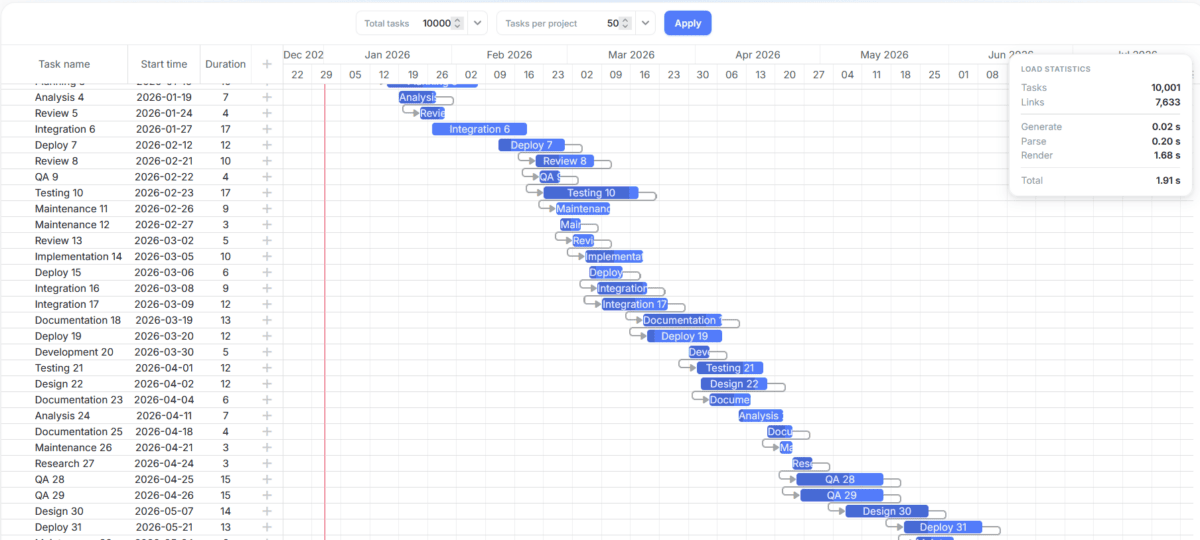
To accommodate large-scale data environments, the architecture incorporates smart rendering and dynamic loading protocols. These performance optimizations allow the interface to process extensive datasets containing thousands of task lines without experiencing severe degradation in client-side responsiveness. Furthermore, the library features a fully customizable task tooltip system, permitting developers to adjust visual styling, data content, and positional rendering to prevent layout obstruction during active task manipulation.
Customization, Localization, and Accessibility
Flexibility remains a central design pillar of the DHTMLX Gantt library. The interface elements—encompassing the task grid, timeline canvas, pop-up tooltips, and structural templates—are deeply configurable, enabling organizations to align the visual presentation precisely with corporate branding guidelines or the cohesive design system of the host application.
Localization support extends across more than 50 languages, accompanied by mechanisms for developers to inject custom linguistic translations. Notably, the language localization matrix accounts for regional dialect variations—offering distinct versions for European Portuguese and Brazilian Portuguese, for instance—alongside support for Right-to-Left (RTL) reading modes required by specific regional markets.
In alignment with modern software compliance and inclusive design standards, the library incorporates comprehensive accessibility features. It natively supports WAI-ARIA attributes to ensure seamless integration with screen readers, while a dedicated keyboard navigation plugin provides out-of-the-box shortcut mappings for fundamental actions such as task traversal, node creation and deletion, tree expansion, and editor activation. Developers retain the flexibility to define custom keyboard shortcuts to satisfy rigorous enterprise accessibility mandates.
Framework Integration and Modern Development Workflows
To minimize friction during implementation, DHTMLX Gantt provides native integration support for dominant contemporary frontend technology stacks, including React, Angular, Vue, and Svelte. This framework compatibility allows engineering teams to adopt the component without necessitating disruptive alterations to their underlying application architecture.
Reflecting broader industry trends in software engineering, DHTMLX has integrated support for AI-assisted development paradigms. The introduction of the DHTMLX Model Context Protocol (MCP) Server equips AI coding assistants with programmatic access to real-time API documentation and reference materials. Concurrently, specialized Agent Skills provide framework-specific integration patterns designed to optimize code generation accuracy across prominent AI development environments such as Claude Code, Cursor, and Codex. Additionally, the vendor supplies exploratory demo applications—including AI Theme Builders and semantic search implementations—to showcase the potential of generative technologies within project planning interfaces.
Data Interoperability and Export Mechanisms
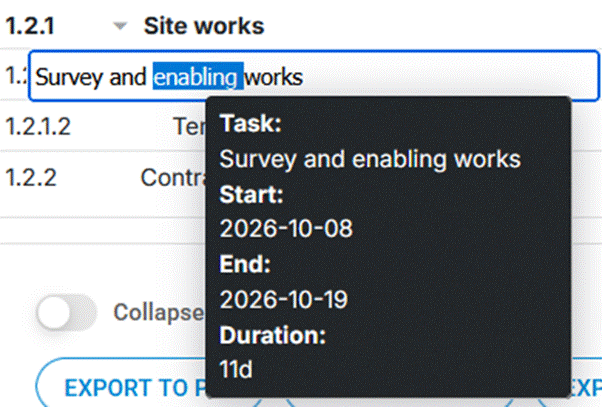
Enterprise data exchange requirements are addressed through robust import and export capabilities. DHTMLX Gantt facilitates native data export into multiple standard formats, including PDF, PNG, Excel, iCal, Microsoft Project, and Primavera P6. Conversely, the library supports the direct importation of project data from Microsoft Project and Primavera P6. This bi-directional compatibility simplifies data migration initiatives and streamlines collaborative workflows when organizations must exchange scheduling data with external contractors or supply chain partners operating on legacy desktop platforms.
Licensing, Pricing, and Community Availability
DHTMLX Gantt operates under a dual-licensing model designed to accommodate varying organizational needs and project budgets. The vendor provides a free Community edition distributed under an open-source MIT license. This tier includes seven predefined visual skins (with full support for custom CSS styling) and provides sufficient core functionality to bootstrap basic application interfaces. However, advanced computational features—such as resource management and automated critical path analysis—are reserved for the paid PRO iterations.
For commercial deployments requiring advanced capabilities, perpetual licensing models begin at $799 for individual developer tiers, which include one year of software updates and technical support. Pricing scales accordingly for multi-developer or organizational licenses, with cost-efficient bundling options available for teams integrating multiple DHTMLX JavaScript products. Prospective buyers are encouraged to leverage the standard 30-day trial period to evaluate technical feasibility within their specific application architecture prior to executing a formal license purchase.
Strategic Implications and Market Outlook
The market demand for embedded developer components like DHTMLX Gantt underscores a broader strategic shift within enterprise IT management. Rather than forcing internal operational workflows to adapt to the rigid constraints of commercial off-the-shelf SaaS platforms, organizations increasingly favor bespoke software development to achieve true operational alignment.
For Chief Technology Officers and product leaders evaluating build-versus-buy strategies, DHTMLX Gantt represents a pragmatic middle ground. By outsourcing the complex mathematics of timeline rendering, dependency calculation, and grid performance optimization to a specialized component library, engineering teams can significantly compress development lifecycles. While successful implementation still necessitates dedicated frontend development expertise, the combination of extensive documentation, framework integrations, and modern AI development support ensures that DHTMLX Gantt remains a compelling asset for organizations committed to building customized project management solutions.