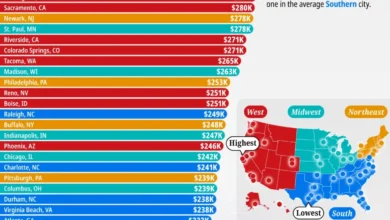
The Correlation Between Climate and Capital: Why Geography Defines Modern Wealth and Quality of Life

The relationship between geographic location, climate, and economic prosperity has long been a subject of intense scrutiny among urban planners, economists, and sociologists. Recent data analysis examining 110 major United States cities suggests that the "climate premium"—the additional cost of living in regions with temperate, predictable weather—is not merely a lifestyle choice, but a rational economic trade-off. As migration patterns shift toward the Sunbelt and coastal enclaves, the intersection of environmental comfort and high-density economic opportunity has become the primary driver of domestic real estate valuation.
The Economic Geography of Climate
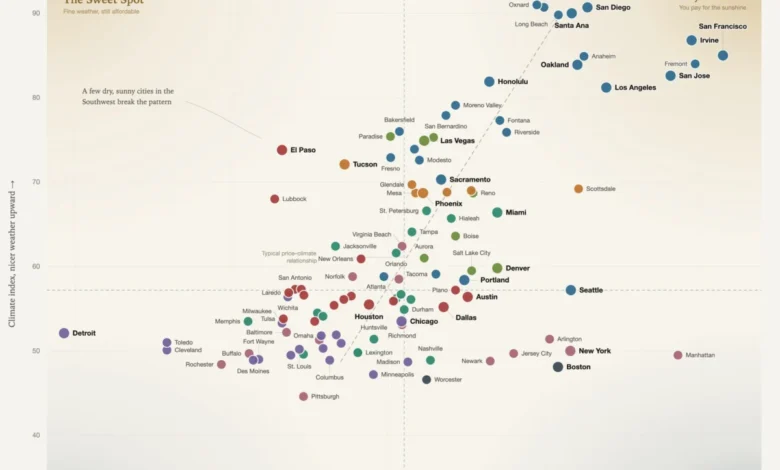
A comprehensive analysis of 110 U.S. cities, utilizing climate data from 1991 to 2020, reveals a stark correlation between a city’s climate index and its median home sale price. When plotting these variables, cities cluster into four distinct quadrants. The "upper right" quadrant—representing high-cost, high-climate-index regions—is dominated by California municipalities including San Diego, San Jose, Los Angeles, and San Francisco, alongside outliers like Honolulu and Miami.
In these regions, the housing market reflects a "bundle" of amenities. A residence in these areas functions as more than shelter; it acts as a year-round recreational facility, a health-maintenance tool, and a social anchor. Unlike regions characterized by extreme seasonal shifts, these cities offer consistent, 12-month access to the outdoors. Economists argue that this consistency provides a "quality-of-life dividend" that is often overlooked in traditional cost-of-living indices, which tend to focus exclusively on housing, transportation, and food prices.
Chronology of Migration and Wealth Concentration
The trend of prioritizing high-cost, high-opportunity regions is not a recent phenomenon but an acceleration of a pattern established in the early 21st century.

- 1999–2001: During this period, major financial hubs like New York City experienced a surge in rent prices, driving young professionals to seek alternatives. Many discovered that while West Coast cities like San Francisco were expensive, the relative value—defined by square footage and weather-adjusted utility—was superior to that of the Northeast.
- 2001–2010: The rise of the tech sector solidified the "opportunity density" of coastal California. The concentration of venture capital, intellectual property, and high-paying employment opportunities created a feedback loop: high incomes supported high property values, which in turn attracted more ambitious talent.
- 2010–2020: The maturation of the Sunbelt and the rise of remote-work flexibility began to challenge the dominance of coastal hubs. However, the climate-wealth correlation persisted, with cities like Austin and Phoenix seeing significant price appreciation as they gained "tier-one" status in the national economy.
- 2020–Present: Post-pandemic shifts have refined the definition of "utility." While remote work allows for greater geographic flexibility, the demand for high-amenity locations has remained robust, further widening the gap between climate-rich and climate-challenged regions.
Analyzing the Quadrants: A Comparative Study
To understand the current real estate landscape, one must look at the specific characteristics of the four quadrants defined by current market data:
1. High-Cost, High-Climate (The "California Premium"):
These cities exhibit limited land supply due to geographic barriers like mountains and oceans, compounded by strict zoning regulations. The high price floor is sustained by a combination of restricted housing inventory and an influx of high-earners drawn by job markets. This region offers the highest concentration of wealth-building opportunities, effectively justifying the "premium" paid for entry.
2. Low-Cost, High-Climate (The Value Hunter’s Opportunity):
Cities such as Tucson, El Paso, and Las Vegas represent a middle ground. While these regions possess desirable climate characteristics, they are often offset by extreme summer temperatures. However, because these areas have historically allowed for more flexible development, they provide a lower barrier to entry. For many households, these cities represent a rational compromise: the acquisition of a detached, high-utility home in exchange for managing seasonal heat through advanced climate-control technology.
3. Low-Cost, Low-Climate (The Yield Strategy):
The Midwestern and Rust Belt cities, including Detroit, Cleveland, and Milwaukee, represent a distinct economic model. The primary advantage here is affordability; housing costs are significantly decoupled from income levels, allowing for faster debt retirement and wealth accumulation. From an investment perspective, these cities offer higher gross rental yields, often in the 7% to 8% range, compared to the 3% yields found in high-cost coastal markets.
4. High-Cost, Low-Climate (The Institutional Hubs):
This category includes New York City, Boston, and Seattle. In these cities, the high cost of living is not driven by the weather, but by the density of cultural, professional, and institutional networks. These cities are hubs for legacy industries, finance, and specialized labor. Residents here are effectively paying a "participation fee" to be at the center of global industries where physical proximity remains an essential component of professional advancement.
The BURL Strategy: A New Financial Framework
Financial analysts have increasingly promoted the "Buy Utility, Rent Luxury" (BURL) strategy as a response to the geographic divide. This strategy posits that individuals should decouple their residence from their investment portfolio. By renting in high-cost, high-weather-index cities, one gains the lifestyle benefits of the region without over-leveraging capital in an expensive, low-yield real estate market.
Simultaneously, by deploying capital into the heartland or the Sunbelt—where rental yields are structurally higher and demographic trends favor growth—investors can capture the cash flow of less expensive markets. This approach mitigates the risk of being "house-poor" in a high-cost city while avoiding the burden of becoming a long-distance landlord through the utilization of passive investment vehicles such as Real Estate Investment Trusts (REITs) and private equity real estate funds.
Broader Impact and Future Implications
The long-term implication of this data is a structural shift in how Americans view personal net worth. Wealth is no longer merely an account balance; it is a calculation of "lifestyle dividend." As technology continues to dissolve the need for daily office attendance, the demand for quality-of-life amenities will likely continue to outpace the demand for traditional office-proximity living.
However, this trend poses a challenge for urban centers in the "low-climate" category. Without the allure of temperate weather, these cities must rely on economic policy, infrastructure investment, and cultural revitalization to maintain their tax bases. As residents become increasingly mobile, the competitive landscape between cities will shift from attracting businesses to attracting individuals through the provision of environmental and social amenities.
Ultimately, the data suggests that while the "California Premium" is indeed a reality, it is supported by a rational assessment of utility. For the individual, the path to prosperity involves a lifecycle approach: utilizing high-cost, high-opportunity cities for career acceleration while leveraging the lower costs of alternative regions for long-term wealth preservation and quality of life. The American landscape, characterized by its extreme diversity of geography and economy, remains the primary tool for the modern individual to optimize their standard of living.