The Explosive Rise of Instinct AI and the Growing Role of Venture Capital in Modern Portfolio Strategy

The emergence of Instinct, a text-based artificial intelligence assistant, has marked a significant inflection point in the venture capital landscape, characterized by an unprecedented velocity of valuation growth. Within a span of approximately five months, the startup has transitioned from an initial seed round to discussions for a $10 billion valuation. This trajectory highlights a shift in private market dynamics, where AI companies are commanding massive capital injections before ever reaching the public markets, fundamentally altering how investors approach asset allocation and long-term wealth preservation.
A Chronology of Rapid Capitalization
The speed at which Instinct has scaled is, by historical standards, anomalous. Founded in April 2026 by Noah Shinn, a former research scientist at Sierra, the company was designed to function as an AI assistant integrated directly into mobile messaging interfaces, removing the friction associated with standalone application downloads.
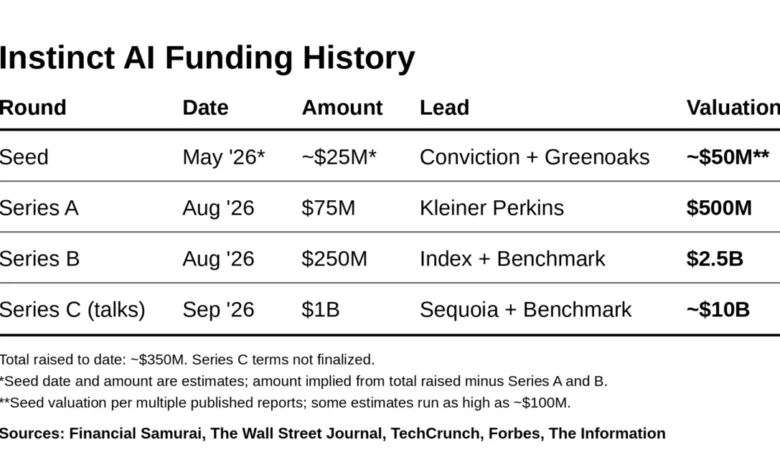
The company’s funding history serves as a case study in aggressive capital deployment:
- April 2026: Company formation and seed funding round led by Conviction and Greenoaks, valuing the entity at $50 million.
- August 2026: Kleiner Perkins leads a $75 million Series A, pushing the valuation to $500 million.
- September 2026: Less than one month later, Index Ventures and Benchmark co-lead a $250 million Series B, resulting in a $2.5 billion valuation.
- Late 2026 (Projected): Ongoing discussions suggest a potential $1 billion Series C round, with major firms including Sequoia Capital and Benchmark in talks to lead at a $10 billion valuation.
If these terms are finalized, seed-stage investors stand to see a potential 200x gross return on their initial commitment, a figure that has drawn significant attention from institutional and private investors alike.
The Mechanism of Private Market Valuation
For investors, the rapid rise of Instinct underscores the increasing importance of the "pre-IPO" window. Because modern technology companies—particularly those in the AI sector—are choosing to remain private for significantly longer periods, the vast majority of value creation occurs before public retail investors have the opportunity to participate.
The financial metrics driving this excitement are rooted in venture capital vernacular: Multiple on Invested Capital (MOIC), Total Value to Paid-In Capital (TVPI), and Distributions to Paid-In Capital (DPI). While MOIC and TVPI serve as primary indicators of paper gains and portfolio health, they are fundamentally different from realized wealth.
As market analysts note, the "paper gain" phenomenon—where a company’s valuation is marked upward following a new funding round—provides a psychological boost to investors but does not equate to liquidity. DPI remains the only metric of functional utility, as it represents cash returned to the investor. In the case of Instinct, while the valuation marks have climbed to multi-billion dollar levels, the capital remains locked within the company’s equity structure. For limited partners (LPs), these valuations function as a "feel-good" wealth effect, yet they remain susceptible to the inherent volatility of the startup ecosystem.
Broader Economic Implications and AI Infrastructure
The valuation of Instinct at $10 billion is predicated on the assumption that it will become a dominant utility, much like email or SMS. By utilizing existing messaging protocols, the service aims to capture a massive user base with minimal customer acquisition costs. However, this model faces significant operational challenges, specifically regarding compute constraints.

AI infrastructure requires immense physical resources, including data centers, energy, and high-performance hardware. This has created a bifurcated investment strategy among those looking to capitalize on the AI boom:
- Direct Equity Investment: Betting on application-layer companies like Instinct, which carry high growth potential but also high risk of failure if competitors like Meta or Google introduce superior, integrated alternatives.
- Infrastructure Investment: Investing in the underlying physical assets—such as data centers and power grids—that support the AI ecosystem.
The latter approach is increasingly viewed as a hedge against the volatility of "paper-rich" startups. By investing in the physical limitations of the AI revolution, investors are effectively betting on the necessity of the technology, regardless of which specific AI assistant dominates the consumer market.
The FOMO Factor in the San Francisco Ecosystem
The concentration of AI innovation in San Francisco has created a distinct socio-economic environment. The "boom-bust" cycle of the city has historically been driven by tech, but the current wave of AI funding has decoupled startup valuations from traditional interest rate sensitivities. Even as mortgage rates have risen, the pace of wealth creation within the AI sector has outstripped the increased cost of borrowing, keeping local asset prices, particularly real estate, elevated.
For those outside the immediate AI industry, this concentration creates a "fear of missing out" (FOMO). The growing chasm between those with exposure to high-growth private assets and those without has influenced investment behavior. Many investors, particularly those following a Financial Independence, Retire Early (FIRE) lifestyle, are increasingly allocating capital toward venture funds as a defensive strategy against the erosion of their relative purchasing power.
Risk and Reality: The "Funny Money" Trap
Despite the optimistic sentiment surrounding Instinct, the risks remain substantial. Venture capital is characterized by a "power law" distribution, where a small number of companies produce the majority of returns, while the vast majority fail.
Official commentary from industry analysts emphasizes that while current valuations for Instinct are high, they are speculative until a liquidity event occurs—such as an initial public offering (IPO) or an acquisition. The transition from a $2.5 billion to a $10 billion valuation in less than a month reflects not only the company’s progress but also the sheer volume of dry powder held by top-tier venture firms.
Ultimately, the Instinct funding saga represents a larger trend in the global economy: the decoupling of paper wealth from tangible assets. While an investor might see their portfolio value grow significantly on paper, the inability to liquidate that position means the "wealth" remains conceptual. For the average investor, this serves as a reminder that while venture capital can provide explosive growth, it requires a high degree of patience, an understanding of the long-term nature of capital calls, and a tolerance for the volatility inherent in the private markets.
As the AI sector continues to mature, the focus will likely shift from pure valuation growth to revenue generation and sustainability. Whether Instinct can navigate the competitive landscape and convert its rapid funding into long-term market dominance remains the definitive question for the next fiscal year. For now, it serves as the most prominent example of the current era’s aggressive, high-stakes approach to artificial intelligence financing.