The Paradigm Shift: From Keywords to Concepts
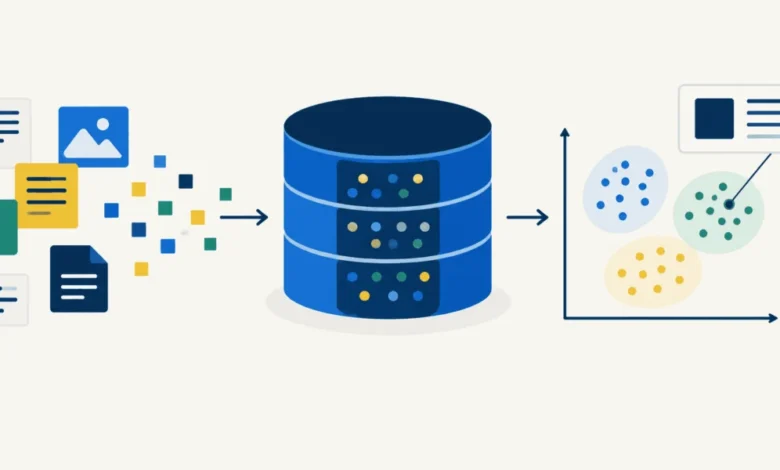
In traditional database management, information retrieval is primarily predicated on lexical matching. When a user enters a query, the system scans for exact strings or keywords, often leading to incomplete or irrelevant results if the terminology does not align perfectly. Vector databases represent a fundamental departure from this legacy approach. They do not search by word; they search by "meaning."
This process involves transforming raw data—whether text, images, or audio—into high-dimensional numerical vectors. In this spatial representation, documents with similar conceptual content are positioned closer to one another. When a query is issued, the system translates the search string into a vector and calculates the proximity to existing document vectors. This allows for highly accurate, semantic-aware retrieval that functions even when the query and the target document share no common vocabulary.
The Architectural Foundation: A Ten-Step Implementation
The tutorial serves as an educational bridge for developers, moving beyond high-level API calls to demonstrate the core logic of vector operations. By relying on NumPy, the implementation avoids the overhead of specialized hardware like GPUs or external proprietary services, making the mechanics of the system transparent and reproducible.
The implementation is structured as follows:
- Environment Configuration: Establishing the workspace, including the necessary Python dependencies such as NumPy and the sentence-transformers library.
- Indexing Mechanics: Demonstrating how to encode unstructured text into fixed-length vectors. Regardless of whether the source text is a short sentence or a long-form essay, the embedding model converts it into a uniform set of 384 numbers, ensuring predictable index sizing.
- Basic Retrieval: Executing the first semantic search to illustrate how conceptual relationships yield relevant results that keyword-based systems would likely miss.
- Semantic Nuance: Proving the system’s efficacy by performing searches where the query and the results share zero common words, validating that the database is truly indexing intent and context.
- Score Interpretation: Explaining the numerical output of searches, which provides a quantifiable metric of relevance. In production, this allows for the implementation of confidence thresholds.
- Metadata Filtering: Introducing structured data constraints. By adding metadata to documents, users can filter searches by specific topics, preventing the system from retrieving semantically similar but contextually incorrect information.
- Scaling Limits: Managing search parameters such as ‘k’ (the number of results) in relation to filtered subsets of the database.
- Data Integrity: Implementing guard rails to ensure that input strings and metadata remain in perfect synchronization, preventing the corruption of the vector index.
- Persistence: Managing the lifecycle of the data by saving and loading the index, ensuring that embedding models remain compatible with their stored vectors.
- Scalability Analysis: Measuring computational performance across varying corpus sizes to demonstrate that the underlying logic remains efficient as data volumes grow.
Computational Performance and Scalability
A critical observation from the 10th step of the process is the scalability of the vector search operation. Because the core calculation is a matrix multiplication—specifically, the dot product of the query vector against the entire matrix of document vectors—the speed of the search remains remarkably high.
Testing on a synthetic dataset reveals that even as the database grows to 100,000 documents, the scan and rank operations occur within milliseconds. This efficiency is why vector databases have become the backbone of Retrieval-Augmented Generation (RAG) and large language model (LLM) applications. The mathematical simplicity of the process ensures that the transition from a prototype with 25 documents to a production environment with millions is a matter of infrastructure management rather than a fundamental rewrite of the search logic.
Industry Implications and Context
The rise of vector databases marks a significant transition in data infrastructure. As organizations increasingly rely on unstructured data to power generative AI, the ability to perform high-speed semantic retrieval has become a critical competitive advantage. Major players in the database market, including Pinecone, Weaviate, and Milvus, as well as extensions like pgvector for PostgreSQL, are all built upon the same fundamental principles outlined in this guide: normalizing vectors and optimizing the search for nearest neighbors.
Experts in the machine learning field note that this democratization of knowledge is vital. By stripping away the "black box" nature of managed vector database services, developers gain a deeper understanding of how to optimize their data pipelines. "The design does not change between 25 documents and 25 million," the tutorial notes. "Only the index structure underneath it does."
Analysis of the Technical Approach
The tutorial’s reliance on cosine similarity—achieved by normalizing vectors to a length of 1—is a masterclass in elegant engineering. It reduces the complex problem of determining semantic closeness to a single matrix-vector multiplication. This approach highlights the importance of the embedding model itself; the database is only as intelligent as the model that converts the text into vectors.
Furthermore, the emphasis on "bookkeeping"—ensuring metadata, text, and vectors stay in perfect alignment—serves as a cautionary lesson for engineers working with production AI systems. Without rigorous data validation and schema management, the performance gains of vector search are negated by the potential for "hallucinated" or incorrectly mapped results.
Conclusion: The Future of Retrieval
As AI continues to integrate into mainstream business operations, the importance of understanding the underlying data structures cannot be overstated. This 10-step guide provides not just a functional codebase, but a conceptual framework for how modern information systems bridge the gap between human language and machine computation.
For developers and data scientists alike, the takeaway is clear: the complexity of modern AI search is often hidden behind layers of abstraction, but the core engine is built on standard, efficient linear algebra. By mastering these ten steps, practitioners are better equipped to build robust, scalable, and highly accurate systems that define the next generation of software development. As the ecosystem continues to evolve, the principles established in this tutorial will remain the standard for any organization looking to leverage the full potential of semantic search.