Mastering Project Governance: The Strategic Value and Execution of Gate Reviews in Modern Project Management


Project governance remains a foundational yet frequently understated pillar of successful organizational delivery. While technical execution and creative problem-solving often capture the spotlight, the structured oversight that shepherds an initiative from its conceptual inception to final delivery determines long-term viability. Within traditional predictive lifecycles—and increasingly within hybrid environments—gate reviews, also known as stage gates or phase gates, serve as critical control mechanisms. Rooted in methodologies such as PRINCE2 and heavily utilized within public sector frameworks like the UK Government’s National Infrastructure and Service Transformation Authority (NISTA) assurance toolkit, these formal checkpoints empower stakeholders to make informed, evidence-based decisions regarding continued investment, redirection, or termination.
Unlike routine status meetings designed simply to track milestones, a gate review is explicitly centered on a binary or multi-path decision: to proceed, hold, recycle, or terminate. By enforcing standardized criteria at structural boundaries, organizations can mitigate financial risk, align initiatives with evolving strategic goals, and maintain rigorous accountability across complex portfolios.
The Evolution and Framework of Gate Reviews
The historical development of gate reviews traces back to industrial engineering and stage-gate product development models before finding widespread adoption in modern project management. While not explicitly emphasized in foundational guides such as the Project Management Institute’s PMBOK Guide, structured phase transitions are widely recognized as best practices across global industries.
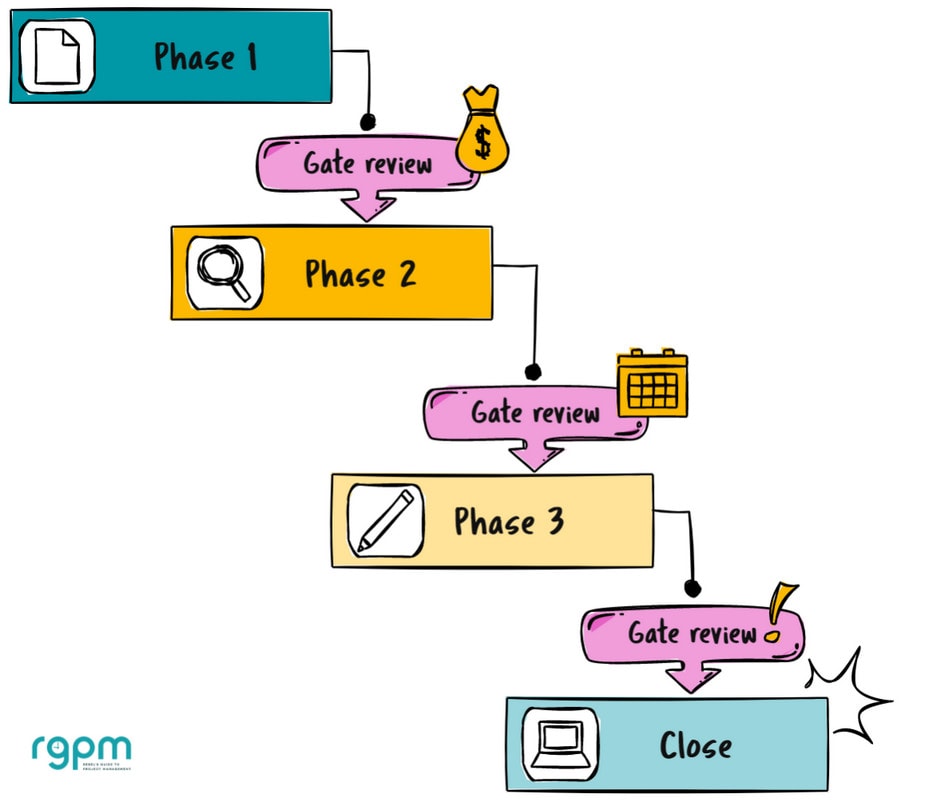
In predictive, waterfall environments, gates establish clear boundaries between sequential project phases, such as moving from the initial business case phase into detailed planning, execution, and final closure. Conversely, agile and hybrid methodologies adapt these control points to authorize continuous investment, product releases, or sprint readiness, ensuring that governance does not stifle iterative delivery speed. Frameworks like the NISTA assurance toolkit explicitly incorporate agile pathways, mandating that review teams include specialized digital delivery practitioners to evaluate modern software and service development pipelines.

Core Benefits of Implementing Stage Gates
Organizations that systematically integrate gate reviews into their Project Management Offices (PMOs) typically realize measurable improvements in project governance and portfolio performance. The primary advantages include:
Shorter Planning Horizons: By segmenting large-scale projects into manageable stages, project managers eliminate the need to forecast every detail years in advance. Detailed planning is restricted to the immediate upcoming phase, reducing estimation error.
Enhanced Risk Management: Gate reviews compel teams to re-evaluate operational, financial, and strategic risks before unlocking subsequent budgets. This mandatory pause prevents overlooked vulnerabilities from compounding into systemic failures.
Stakeholder Alignment: Bringing key sponsors, board members, and executives together at structural boundaries reaffirms organizational commitment, clarifies shifting expectations, and maintains transparent communication channels.
Increased Delivery Confidence: Independent oversight and rigorous accountability establish a predictable cadence, simplifying phase transitions and elevating overall success rates for enterprise portfolios.

Defining Entry and Exit Criteria
To preserve their strategic value, gate reviews must operate under objective, pre-agreed criteria rather than subjective impressions. Governance structures rely on two distinct categories of evaluation metrics:
Entry Criteria: These parameters determine whether a project is adequately prepared to face the review board. Examples include a completed business case, updated financial forecasts, and assigned ownership for high-level risks. If entry criteria are unmet, best practice dictates postponing the review rather than convening a meeting for an unready project.
Exit Criteria: These define the exact conditions that must be satisfied before the project can cross the threshold into the next phase. Typical exit requirements include formal budget approval, resource commitments from functional managers, and executive acceptance of residual risk profiles.
The Multi-Step Gate Review Process
Implementing a standardized stage gate procedure ensures consistency across an organization’s portfolio. While specific internal workflows vary by PMO, a typical review follows a structured five-step progression:
Step 1: Production of Decision-Led Documentation
The project manager compiles evidence addressing core evaluative questions, often referred to as the "exam questions" of the gate. Key documentation typically includes updated business cases, financial models, risk registers, and resource schedules. Standardized templates ensure uniformity, allowing review boards to rapidly assess strategic alignment, cost-benefit ratios, and delivery readiness.
Step 2: Preliminary Stakeholder Review
Before submitting papers to executive oversight bodies, the project manager shares the documentation with the project sponsor and immediate stakeholders. This preliminary review prevents unexpected findings during formal sessions and ensures alignment between operational teams and executive sponsors.
Step 3: Internal Authorization Check
An internal governance group—such as a project steering committee or PMO assurance team—performs a preliminary compliance check. This verification ensures that all prior stage deliverables are complete and that the project is genuinely ready for formal evaluation.
Step 4: Final Executive Decision
The project dossier is presented to the ultimate decision-making authority, which may include an investment committee, portfolio board, or executive sponsor group. This forum evaluates the evidence against established criteria to issue a formal determination.
Step 5: Execution of Decision
Based on the review board’s findings, the project team acts on one of four standard outcomes: unconditional approval to proceed, conditional approval subject to minor remediations, a temporary hold requiring structural changes, or outright project cancellation.
Common Pitfalls in Gate Implementation

Despite their proven utility, gate reviews can lose effectiveness if mismanaged. Industry analysts and PMO directors frequently warn against two major anti-patterns: rubber-stamping and administrative bloat.
When every project successfully passes every gate regardless of underlying performance data, the review process degrades into an empty administrative checkbox rather than a genuine governance control. Similarly, transforming gates into exhaustive document-completeness exercises shifts focus away from strategic viability and toward bureaucratic compliance. Effective governance prioritizes whether sufficient evidence exists to justify continued capital investment, ensuring that controls safeguard organizational resources without obstructing operational momentum.