Migrating Multi-Model Healthcare AI Agents to Amazon Bedrock AgentCore Runtime for Optimized Infrastructure Management

The proliferation of agentic AI applications has created a significant operational bottleneck for enterprise development teams. As organizations increasingly adopt complex, multi-model architectures to handle specialized tasks—such as medical diagnostics, financial analysis, or automated supply chain logistics—the burden of managing the underlying infrastructure has begun to outpace the development of actual agent logic. Engineering teams are currently spending a disproportionate amount of time configuring container orchestration, scaling policies, identity protocols, and observability stacks rather than refining the decision-making capabilities of their AI models. To address this, Amazon Web Services has introduced the Amazon Bedrock AgentCore runtime, a managed platform designed to streamline the lifecycle of agentic workloads.
The Evolution of Agentic Infrastructure
In the early stages of generative AI adoption, most developers relied on self-managed infrastructure. A common pattern involved deploying agents on Amazon Elastic Container Service (Amazon ECS) using AWS Fargate. While this provided granular control over the deployment environment—allowing teams to customize every aspect of the networking, security, and compute resources—it required deep expertise in infrastructure operations.
Data from industry benchmarks suggests that for teams deploying multi-model frameworks, operational overhead accounts for nearly 60% of the total engineering effort during the initial development cycle. By migrating these workloads to a managed runtime like Amazon Bedrock AgentCore, organizations can abstract the complexities of container management, identity, and scaling. This shift represents a transition from “infrastructure-centric” development to “logic-centric” development, where the runtime handles the heavy lifting of keeping the application available, secure, and performant.
The Healthcare Use Case: A Case Study in Complexity
The healthcare sector serves as an ideal testbed for the necessity of multi-model orchestration. Modern healthcare agents often require a sophisticated "triage" approach to information retrieval. For instance, a query regarding medical side effects may require the breadth of a general-purpose Large Language Model (LLM), while a specific request for biomedical analysis might necessitate a domain-specific model trained on clinical trial data or medical textbooks.
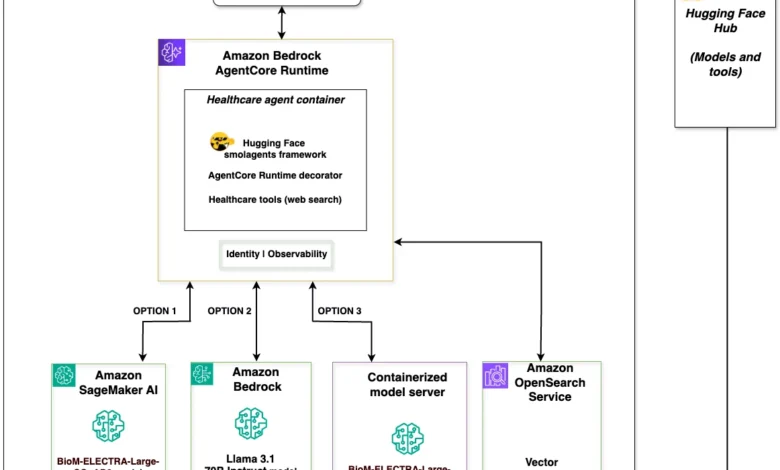
In a recent demonstration, developers migrated a multi-model healthcare agent from a standalone ECS-based deployment to the Amazon Bedrock AgentCore runtime. The original architecture utilized a combination of Meta’s Llama 3.1 70B Instruct for general reasoning, BioM-ELECTRA-Large-SQuAD2 on Amazon SageMaker AI for specialized biomedical queries, and a custom containerized model server for additional niche tasks.
By wrapping this agent in the AgentCore decorator pattern, the team successfully transitioned the architecture without altering the core business logic. The migration effectively maintained the agent’s ability to perform triple-model orchestration and vector-enhanced knowledge retrieval via Amazon OpenSearch Service, while offloading the operational lifecycle management to the platform.
Chronology of the Migration Strategy
The migration process follows a structured methodology designed to minimize downtime and prevent the need for code refactoring.
- Project Initialization: The process begins with the installation of the AgentCore CLI, which creates a standardized scaffold for the application. Developers define the build parameters, such as the container environment, language, and protocol, while keeping the core agent code modular.
- Integration via Decorators: The most critical step involves wrapping the existing agent logic in a
BedrockAgentCoreAppdecorator. This pattern allows the AgentCore runtime to inject observability, identity, and scaling logic directly into the application’s entry point. - Containerization and Deployment: Once wrapped, the AgentCore CLI builds the container and pushes it to the Amazon Elastic Container Registry (Amazon ECR). The deployment process itself, which previously required manual ECS service updates, is reduced to a single command.
- Validation and Testing: Post-deployment, the agent is validated through the CLI or via the
boto3SDK. By invoking the agent through the AgentCore runtime, developers can ensure that the request/response flow—using the Hugging Face Messages API compatibility—remains consistent with the pre-migration state.
Comparative Analysis: Managed vs. Self-Managed
The decision to migrate from a self-managed environment to a managed runtime involves a fundamental trade-off between control and convenience.
Self-Managed (Amazon ECS with Fargate):
- Pros: Total control over networking, specific kernel configurations, and precise scaling thresholds. Ideal for highly regulated environments where specific, non-standard compliance controls must be hard-coded into the infrastructure layer.
- Cons: High operational overhead. The team is responsible for monitoring, patching, and configuring every component, leading to “configuration drift” if not managed rigorously.
Managed (Amazon Bedrock AgentCore Runtime):
- Pros: Significant reduction in operational tasks. The runtime provides native identity integration (IAM), built-in observability (tracing and logs), and automated session-based scaling. This allows developers to iterate faster and deploy features without waiting for infrastructure teams to provision resources.
- Cons: Less granular control over the underlying infrastructure. While this is an advantage for most, specialized edge cases requiring non-standard container runtimes may find the platform’s constraints limiting.
Implications for the Industry
The shift toward managed agent runtimes signals a maturing market. As businesses move from experimental AI projects to production-grade applications, the focus has shifted from "can we build this?" to "can we maintain this at scale?"
The ability to maintain a framework-agnostic approach is crucial. Because the AgentCore runtime supports any framework—such as Hugging Face’s smolagents—teams are not locked into a proprietary ecosystem. This flexibility is vital for industries like financial services and manufacturing, where specific models are often chosen for their accuracy in niche domains rather than their popularity in the general market.
Furthermore, the integration of security features, such as Amazon Bedrock Guardrails, remains a critical requirement for production deployments in sensitive sectors. Even within a managed runtime, developers are encouraged to implement content filtering and grounding validation to ensure that the multi-model orchestration does not produce inaccurate or harmful medical advice.
Strategic Recommendations for Organizations
For teams currently evaluating their infrastructure strategy, the following factors should guide the decision-making process:
- Operational Readiness: If your team spends more than 30% of its time on container maintenance, observability setup, or IAM role configuration, moving to a managed runtime will likely yield an immediate increase in development velocity.
- Model Diversity: If your agent workflow relies on a mix of open-source models, foundation models from Amazon Bedrock, and custom fine-tuned models on SageMaker, ensure that the chosen runtime supports seamless integration across these disparate backends.
- Compliance and Security: Managed runtimes often come with pre-integrated security features. However, ensure that your specific regulatory requirements (e.g., HIPAA for healthcare, PCI-DSS for finance) are fully met by the runtime’s service-level agreement and security controls.
Conclusion and Outlook
The migration of the multi-model healthcare agent serves as a blueprint for the future of enterprise AI. By decoupling agent logic from infrastructure concerns, Amazon Bedrock AgentCore allows for a more agile development lifecycle. As the landscape of agentic AI continues to expand, the ability to rapidly swap models, scale across different environments, and maintain observability will become the defining characteristics of successful AI-driven enterprises.
The move toward managed infrastructure does not diminish the developer’s role; rather, it elevates it. By removing the repetitive, non-differentiating work of infrastructure management, teams are free to focus on the high-value tasks of fine-tuning agent logic, optimizing model selection, and improving the accuracy of knowledge retrieval. In the coming years, we can expect this pattern of "runtime-first" development to become the industry standard, enabling a new wave of highly specialized, scalable, and secure AI agents across every major sector of the global economy.