Opsera Reimagines DevOps with AI-Native Software Factory Forge to Bridge the Gap Between Code Generation and Enterprise Delivery

The software development lifecycle (SDLC) has undergone a seismic shift over the past two years, catalyzed by the rapid proliferation of generative AI coding assistants. While these tools have significantly accelerated the velocity of code generation, they have simultaneously created a "delivery bottleneck." Organizations are producing more code than ever before, but the processes for validating, securing, and deploying that code—particularly when modernizing legacy systems—have struggled to keep pace. Addressing this widening gap, Opsera has officially relaunched its platform, pivoting from a continuous orchestration provider to an AI-native software factory centered on its newly debuted Forge platform.
The transition marks a pivotal moment in the evolution of DevOps. Historically, Opsera was recognized for its unified DevOps orchestration platform, which helped engineering teams integrate disparate tools into a cohesive pipeline. However, as the industry moved toward AI-driven development, the company identified a fundamental flaw in the modern enterprise stack: AI is excellent at writing code, but it lacks the contextual guardrails necessary to make that code enterprise-ready. By launching Forge, Opsera aims to act as an "AI harness," providing the missing infrastructure required to turn raw AI output into production-grade software.
The Evolution of the Software Delivery Paradigm
To understand the necessity of this pivot, one must examine the state of enterprise software development in 2024. According to industry data from sources like Gartner and Forrester, nearly 80% of organizations have integrated or are piloting AI-assisted coding tools. Despite this, the "time-to-production" metric has not seen a commensurate improvement. Developers often spend more time remediating AI-generated code for security vulnerabilities, compliance failures, and architectural misalignment than they would have spent writing the code manually.
The relaunch of Opsera is structured around solving three primary challenges that have plagued the industry since the advent of the "AI coding boom": the modernization of legacy systems, the orchestration of AI-driven delivery, and the opaque nature of AI financial management. By integrating these solutions into a single, cohesive software factory, Opsera is positioning itself not just as a tool provider, but as a strategic layer in the enterprise IT stack.
Forge: The Heart of the AI-Native Factory
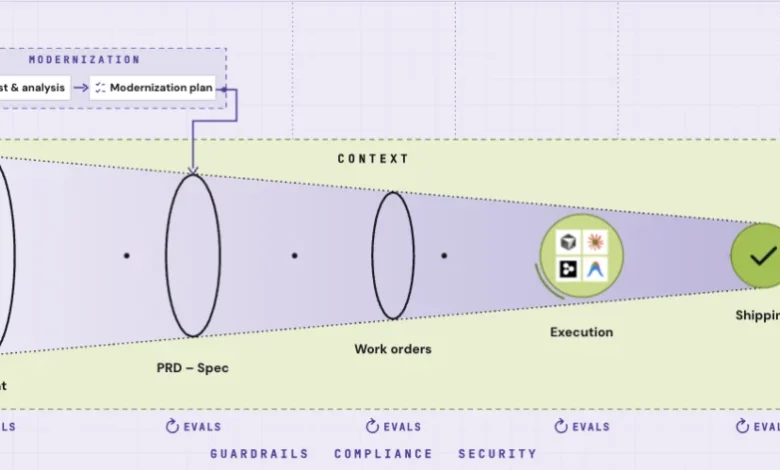
At the core of the new Opsera is Forge, an intent-and-context-aware enterprise software factory. Introduced in April, Forge was designed to address the "context vacuum" that exists in many AI-assisted development environments. When a developer prompts an LLM (Large Language Model) to generate code, the model often lacks the specific architectural constraints, security policies, and business logic of the organization.
Forge bridges this gap by acting as a mediation layer. It enforces spec-based development, meaning that code is generated against predefined architectural blueprints and business requirements rather than in a vacuum. This ensures that the output is not just syntactically correct, but also compliant with the organization’s existing security posture and operational standards. By providing this traceability, Forge allows enterprises to treat AI-generated code with the same level of trust as code written by human engineering teams.
Modernization Assessment with ForgeScore
One of the most complex hurdles for legacy enterprises is the "modernization debt." Organizations are currently sitting on millions of lines of legacy code that are expensive to maintain and difficult to secure. Manually auditing this code for migration to cloud-native or AI-optimized architectures is a monumental task.
To facilitate this transition, Opsera has introduced ForgeScore. This tool functions as a diagnostic engine that scans legacy codebases to provide a comprehensive health assessment. It evaluates the code based on several critical dimensions:
- Security Vulnerability Mapping: Identifying outdated libraries and common attack vectors.
- Maintainability and Cognitive Load: Measuring how easily a new developer can understand and modify the existing logic.
- Semantic Quality: Ensuring the code aligns with modern software design principles.
- AI Readiness: Evaluating whether the codebase is structured in a way that allows for effective AI-assisted refactoring.
The output of this assessment is a "Modernization Blueprint." This document provides leadership with a data-driven roadmap, categorizing legacy modules based on technical risk, architectural complexity, and the potential ROI of modernization. This shifts the conversation from a subjective "gut feeling" about technical debt to a quantifiable, business-centric strategy.

The Financial Visibility Gap: Unified Insights
As enterprises scale their use of AI, the cost associated with token consumption and tool licensing has become a significant line item. Many organizations currently lack visibility into which teams are driving the most value from these investments. The "black box" nature of AI spend—where consumption is tied to fluctuating token usage—makes it difficult for finance departments to forecast budgets or measure efficiency.
Opsera’s "Unified Insights" module is designed to solve this by providing a panoramic view of the AI-driven SDLC. It connects the dots between development velocity and financial expenditure. By utilizing tokenomics and token mapping, the platform allows stakeholders to see exactly how specific AI tools are impacting the bottom line.
For instance, an engineering lead can determine if a particular coding assistant is reducing the time-to-market for a specific microservice, while a finance leader can simultaneously track if the token costs associated with that assistant are staying within budget. This level of granularity is vital for organizations transitioning from experimental AI pilots to enterprise-scale production environments.
Industry Implications and Strategic Alignment
The strategic pivot of Opsera mirrors a broader trend in the DevOps space: the shift from "pipeline management" to "value stream orchestration." For years, the industry focused on automating the CI/CD pipeline—ensuring that code moved from commit to deployment without manual friction. In the era of AI, the focus has shifted to ensuring that the right code is being built and that it aligns with business intent.
"AI has changed how code gets written. It hasn’t yet changed how software gets delivered, how legacy systems get modernized or how AI investment gets measured," noted Kumar Chivukula, CEO of Opsera, during the relaunch announcement. "We rebuilt Opsera to solve those three problems. Enterprises keep their code, their models and their tools, and our AI-native software factory, with an AI harness at its core, gives them the context, specifications and guardrails to turn AI generated code or legacy code into applications they can ship, trust and measure."
This perspective is resonating with market analysts who emphasize that the next phase of enterprise AI will be defined by "governance and trust." Companies that cannot prove their AI-generated code is secure and compliant will find themselves exposed to significant operational and legal risks. By embedding these guardrails directly into the software factory, Opsera is moving to become a prerequisite for the enterprise AI stack.
Chronology of the Transformation
The journey to the current iteration of Opsera has been marked by a clear progression:
- Initial Foundation: Opsera established itself as a leader in continuous orchestration, focusing on multi-cloud, multi-tool DevOps pipelines.
- Market Observation: As generative AI tools like GitHub Copilot and Tabnine gained traction, Opsera’s leadership team observed that while developer productivity spiked, the downstream impact on quality and security was inconsistent.
- The "Forge" Development Phase: Throughout late 2023 and early 2024, the company shifted its internal engineering efforts toward building the AI harness.
- April 2024 Launch: The official debut of the AI-native software factory and the Forge platform, marking the formal pivot in the company’s business model.
- Current State: Integration of Unified Insights and ForgeScore to provide a holistic view of the software delivery lifecycle.
The Road Ahead: Scaling the AI-Native Enterprise
As organizations move toward a state of "continuous intelligence," the role of a software factory will become even more critical. The ability to automatically generate, test, secure, and monitor code is no longer a luxury but a competitive necessity. Opsera’s focus on maintaining tool-agnosticism—allowing enterprises to keep their existing code repositories, models, and cloud providers—is a strategic move that minimizes the barrier to adoption.
The implications for the broader DevOps market are significant. Traditional CI/CD vendors will likely be forced to incorporate similar contextual guardrails and modernization tools to remain relevant. If they fail to do so, they risk becoming legacy infrastructure themselves, incapable of supporting the requirements of modern, AI-augmented development teams.
For organizations currently struggling with the "AI hangover"—the realization that AI is easy to start but hard to scale—the Opsera model offers a potential blueprint for maturity. By focusing on the intersection of technical debt, financial visibility, and AI-driven delivery, the company is effectively defining the next generation of the software factory. As the industry continues to iterate, the success of platforms like Forge will be measured by their ability to provide not just speed, but the certainty that every line of code deployed is built with intent, verified by data, and aligned with the enterprise’s long-term business goals.