Beyond Content: How AI-Driven Practice is Redefining Workplace Readiness and L&D Strategy

The corporate learning and development (L&D) sector has long chased a singular holy grail: delivering the right learning intervention to the right individual at the exact moment of need. Over the past two decades, technological evolution has steadily chipped away at this operational hurdle. Organizations transitioned from static course catalogs to sophisticated keyword search tools, progressed to algorithmic recommendation engines, and eventually embraced adaptive learning platforms. Today, artificial intelligence has dramatically accelerated this trajectory, streamlining course discovery, automating content generation, tailoring assessments, and analyzing user behavior with unprecedented precision.
However, as Chief Learning Officers (CLOs) and enterprise training leaders evaluate their ongoing tech investments, a critical strategic question is overshadowing traditional metrics: How does an organization genuinely verify that an employee is ready to perform? While advanced AI algorithms excel at recommending subsequent learning modules, modern enterprises ultimately require empirical evidence that learners can successfully translate acquired knowledge into practical execution during high-stakes, real-world situations.
The Evolution of Corporate Personalization
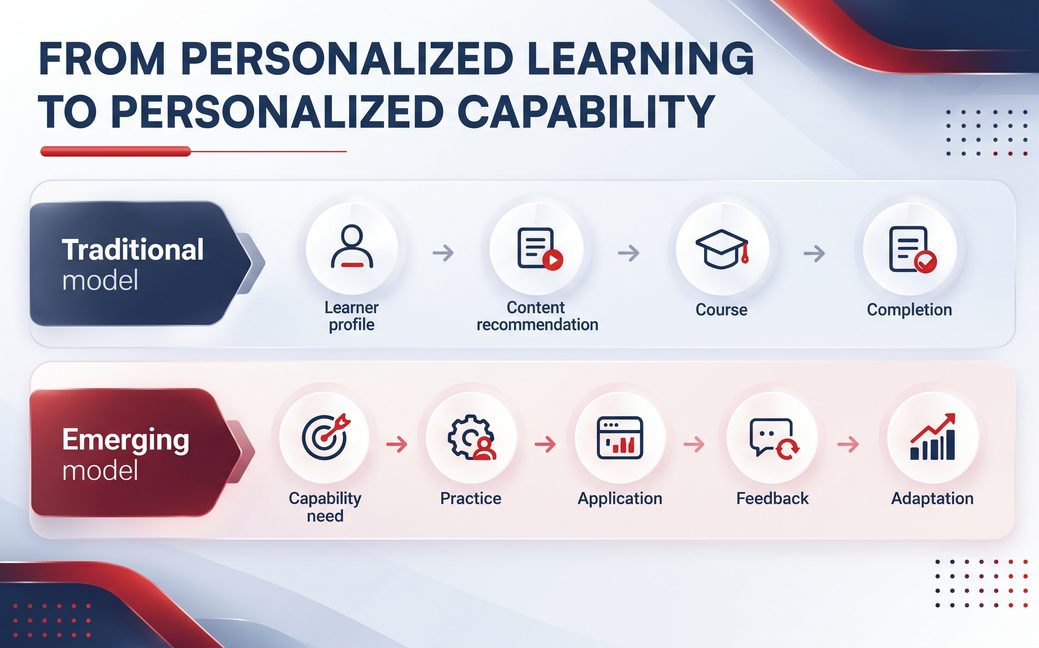
Historically, personalization within enterprise learning ecosystems has been strictly synonymous with content consumption. A typical learning management system (LMS) identifies a user’s stated interests, historical training logs, or identified skill gaps, subsequently serving up a tailored curriculum or recommended module. This approach successfully enhances course relevance and alleviates the administrative burden of manual content discovery.
Nevertheless, industry analysts and workforce psychologists emphasize a fundamental operational disconnect: relevance does not equate to readiness. Completing an assigned digital course confirms that an employee engaged with a learning activity. It offers virtually no measurable proof regarding their competence or confidence in applying that specific skill set on the job.
This realization highlights a deeper structural limitation in standard digital training. The traditional learning model personalizes the consumption of information rather than the development of actual capabilities. Enterprise capability development must operate further upstream, beginning not with the question of what an employee should learn next, but rather with what specific competencies an individual requires to optimize their job performance.

Answering this foundational question demands a far richer matrix of diagnostic signals. Instead of relying purely on historical course completions, modern L&D frameworks must ingest real-time data covering current role expectations, active performance gaps, operational work contexts, prior professional experiences, and ambient signals generated during everyday workflows. Consequently, enterprise personalization is pivoting away from static course catalogs toward dynamic capabilities such as strategic negotiation, executive decision-making, and the fluent adoption of emerging workplace technologies.
Bridging Knowledge and Performance Through AI-Driven Practice
The transition from passive content consumption to active capability building is proving especially vital in complex professional domains. For instance, professional certification organizations and leadership development programs are increasingly discovering that simply offering more instructional content fails to resolve operational deficiencies. Candidates and managers frequently do not need another informational module; rather, they require robust diagnostic tools to pinpoint their weaknesses, safe environments to practice against those gaps, real-time iterative feedback, and structured opportunities to build operational confidence prior to formal evaluation.
Consider the landscape of leadership development. Understanding the theoretical frameworks of a difficult performance conversation bears little resemblance to successfully navigating an emotionally charged dialogue with an unpredictable direct report. Modern AI-enabled simulation environments now allow managers to safely rehearse these high-stakes interactions, respond dynamically to simulated emotional pushback, and receive granular analytical feedback regarding their tactical choices.
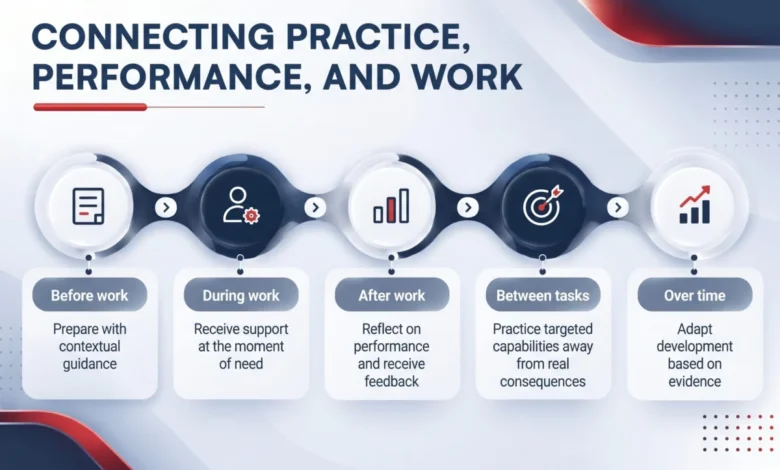
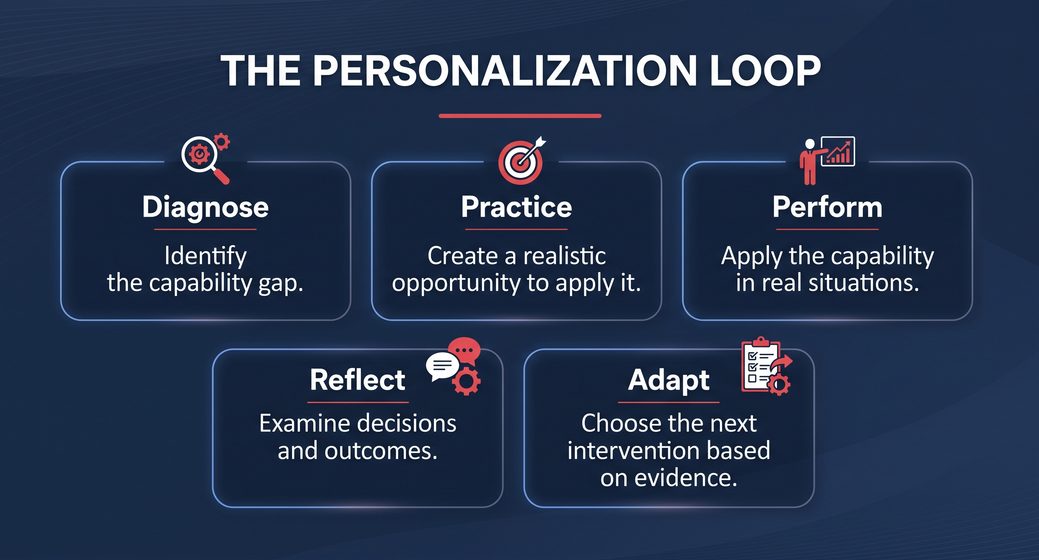
In these advanced operational settings, personalization shifts from suggesting the next available e-learning module to identifying precisely what scenario an executive needs to practice next. This methodology reframes professional development as an ongoing, iterative loop: an employee practices a targeted skill, applies it within their workflow, receives diagnostic feedback, refines their approach, and engages in subsequent targeted practice.
Industry experts stress that while artificial intelligence dramatically scales this iterative practice loop, human mentorship remains irreplaceable. Enterprise managers, executive coaches, and subject-matter experts continue to provide vital human elements—such as contextual judgment, operational accountability, and nuanced developmental relationships—that technology cannot fully replicate. AI optimizes the process by dynamically adjusting scenario complexity and operational context during practice, offering contextual decision support during live tasks, and subsequently analyzing decision-making metrics to determine whether a worker requires additional coaching, targeted learning, or direct field application.
Furthermore, this capability-centric approach introduces a radical efficiency metric for L&D departments: sometimes the most effective personalized learning intervention is no intervention at all. If diagnostic data confirms an employee already demonstrates full proficiency in a given competency, the learning system should systematically step aside, prioritizing real-world application over redundant instructional mandates.
Macro-Level Integration: The Rise of Specialized Enterprise AI Agents
This internal shift within L&D mirrors broader enterprise software trends. According to market projections published by Gartner, the integration of task-specific artificial intelligence agents into core enterprise applications is accelerating rapidly. Gartner forecasted that the proportion of enterprise applications featuring specialized AI agents would surge from less than 5 percent in 2025 to 40 percent by the close of 2026.
Subsequent Gartner research underscores that the most tangible, quantifiable business value derived from agentic AI stems from domain-specific implementations rather than generalized, broad-spectrum models. For corporate learning leaders, the operational implication is unambiguous: context is paramount. Layering generic artificial intelligence over standardized, off-the-shelf instructional content is wholly inadequate for addressing the rigorous, nuanced performance standards required across specialized enterprise roles.
This operational reality necessitates a fundamental reassessment of how organizations measure learning efficacy. For decades, corporate training departments have relied heavily on vanity metrics: course completion rates, platform engagement hours, and learner satisfaction scores. While these indicators offer baseline operational data regarding platform usage, they fail to establish a verifiable causal link between training investments and on-the-job performance execution.
Establishing Measurable Workforce Readiness
A significant hurdle in modern workforce analytics has been the historical conflation of capability evidence with subjective capability indicators. For example, learner self-confidence surveys frequently measure how prepared an individual feels, but they do not objectively prove that the worker can successfully execute the task under operational pressure. An employee may feel fully prepared during a simulated training exercise yet falter when variable conditions disrupt real-world workflows.
A rigorous, multifaceted framework for measuring workforce readiness relies on a triangulation of concrete evidence:
- Demonstrated proficiency within simulated practice environments
- The objective quality of skill application during actual job tasks
- Direct observational assessments conducted by managers or subject-matter experts
- Consistency of performance execution over extended periods
- Validated self-reported confidence metrics where appropriate
By evaluating these signals in aggregate, L&D leaders can construct a comprehensive overview of workforce capability. This holistic visibility allows organizations to determine whether developmental interventions are successfully translating into bottom-line performance, identify precise operational areas requiring targeted remediation, and distinguish whether performance breakdowns stem from individual skill gaps or structural flaws within the work environment itself.
Importantly, industry leaders emphasize that measuring capability must maintain strict ethical boundaries. The objective is not to establish continuous, invasive employee surveillance, but rather to capture sufficient, meaningful performance evidence to guide effective talent development.
Strategic Imperatives for Chief Learning Officers
As organizations worldwide continue to redesign operational workflows around artificial intelligence and automated systems, Chief Learning Officers are uniquely positioned to bridge the strategic gap between human talent development and enterprise technology infrastructure. To successfully navigate this transition, L&D executives are advised to focus on three foundational strategic decisions:
First, enterprise leadership must explicitly define what operational capability looks like. Before deploying advanced AI tools into learning environments, organizations must reach internal consensus regarding the observable behaviors that constitute successful job performance.
Second, leaders must strategically determine where practice belongs within the operational lifecycle. While routine procedural tasks may benefit from workflow integration, high-stakes, safety-critical, or emotionally complex capabilities often require deliberate, isolated pre-execution practice. L&D teams must evaluate whether a given competency demands digital simulation, executive coaching, peer observation, or direct field feedback.
Third, organizations must establish trusted frameworks for evidentiary governance. While digital clicks and course completions are easily tracked, meaningful capability signals require rigorous cross-functional agreement on what constitutes valid, actionable performance evidence.
Ultimately, the overarching objective of corporate learning technology is undergoing a permanent maturation. While personalized content delivery successfully eliminated irrelevant training modules, it represented only the starting point of modern talent development. As the corporate learning sector enters its next evolutionary phase, the ultimate metric of success will no longer be how efficiently an organization distributes educational content, but how effectively it empowers the right individuals to demonstrate critical operational capabilities at the exact moment of business need.